A transit operator’s work goes beyond just driving the bus.



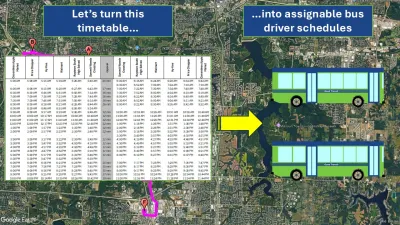
Welcome to Transit Scheduling 101, a series in partnership with Chicago-based transit planner extraordinaire Joshua Woods, who authors Thoughts About Cities. A follow-up to his popular 2025 column, Transit Planning 101, Transit Scheduling 101 is the next installment in his journey to give you the transit planning boot camp you wish you got in planning school. Read the other installments of Transit Scheduling 101 here.
Welcome back to Transit Scheduling 101. I hope you’ve found the series informative and engaging so far.
In the last installment, Building a Timetable, we demonstrated the process of taking a set of route parameters (runtime, layover, frequency, etc.) and turning them into an operable, public-facing timetable. See the video embedded in that article if you need a refresher!
Today, we’re going to break that timetable up into pieces of work to be assigned to a bus driver. Similar to the last exercise, this is more easily demonstrated than written out, so jump to the end for another demonstration video detailing this process. However, before the demonstration, some context, as well as some scheduling resources you can use as you take the foundation we’ve developed over the course of Transit Scheduling 101 and set out into the real world.
1️⃣ First, some context
The public timetable shows all of the time that the transit bus is in revenue service.
Revenue Service (n) - Transit Operations. The time when a transit vehicle is available to the public and carrying passengers (or ready to carry passengers) for which a fare is collected or could be collected. This includes travel time along a route, as well as layover time.
However, before a transit vehicle reaches its first timepoint of the day, the bus driver must conduct several non-revenue activities to prepare the vehicle for the service day ahead. After reporting to the garage in the morning but before moving the bus, the driver must first conduct a pre-trip inspection. In this inspection, the driver walks around the vehicle and inspects all key systems to ensure the vehicle is in a safe and presentable condition to carry hundreds of lives throughout the day. This inspection also serves as a liability safeguard for the driver. Buses are big, roads can be narrow, corners can be tight, and accidents do happen.
A car is typically about 6’ wide. A standard transit bus is about 8.5’ wide, not including the mirrors jutting out from the side of the vehicle. Catching the passenger side mirror on a tree or pole isn’t an incredibly uncommon thing to happen to a bus.¹
When I worked in the training department of a transit authority, one of the trainers used to train new and returning² drivers on a route with trees and light poles that were famously close to the road. Whenever a driver in training would have a close call with a tree or pole, she would call out “5 points!” a reference to the standard, 5-point penalty associated with knocking a mirror off a bus detailed in the agency’s progressive discipline policy.
If there is non-critical damage to the vehicle (think dings and scrapes, not blown engine compartments), simply noticing and recording the damage in the pre-trip inspection log is generally enough to absolve the driver from being held liable for the damage. Conversely, a driver who skips the pre-trip inspection risks being held liable for existing damage when they take the bus over for their shift.
After ensuring the vehicle is safe and ready to start the day, the driver then has to drive the bus to the first timepoint on the route. This non-revenue travel is typically called deadhead.
Deadhead (n) - Transit Operations. The movement of a vehicle without passengers in service, typically while traveling to or from the start or end of a route, a garage, or another assignment.
At the end of their shift, the bus driver does the same thing again, but in reverse.

After finishing their shift, the driver has to deadhead back to the garage (in the bus, or in a relief vehicle if the bus is staying out on the road). If the driver is deadheading in the bus, upon arriving at the garage they must perform the post-trip inspection, documenting any new defects that presented themselves during the day so the mechanics can resolve them as necessary.
Although much of this work is invisible to the transit rider, it represents an integral part of the job of a professional bus operator. More to the point, it represents time the driver must be paid for. Because these activities must be performed by every driver, every time they come to work, the associated costs are a non-negligible factor in determining the cost of transit service. Keep that in mind when we build the operator schedule for the 30-minute peak, 60-minute off peak schedule.
2️⃣ Some Resources
- Transit Cooperative Research Program (TCRP) Report 30 - Transit Scheduling: Basic and Advanced Manuals — This report is the go-to reference for scheduling questions. I only touched the surface through this series. If you want to take a deeper dive, I highly recommend working through this document.
- CSched Scheduling Trainings — CSched hosts trainings where they teach new, established, and aspiring schedulers how to hone their craft.
- Nelson\Nygaard Scheduling Consultants — I learned a lot of what I know about scheduling in my time at Nelson\Nygaard, and can vouch for the technical credibility of their team. If you have a scheduling challenge beyond your current capacity or scope, give them a ring and I’m sure they can help!
- Link to the spreadsheet used in the video
3️⃣ Let’s get to the Demo
¹ Guilty
² If a driver hasn’t been behind the wheel of a bus for a while, perhaps out on short term disability or an extended vacation, many transit authorities require the driver to go through some return to work training to ensure their skills haven’t atrophied.

Transit Scheduling 101: Never Cheat the Layover!
Letting drivers take their bathroom break keeps buses running on time, prevents burnout, and might even save the world from tech-fueled social entropy. Why risk it?!
Transit Scheduling 101: Developing A Runtime
Runtime (n) - The time required for the transit vehicle to travel from one end of the line to the other. We'll take a deeper look at runtimes in this installment of Transit Scheduling 101!
Transit Scheduling 101 — What is Transit Scheduling?
When a 10 minute change in layover can cost your system 33% more to run the same route, the nuts and bolts of good scheduling start looking darn sexy.

Planetizen Federal Action Tracker
A weekly monitor of how Trump’s orders and actions are impacting planners and planning in America.

‘Going backwards:’ Baltimore mayor, students rally against state's transit funding plan
Maryland's proposed six-year plan provides no funding for Baltimore’s BMORE bus program and reduces its road maintenance funding.

Detroit to transform waterfront with $2.2 billion investment
Developers will convert about 18 acres of unused parking lot space into civic spaces.

Senate bill would ‘overhaul’ environmental permitting laws
Under the proposed act, government agencies would also not be able to suspend or rescind permits after granting them.

Exemption applications for NYC’s pied-à-terre tax see 55% success rate
The city sent nearly 40% of its initial pied-à-terre tax warnings erroneously.

MTA invests $1.1 billion in ‘nearly-impossible’-to-evade fare gates
The new technology marks the Metropolitan Transit Authority's first turnstile redesign in decades.

FREE Course: Walkable City 1: Why Walkability?
After describing his path towards focusing on walkability as the essence of good planning, Jeff Speck marches through his five principal reasons for making more walkable places.
Reinventing Malls: Planning Alchemy—Turning Gray Fields Into Gold
The course focuses on the opportunities and imperatives that shape reinvention of mall sites.

One Hundred Miles
County of Mendocino
planning NEXT
The Architects Foundation
University of Cincinnati Online
Montrose County
Northern Illinois Transit Authority (NITA)
The Pocatello Development Authority

