Appropriate bus stop spacing keeps the bus moving and ensures people get where they need to be in a reliable amount of time.



This column is the first in a seven-part series in partnership with Chicago-based transit planner extraordinaire Joshua Woods, who authors Thoughts About Cities. Titled Transit Planning 101, it’s the transit planning boot camp you wish you got in planning school. Learn more about Joshua and the inspiration for the column here. First stop: bus stop balancing!
Bus stop balancing (aka “bus stop consolidation” or “bus stop optimization”) is the process of eliminating or relocating bus stops to achieve more consistent bus stop spacing. It looks at all of the bus stops in a system and strategically removes and relocates stops to achieve a roughly ¼ mile spacing between stops (the emerging industry standard), taking special care to preserve stops at key destinations like grocery stores, hospitals, schools and transfer points.
Bus stop balancing is unironically one of my favorite transit topics to talk about because it’s such low hanging fruit. It’s cheap, it’s easy, and it improves operations. Let’s talk about it!
How stops get unbalanced
When a new bus route is planned, especially when there aren’t existing bus stops, stops are usually placed in a semi-regular interval and aligned with major destinations. However, cities are inherently dynamic places. The best place for the stop now might not be the best place for the stop a year from now.
Because of this, transit authorities regularly get requests for new and relocated bus stops. Maybe a new grocery store opened between two existing bus stops. Maybe a hair salon moved a few doors down and a regular wants to keep getting front door service. Maybe a passenger with a board member’s ear wanted a bus stop outside of their house. Maybe a business has decided they don’t want the bus stop (and the people that use the bus) outside of their location (ugly, but something that does happen. See this extreme case in Kansas City).
If feasible, meeting these individual requests is an easy way to score points with the riding public (and to keep the peace with the non-riding public). However, over time these requests can compound into a clustered mess of stops that has the bus preparing to stop seconds after pulling away from the previous stop.
Why more transit authorities should balance bus stops
Operational efficiencies
Buses spend a lot of their time at bus stops. Beyond simply boarding and alighting passengers (letting people off), this includes the time it takes to exit and re-enter the flow of traffic. When bus stops are too close together, buses spend more time entering and exiting the flow of traffic without necessarily serving more passengers.
For example, let’s assume that it takes 10 seconds to leave the flow of traffic, 3 seconds per person to board passengers, and 15 seconds to reenter the flow of traffic. At ⅛ mile spacing (8 stops per mile), a bus would spend 3 min 44 sec serving 8, equally distributed passengers. At ¼ mile spacing (4 stops per mile), this drops to just 2 min 4 sec.

Bus stop balancing allows transit agencies to serve the same number of passengers in less time by consolidating where the boarding process occurs. In edge cases, this might mean it takes fewer buses (i.e. less $$) to run the same service, freeing up resources to be reallocated elsewhere. However, even in the absence of this benefit, the trip still gets faster for everybody riding the bus. Arguably more significant than decreased travel times, bus stop consolidation often means increased travel time reliability. It’s much easier to predict how long it will take a bus to cover 1 mile when it might stop 4 times, than when it might stop 8 times.
Improved passenger amenities
Everybody would like a bench and a shelter at their bus stop, but for many transit authorities, that is not financially or operationally feasible. Beyond the cost of installing the amenities, the authority has to maintain them (nobody wants to find the glass shattered at their bus stop). Bus stop consolidation makes it more feasible for transit authorities to have amenities at a higher share of their stops. It also makes it more feasible to ensure that the stops that do exist are accessible to passengers with disabilities. A publicized plan for improving amenities at remaining stops after a stop consolidation can be a way of assuaging the concerns of passengers that may need to walk an extra minute or two to the bus stop.

Passengers can’t do it themselves
There are a lot of expectations that can be placed upon passengers to keep the bus moving, like having their fare ready upon boarding and exiting through the rear doors. Expecting them to coordinate adjacent boardings and alightings with their fellow riders is not one of these things. Occasionally, an impatient transit nerd (see me) wanting to keep the bus moving may recognize that someone is waiting within eyeshot at the next bus stop and join them, or they may get off one stop early if people are already getting off the bus. But this is the exception, not the rule. Unlocking the travel time benefits associated with bus stop balancing requires top-down action from the transit authority itself.
Getting more transit authorities to balance bus stops
By now, I hope you’re as excited about bus stop balancing as I am, and are wondering why the stops are so close at your local transit authority. The simple answer is that bus stop balancing can be a political hurdle. People are naturally averse to change, and the notion that the place that they have always caught the bus might be different can be daunting. However, the potential benefits of bus stop balancing are well worth the risk. Below are a few tips and tricks for a successful bus stop balancing campaign that I have picked up in my career as a transit planner.
Communicate why bus stops are being balanced
Bus stop balancing can mean faster trip times, more reliable travel times, and better amenities at the bus stop. However, to the passenger whose stop is being affected, it just looks like their transit trip is getting a little worse. Inform them of the benefits like reduced travel times and improved stop amenities1.
Communicate how much people’s trip will change (Surprise! It’s probably not a lot.)
The obvious downside to bus stop balancing is that passengers may need to walk a bit further to access their bus stop. However, in most cases, this added time only amounts to 1-2 minutes. In the example shown below, passengers at consolidated stops only need to walk ⅛ of a mile (~2 min) to reach the next available stop.
Be intentional with language
Look at the two bus stops below. They are 350 ft apart from one another (0.06 miles, ~1 min walk) and located in a very walkable neighborhood. This makes them great candidates for consolidation.

If you decide to eliminate stop A and keep stop B (I would opt for this because stop B is at a major intersection that the bus will have to stop at anyway):
- DON’T SAY: “Stop A is being eliminated”
- DO SAY: “Stop A is being relocated 350 feet to the east”
Admittedly, this can be read as a bit disingenuous, but it’s not a misstatement of reality. If a stop near another bus stop is eliminated, it is effectively relocated. Bus stops get relocated for things like construction all the time. Alarmist language like “eliminated”, “deleted”, and “removed” will not help your cause.
Vet the list of stops to be consolidated with bus operators
Bus operators have incredibly intimate knowledge of how bus stops are used. This is incredibly beneficial in mitigating potential conflicts in the bus stop balancing process. For example, I once led a bus stop balancing effort where I slated a stop for removal because it had very low ridership. However, a bus operator informed me that the person that regularly used that stop was a visually impaired woman that lived by the stop. This bus stop gave her an independence that she wouldn’t have otherwise, and since she was the only one that really used it, the potential travel time savings weren’t all that significant. Under this justification, the stop was retained and her trip was preserved. Everybody’s happy!
Clearly identify the stops that will be impacted and include a grace period
This goes without saying, but please post physical signage on the bus stops that are going to be consolidated letting passengers know when their bus stop will close, where the new stop will be, and where they can find more information about the bus stop balancing process. After the stop is consolidated, instruct bus drivers to keep picking people up at the stop for a week or two, and to communicate that the stop is closed and they will should not expect be picked up there in the future.
(Controversial) Manage the level community engagement in the process
This one is a bit thorny, but I think it’s worth mentioning. It’s important to engage the community in the process to ensure they know what’s going on. However, people’s perspectives are often limited to their individual trip, so if you simply ask people if they want their stop moved, most will say no. If the final say rests in the community engagement process, you’re probably not going to be successful in your bus stop balancing efforts. Collect feedback from the community about individual stops, and use that information to check for blind spots in deciding which stops to consolidate. Once that’s done, come up with a revised list of stop consolidations, and implement it. Some people will probably be upset in the short term, but when they’re getting to work and school faster, they will likely come around.
Want to learn more about bus stop balancing?
Learn more about bus stop balancing and its advantages here and here.
1 Don’t expect that to change their mind, but don’t let their specific concern govern everybody else’s transit trip

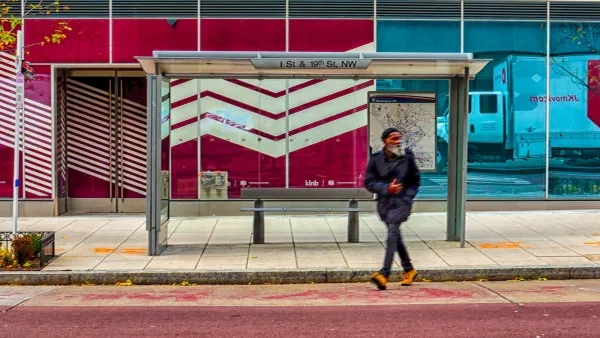
Commentary: Fewer Bus Stops Can Mean Better Service
Effective bus stop balancing can make buses faster while preserving accessibility.
What Is Good Transit?
Good Transit is frequent. Good Transit is reliable. Good Transit is (reasonably) fast. Good Transit feels safe.
Calculating Bus Stop Spacing for 43 U.S. Cities
New research documents the distance between bus stops in U.S. cities—a key question for service designers that determines a lot about the public transit user experience.

Planetizen Federal Action Tracker
A weekly monitor of how Trump’s orders and actions are impacting planners and planning in America.

Amtrak, CN end decades-long dispute with eight-year agreement
The new operating agreement establishes an updated framework for the companies to work together, including processes to resolve disputes.

Judges permit Denver to divert 77,000 acre feet from the Colorado River for reservoir expansion
Overuse and climate change have caused the Colorado River’s water levels to plummet.

NYC DOT wants faster, more permanent street upgrades
The city is examining ways to build more concrete infrastructure without getting entangled in 'decades-long' projects.

'Something we’ve never seen before:' rising utility rates could strain city finances nationwide
Data centers, climate change and other factors have caused utility rates in the United States to increase by 38% since 2020.

Trump to overrule local leaders, lease millions of acres of America’s Pacific Island territories’ seafloors to mining companies
International law says that the Indigenous people of America’s territories have a right to prior and informed consent regarding projects that impact their countries.

FREE Course: Walkable City 1: Why Walkability?
After describing his path towards focusing on walkability as the essence of good planning, Jeff Speck marches through his five principal reasons for making more walkable places.
Reinventing Malls: Planning Alchemy—Turning Gray Fields Into Gold
The course focuses on the opportunities and imperatives that shape reinvention of mall sites.

Harvard University Graduate School of Design
KFH Group Inc.
Greater Baltimore Committee
The Architects Foundation
University of Cincinnati Online
The Pocatello Development Authority
The Urban Renewal Agency of the City of Pocatello


