Public transportation provides many often-overlooked benefits. We can do better at communicating the value of transit investments. We have good stories to tell.



Public transit plays a unique and important role in an efficient and equitable transportation system. It provides affordable, basic mobility for non-drivers, and efficient urban mobility. When all impacts are considered, public transit investments are often the most cost-effective way to improve transportation. However, conventional planning tends to overlook and undervalue many transit benefits, resulting in underinvestment. We need to tell better stories about why and how to improve public transit.
High quality transit
Most North American communities have inconvenient and unattractive public transit services. They operate buses in mixed traffic with limited operating hours and frequency, modest amenities, little integration into communities, and inconvenient user information and payment systems. These systems are designed to provide basic mobility for non-drivers and little else.
When people become economically successful they naturally demand higher quality goods: they eat better food at nicer restaurants, live in more comfortable homes and purchase more luxurious cars. Low quality transit essentially tells travellers that once they become successful they should purchase a car and stop riding transit because it is not intended to serve their sophisticated demands.
High quality transit changes that narrative. It is a catalyst for transit-oriented development, which creates compact, multimodal communities where residents own fewer vehicles, drive less, rely more on non-auto modes, and spend less time and money on transportation. Experience around the world demonstrates that where transit is convenient, comfortable and integrated it attracts a major portion of travellers, including many who could drive but prefer public transport as a more relaxing and enjoyable way to get around.
Unmet demands
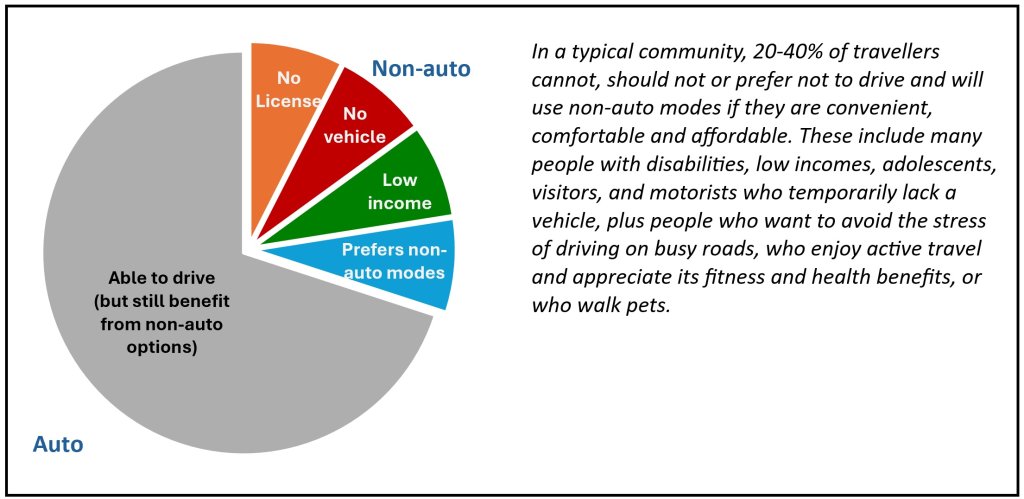
To be efficient and fair a transportation system must be diverse in order to serve diverse demands. In a typical community, 20-40 percent of travellers cannot, should not or prefer not to drive and will use non-auto modes if they are convenient, affordable and integrated.
Travellers Who Cannot, Should Not, or Prefer Not to Drive
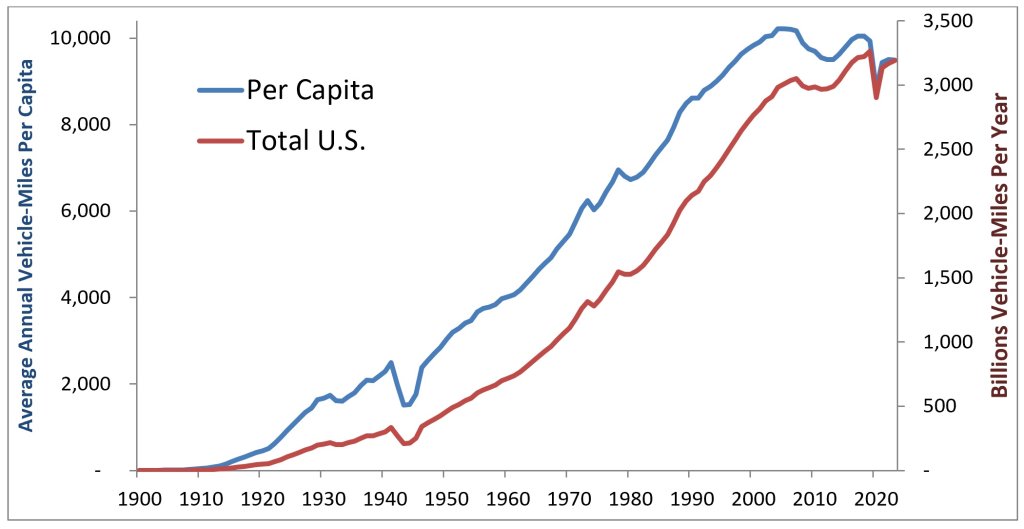
Travel demands are changing and so, too, should transportation investments. Per capita VMT peaked early in this century and current demographic and economic trends — aging population, rising vehicle costs, increasing affordability and health concerns — are increasing demand for non-auto modes. Improving transit service and transit-oriented development prepares communities for our future needs.
Fair share funding
Most North American communities significantly underinvest in public transit compared with what is efficient and fair. In the U.S. governments spend less than $150 annually per capita to subsidize public transit services, compared with about $1,000 on roads and traffic services and about $4,000 on government mandated off-street parking facilities. Overall, transit receives less than 4 percent of transportation infrastructure spending. That is about equal to its share of trips but much smaller than the portion of people who rely on it at least occasionally, and much smaller than transit mode shares in communities that invest in high quality public transit.
Transit benefits and costs
High quality transit can provide many economic, social and environmental benefits. The table below summarizes categories of benefits and costs that should be considered when evaluating transit investments.
Public Transport Benefits and Costs

Some transit benefits are widely recognized and considered when evaluating transit programs: advocates tend to highlight basic mobility for non-drivers, plus congestion and emission reductions. Other benefits are often overlooked or undervalued.
For example, automobile trips require parking facilities at each destination. Considering land, construction and operating expenses a typical urban parking space costs about $1,200 annually, a cost that is avoided if the same trips are made by public transit. Public transit has an order of magnitude lower traffic crash rates than driving, and per capita traffic fatality rates are much lower in transit-oriented than in auto-dependent communities. Since most transit trips include walking or bicycling links, frequent transit users tend to be fitter and healthier than people who rely on driving, too.
Public transit and transit-oriented development can provide large user savings and increase affordability (savings to lower-income households). A typical household can save about $2,500 annually if transit substitutes for automobile commuting, and about $6,000 if high quality transit allows it to reduce car ownership — for example, to go from owning two vehicles to one or to become car-free.
Transit-oriented development creates compact, multimodal communities where it is easy to get around without driving. This improves overall accessibility, particularly for non-drivers, and reduces the time and money that residents must spend on transportation.
By giving non-drivers more travel options, public transit reduces drivers’ chauffeuring burdens. For example, in automobile-dependent areas many parents must spend several hours each week driving adolescents to school, sports and social activities, and seniors often require chauffeuring for errands that they would prefer to do independently. Such trips are particularly inefficient because they often involve empty backhauls, so a five-mile trip requires ten vehicle-miles of travel and takes a half hour in total time.
These savings and benefits tend to be particularly large because public transit tends to substitute for particularly costly and inefficient vehicle trips, such as driving under urban-peak conditions, and by higher-risk drivers (youths, seniors and drinkers) who tend to use transit if service is convenient and affordable.
High quality public transit and transit-oriented development support economic development in several ways: they improve overall accessibility and transportation system efficiency; reduce road and parking infrastructure costs; improve disadvantaged workers’ economic opportunity and productivity; reduce external traffic costs including congestion, crash and pollution damages; and support more compact development, providing agglomeration efficiencies.
Better transit funding
There are good reasons to increase public transit funding. High quality services require about two or thee times as much investment as existing transit funding provides. This may seem to be a large increase, but it is small compared to the total road and parking subsidies provided to motorists, total traffic external costs (congestion, crash and pollution damages), and total household motor vehicle expenditures. Increasing public transit funding can provide economic returns if it reduces total automobile costs by just a few percentage points.
Transit Funding Compared with Other Transportation Costs

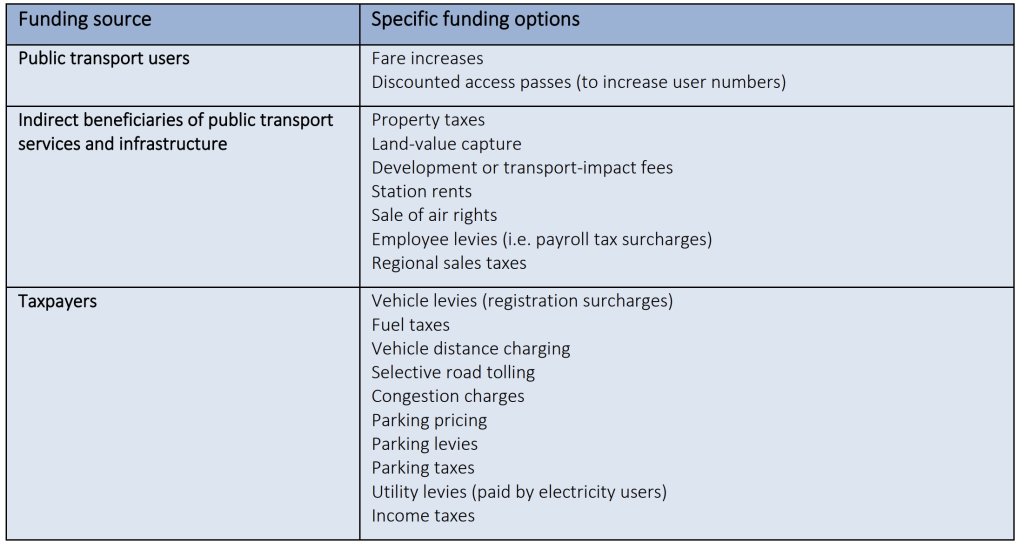
There are many possible ways to fund public transit improvements. A new International Transport Forum report, The Future of Public Transport Funding (which draws significantly on my report, Local Funding Options for Public Transportation) identifies and evaluates about twenty ways to finance transit improvements. It suggests using diverse funding sources to increase financial stability and to distribute cost burdens in recognition that public transit provides diverse benefits.
A Taxonomy of Public Transit Funding Sources
Public transit funding increases can be described as a substitute for road and parking spending. Sometimes transportation agencies can shift funding within their budgets, and municipal governments can sometimes allow developers to help fund transit improvements in exchange for reduced parking requirements. Most funding sources should be local or regional since that is where most benefits occur. Federal, state and provincial governments may sometimes provide special funding, particularly for capital projects, but don't count on it.
Telling terrific transit stories
High quality transit benefits virtually everybody, including motorists who experience less traffic and parking congestion, crash risk and chauffeuring burdens. Public transit investments are usually more cost effective, beneficial and equitable than expanding roads and parking facilities to accommodate more driving. Rational planning would invest much more in public transit, transit-oriented development and transportation demand management.
However, transportation planning is not very rational; the process is distorted in various ways that tend to overvalue investments in automobile infrastructure and underinvest in alternatives. Most decision-makers are busy professionals who drive and seldom rely on non-auto travel or face the problems experienced by low-income non-drivers, a phenomena called elite bias. To overcome this, we must provide more than rational arguments to justify transit funding — we must also provide stories that illustrate the problems caused by inadequate transit services, and the many benefits provided by transit improvements.
These stories should be tailored to specific audiences. For example, for elected officials, stories should illustrate how transit investments will satisfy their constituents and generate votes. For business managers, stories should show how transit investments can expand their pool of customers and employees, and support local economic development. For middle-class residents, stories should illustrate how transit investments can improve their lives with financial savings, less driving stress, nicer neighborhoods and reduced chauffeuring burdens.
What makes a good story? It should be engaging, entertaining, realistic and relevant to the audience. Transit advocates sometimes make the mistake of assuming that everybody shares their priorities, such as reducing climate emissions or addressing social injustices. Some audiences may consider these unimportant but respond well to other concerns such as basic mobility for non-drivers, affordability, helping residents age in place, traffic safety, or improving public health.
There are countless stories to tell. Become a transit story catcher. Collect stories that illustrate the problems facing non-drivers as well as examples of inadequate transportation services in your community, successful transit improvements, and specific people whose lives improved with better transit.
Of course, stories are not sufficient by themselves — they should be supported with information. Produce fact sheets that provide information concerning why and how your community can fund better public transit.
Public transit is a terrific product. It up to us to communicate the full value it provides to our communities.

Chicago Transit Recovery Trails Behind Other Major US Cities
Sluggish ridership rates and staffing shortages are dampening recovery. Looming budget gaps could make things even worse.
Boston Transit Ridership Grows Steadily
Ridership on the region’s commuter rail reached 80 percent of pre-pandemic levels in March.

How Mass Transit Can Adapt to Post-Pandemic Needs
With commuter ridership playing a smaller role in transit operations, agencies must reorganize their services around different travel schedules and patterns.

Planetizen Federal Action Tracker
A weekly monitor of how Trump’s orders and actions are impacting planners and planning in America.

Amtrak, CN end decades-long dispute with eight-year agreement
The new operating agreement establishes an updated framework for the companies to work together, including processes to resolve disputes.

Northwest rail fans eager for Sept. 30 debut of Amtrak’s Airo fleet
Get ready for that new train smell and more seats. But they won’t go faster or run more frequently on the Cascades route in Washington and Oregon.

LAX SkyLink opening delayed again, contractor won’t commit to new deadline
The project was supposed to open its doors to the public in 2023.

Caltrain may slash over one-third of its stations
If Bay Area voters reject two transit tax measures, Caltrain, BART and AC Transit will see steep service cuts.

A 'dangerous' precedent: North Carolina successfully pressures communities into voting for toll roads
Two mayors resigned from the Charlotte Regional Transportation Planning Organization after it voted in favor of the toll roads.

FREE Course: Walkable City 1: Why Walkability?
After describing his path towards focusing on walkability as the essence of good planning, Jeff Speck marches through his five principal reasons for making more walkable places.
Reinventing Malls: Planning Alchemy—Turning Gray Fields Into Gold
The course focuses on the opportunities and imperatives that shape reinvention of mall sites.

City of Thousand Oaks
City of Wisconsin Rapids
Harvard University Graduate School of Design
The Architects Foundation
University of Cincinnati Online
The Pocatello Development Authority
The Urban Renewal Agency of the City of Pocatello

