Festivities in these five U.S. cities and towns honor Irish and Irish American culture with an urban planning twist.




On March 17, millions of people across the U.S. will don the color green, eat and drink traditional fare, and attend parades in celebration of Irish and Irish American culture. The holiday has been observed in what is now the United States since 1601, long before the signing of the Declaration of Independence in 1776.
When it comes to St. Patrick’s Day festivities, most people immediately think of Boston, Philadelphia, and New York, which have some of the largest concentrations of Irish descendants in the country — and know how to throw a great party. In honor of this year’s holiday, we’ve gathered a list of five cities and towns, some lesser known, whose St. Patty’s Day traditions are inextricably urbanist.
1. Chicago, Illinois (pop. 2.7 million)
The annual dye job of the Chicago River is one of the most iconic St. Patrick’s Day traditions in the United States. But did you know it originated from a water quality management technique? In the 1950s, the city used green dye to identify leaky sewage pipes as part of its efforts to clean up the river downtown. Then, in 1962, the Plumbers Local Union decided to dump 100 pounds of the dye into the river to celebrate St. Patrick’s Day. The tradition stuck.
2. New London, Wisconsin (pop. 7,320)
On March 17 each year, locals of Irish descent (and a few who wish they were) in this Midwestern town dress up as leprechauns and go around changing the town’s name from New London to New Dublin on road signs. They then hold a parade, complete with a parody of an Irish funeral procession called Finnegan’s Wake.
3. Hot Springs, Arkansas (pop. 38,114)
This city hosts the world’s smallest St. Patrick’s Day parade — not for lack of participants or crowds but rather because it takes place on Bridge Street, which is only 98 feet long (the length of approximately three school buses). Fun fact: Bridge Street is the second shortest street in the U.S. (beat out only by 30-foot McKinley Street in Bellefontaine, Ohio) and the fifth shortest street in the entire world.
4. O’Neill, Nebraska (pop. 3,537)
Known as the Irish Capital of Nebraska, this town holds the world record for the largest permanent shamrock. The 65' x 55’ ode to Ireland is built out of concrete in the middle of the town’s main intersection. It’s touched up annually with 20 gallons of green paint.
5. San Antonio, Texas (pop. 1.45 million)
In this city’s annual St. Patrick’s Day River Parade, the floats literally float! Celebrants can view the festivities — and the dyed green river — from a 2.5-mile stretch of the beautiful San Antonio Riverwalk, which is lined by restaurants and shops. The 15-mile man-made waterway is admired by urban planners around the globe for its design, walkability, and mixed-use development.
Know another urbanism-tinged St. Patrick's Day tradition? Let us know in the comments.


Two Railways Diverged: Amtrak Planning Expansion While Cutting Service
Amtrak is presented with the potential for two futures: In one is a $25 billion expansion to update national intercity rail with contemporary patterns of settlement. In the other is fiscal crisis and continued service cuts.

Feds to more closely scrutinize proposed Amtrak facility’s environmental impact
The Federal Railroad Administration had initially said the facility qualified for a less extensive environmental review.
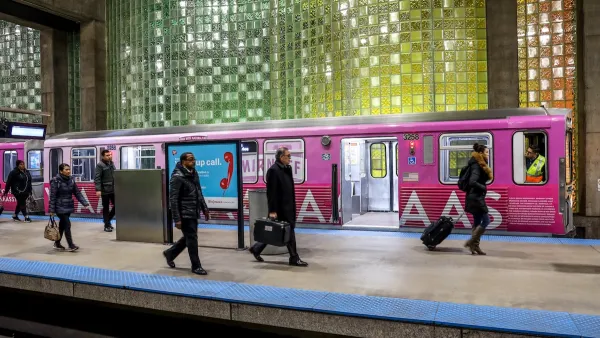
Chicago’s new transit authority has ‘unprecedented’ land development power
The Northern Illinois Transit Authority is allowed to buy and develop land for reasons unrelated to transit, a power that is fairly unique among transit authorities.

Planetizen Federal Action Tracker
A weekly monitor of how Trump’s orders and actions are impacting planners and planning in America.

California plans to bury El Niño’s downpour
If the state plays its cards right, it may be able to store a billion acre-feet of El Niño’s water in aquifers.

Chicago breaks ground on $3 billion megadevelopment
The new neighborhood, titled Foundry Park, will one day host 3,700 residences.

California High-Speed Rail Authority CEO resigns after $600,000 scandal
Under Ian Choudri, the authority used taxpayer dollars to fund first class flights and trips to nightclubs.

Want to study the Missouri River? Soon, you may need unanimous approval from 10 states
Legislation would require 10 governors’ permission to study or build projects moving water outside the basin.

Desperate measures: Advocates weigh draining Lake Powell to fill Colorado River
Draining the reservoir could reduce evaporation losses by a couple hundred thousand acre-feet.

FREE Course: Walkable City 1: Why Walkability?
After describing his path towards focusing on walkability as the essence of good planning, Jeff Speck marches through his five principal reasons for making more walkable places.
Reinventing Malls: Planning Alchemy—Turning Gray Fields Into Gold
The course focuses on the opportunities and imperatives that shape reinvention of mall sites.

City of Rosemead
Rutgers University, Edward J. Bloustein School of Planning and Public Policy
One Hundred Miles
Hunter College, City University of New York (CUNY)
The Architects Foundation
University of Cincinnati Online
City of Cambridge
Montrose County
The Pocatello Development Authority

