The most topical show on television got in on the e-scooter craze this week.


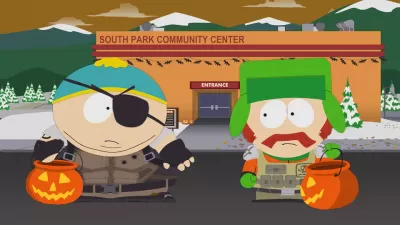
South Park placed e-scooters, perhaps the most hotly-contested signifiers of contemporary urban living, at the center of its most recent Halloween episode. In the episode, titled "The Scoots," dockless electric scooter share (called "e-scooters" in most places, as well as in South Park) arrives in massive numbers, changing the Halloween game forever.
All of the kids in South Park and the surrounding region discover the potential of e-scooters to speed up trick-or-treating operations, setting off an absurd scene of adult panic as dystopian levels of micro-mobility on Halloween. Despite its absurdity, the hysteria feels familiar. I'll leave it to you to decide which side of the scooter debate is being satirized (or maybe it's both).
A few more obvious, serious points are made along the way, however, namely with regard to the plight of Kenny McCormick. As one of the very few low-income residents in South Park, Kenny doesn't have a phone and thus can't access the e-scooters. Those who don't think South Park's creators are capable of slipping a message about social and economic inequality into an otherwise absurd rendering of American culture probably have never seen the show. The point about cell phones as the key enabler of economic and social mobility is subtle enough that one might even read this episode as a critique of smart phones, rather than e-scooters, like John Hugar did for AV Club.
Meanwhile, the school's counselor, Mr. Mackey (serving as the adult protagonist of the episode), struggles to reckon with e-scooters as a popular form of transportation. "I just think people should drive," says Mackey. "I don't think people should scoot. I just hope the future isn't scooting."
It's clear that Mackey speaks for a lot of people in a lot of cities in his preference for the car over all alternative forms of transportation (remember, the lyrics of the show's opening song includes the words "ample parking day or night"). Mackey spends the show haunted by the e-scooters, despite rounding up all the scooters and dropping them off a Tim Burton-sized cliff. In addition to e-scooters multiplying rapidly every time Mackey turns his back, one of the show's best recurring bits is e-scooter riders repeatedly running into Mackey's car, lamely issuing the apology of "sorry dude."
Mackey's hot take on "scooting" also isn't too far off the mark from Stan Marsh's review of his first ride on a scooter: "pretty stupid but sweet." The "cool" factor of e-scooters is an underreported dynamic in the whole micro-mobility revolution. Until recently very few people could have even remotely considered scooters to be cool. Still, the adoption rate of the scooters is remarkably conspicuous. Mr. Mackey speaks for all of us when he's caught completely off-guard by the sudden ubiquity of scooters and people riding scooters. It's almost as if there was pent up demand for the ability to zip around without a car for once in their lives. It's almost as if e-scooters have found a broadly appealing niche that triangulates the benefits of walking, driving, and riding a bike. Maybe it's driving that isn't as cool as most people assumed.
Maybe it's time for Mackey to adjust his attitude, and accept that scooters might be pretty stupid, but they're also sweet. And it's definitely time to get Kenny on a scooter.
While South Park is famous for lambasting anything or anyone in the public eye, e-scooters don't come off as a force of evil. It's excess that's the subject of satirical scorn. Excess is why we can't have nice things: excessive driving, excessive scooting, excessive Halloween candy, excessive competition, excessive entitlement.
With that, here's the Planetizen Scooter Media Brief for the end of October:
National News
- Electric scooter giant Lime says it recalled scooters amid fears that some could catch on fire (The Washington Post, October 30)
- Bird poll: Voters would make 'interesting sacrifices' to reduce time spent in traffic (Smart Cities Dive, October 26)
- Scooter companies are moving fast and breaking people, but they say they’re not to blame (The Verge, October 24)
National Commentary
- Public transit has been declining in the US for seven years. Scooters and bike-share could help save it. (Quartz, November 1)
- Hey Cyclists, Electric Scooters Are Not the Enemy (Bicycling, October 26)
Local News
- Detroit is about to see many more Bird and Lime scooters (Detroit Free Press, October 24)
- How many people are getting hurt on electric scooters in Dallas? Hospitals may have the answers (Dallas Morning News, October 24)
- Back for a week, e-scooters in San Francisco draw fewer complaints this time around (San Francisco Examiner, October 23)
- Lyft scooter hit DC streets (WTOP, October 18)

Scooter Media Brief: Safety, Security, and Business Models Raise Concerns
Recent news has revealed some cracks in the pavement below the speedy wheels of electric scooter share.
Scooter Media Brief: A Fork in the Road for Scooters
A few milestones stick out from the rest of the scooter news from January 2019.
Scooter Media Brief: The Dawn of the Age of Scooters
Electric scooter rentals will never be new again.

Planetizen Federal Action Tracker
A weekly monitor of how Trump’s orders and actions are impacting planners and planning in America.

The state-sanctioned urbicide of Austin
People don’t kill cities. Freeways do.

US to reduce Colorado River water deliveries to Mexico
A new Colorado Treaty amendment reduces Mexico’s Colorado River water allocation by 250,000 acre feet.

Baltimore to break ground on $50 million Transit Priority Project
The project will bring faster bus trips, safer streets and better bike connections to Baltimore.

Airbnb launches $250 million 'last-dollar financing' housing accelerator, makes first investment in Austin
The company will put $6.4 million towards affordable housing development in Texas’ capital.

Guerilla urbanists are building DIY bus stop benches in Chicago
A before-and-after of one of the bus stops with a new bench. The new benches are not officially sanctioned or permitted, but the residents who placed them hope they will be the start of a network of DIY benches across the city.

FREE Course: Walkable City 1: Why Walkability?
After describing his path towards focusing on walkability as the essence of good planning, Jeff Speck marches through his five principal reasons for making more walkable places.
Reinventing Malls: Planning Alchemy—Turning Gray Fields Into Gold
The course focuses on the opportunities and imperatives that shape reinvention of mall sites.

Eagle County Government
Harvard University Graduate School of Design
Nashville Planning Department
The Architects Foundation
University of Cincinnati Online
The Pocatello Development Authority
The Urban Renewal Agency of the City of Pocatello
Journal of the American Planning Association

