Unlike other measures of value, writes Jeanne Gang, pay is a number. And that should make it easy for architecture firms to address any existing wage gaps.



Citing the architectural profession's lack of diversity as well as its record of gender discrimination, Jeanne Gang asks: "What can we do, immediately, to promote gender equality?"
"It's obvious," she goes on. "We can start by looking to the fundamental issue of respect in the workplace—pay. Unlike other measures of value, pay is a number. It's tangible and objective."
Gang argues that tackling the gender pay gap is a simple matter of arithmetic, and tools already exist to help firms determine if they have a problem and how to address it. In her own firm, she says, "What we discovered was that, despite our ideological commitment to equality [...], a small pay gap nevertheless existed between the women and men in my office. We fixed that with this year's raises and now have no wage gap as an organization."
Although it often takes ideological commitment to address the pay gap in concrete ways, Gang also points to a pragmatic rationale. "In fields dedicated to creative problem-solving, it is critical to bring diverse people and ideas to the table and create a supportive environment in which varied skills and voices can develop."
Read the full story: Architecture’s great injustice, according to Jeanne Gang

How urban design makes the world unsafe for women — and how we can change that
An industrial designer explains how cities, cars and other everyday items could better serve women.
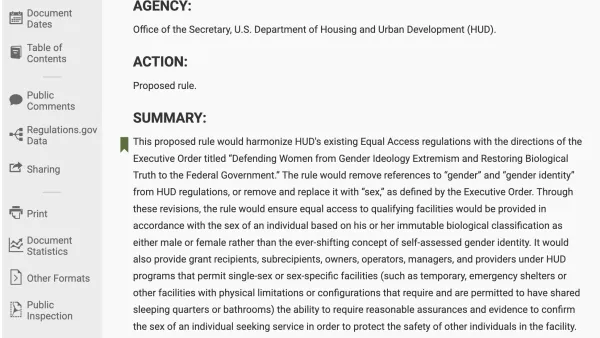
New HUD rule would remove gender from housing protections
The proposal in the federal registry would replace “gender” and “gender identity” with “sex” as defined by Trump’s January, 2025 executive order.

Federal Government Will no Longer Recognize Architects as ‘Professionals’
The change could dramatically impact how many people can afford to enter graduate professional degree programs.

Planetizen Federal Action Tracker
A weekly monitor of how Trump’s orders and actions are impacting planners and planning in America.

Eastern Nebraska is running out of electricity
Data centers and electrification are straining eastern Nebraska’s grid, throttling economic development.

Study reveals best places in the U.S. for cycling, walking
New research from Streetlight Data examines bicycle and pedestrian miles per capita in the 100 largest U.S. cities by population.

Federal government nominates new FTA administrator
Mark Aesch is currently the founder and CEO of a transportation management consulting firm.

Developers reveal $10 billion stadium plan as ‘Hail Mary’ to keep Bears in Chicago
The plan would also boast a public park, high- and mid-rise buildings and a youth sports complex.

As Texas embraces carbon storage, a Black community questions the risks
Texas now issues permits for companies to store carbon dioxide underground. East Texas residents fear safety risks, and skeptics doubt the climate benefits.

FREE Course: Walkable City 1: Why Walkability?
After describing his path towards focusing on walkability as the essence of good planning, Jeff Speck marches through his five principal reasons for making more walkable places.
Reinventing Malls: Planning Alchemy—Turning Gray Fields Into Gold
The course focuses on the opportunities and imperatives that shape reinvention of mall sites.

City of Charlotte
City of Rosemead
Rutgers University, Edward J. Bloustein School of Planning and Public Policy
University of Michigan School for Environment and Sustainability (SEAS)
Hunter College, City University of New York (CUNY)
The Architects Foundation
City of Cambridge
The Pocatello Development Authority
The Urban Renewal Agency of the City of Pocatello