The Los Angeles Transit-Oriented Communities program, which offers development bonuses in exchange for affordable housing in developments near transit lines, is the city's most successful affordable housing tool.


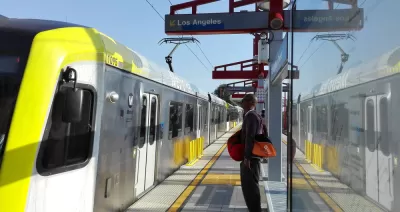
"The [city of Los Angeles'] Transit-Oriented Communities program went into effect nearly 10 months ago, and in that time, it has helped put more than 1,000 affordable housing units in the pipeline," reports Dennis Lynch.
That information comes by way of a report from the Los Angeles Department of City Planning [pdf], showing that 1,145 affordable units have been added to otherwise market rate developments. "The program only applies to projects within a half-mile of major transit stops, which include some bus lines and all Metro light-rail lines. It allows more significant bonuses to projects closer to those stops and those that incorporate higher percentages of affordable units," explains Lynch.
A March article by Dennis Lynch reported willingness by developers to add the requisite affordable housing to participate in the program.
Read the full story: Developers have filed for 1K+ affordable housing units under city program: report


Year One of L.A.'s 'Transit Oriented Communities Affordable Housing Incentives Program'
After one year in action, the Transit Oriented Communities Affordable Housing Incentives Program has enabled a rare feat in Los Angeles: new development.

Report: Ballot Measure Intended to Spur Affordable Development Had the Opposite Effect in L.A.
L.A. voters approved Measure JJJ in 2016 in the hopes of encouraging more affordable housing as a trade-off for discretionary approval. The result has been no development at all.
South L.A. Housing Project First to Use New 'Transit Oriented Community' Incentives
The city's new guidelines incentivize the development of affordable housing near transit.

Planetizen Federal Action Tracker
A weekly monitor of how Trump’s orders and actions are impacting planners and planning in America.

California plans to bury El Niño’s downpour
If the state plays its cards right, it may be able to store a billion acre-feet of El Niño’s water in aquifers.

Chicago breaks ground on $3 billion megadevelopment
The new neighborhood, titled Foundry Park, will one day host 3,700 residences.

Satanic Place Names
From streams and lakes to valleys and canyons, I mapped more than 1,000 places named after the Devil.

California High-Speed Rail Authority CEO resigns after $600,000 scandal
Under Ian Choudri, the authority used taxpayer dollars to fund first class flights and trips to nightclubs.

Want to study the Missouri River? Soon, you may need unanimous approval from 10 states
Legislation would require 10 governors’ permission to study or build projects moving water outside the basin.

FREE Course: Walkable City 1: Why Walkability?
After describing his path towards focusing on walkability as the essence of good planning, Jeff Speck marches through his five principal reasons for making more walkable places.
Reinventing Malls: Planning Alchemy—Turning Gray Fields Into Gold
The course focuses on the opportunities and imperatives that shape reinvention of mall sites.

City of Rosemead
Rutgers University, Edward J. Bloustein School of Planning and Public Policy
One Hundred Miles
Hunter College, City University of New York (CUNY)
The Architects Foundation
University of Cincinnati Online
City of Cambridge
Montrose County
The Pocatello Development Authority