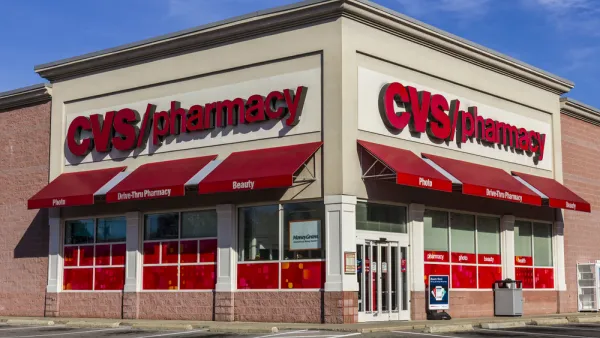
CVS is about as American as apple pie, but at what cost to American communities?



Mark Lamster, architecture critic for the Dallas Morning News, pens a scathing critique of the CVS drugstores that populate urban street corners and anchor suburban strip malls all over the country:
If I were to tell you a drug dealer had recently colonized a popular street corner, thereby precluding all civic life around it, that would sound like a familiar scenario, conjuring visions from crime dramas likeThe Wire.
But what if the drug dealer in question wasn't some low-rent street pusher, but one of America's largest corporations, and what if it was operating not just in some impoverished neighborhood most of us don't visit, but all across the city?
What if that dealer was CVS?
Lamster goes on from that beginning to provide an honest appraisal of both the interior design choices and the site plans that produce a footprint in the built environment that encourages all of the vices of sprawl, and none of the health benefits a neighborhood drugstore should be aiming to deliver. A recently constructed example from Dallas, the Bishop Arts store on the corner of Zang Boulevard and West Davis Street, provides a case study in the urban design failings of CVS.
FULL STORY: CVS commits urban malpractice with generic store designs that poison neighborhoods

Chain Drugstores Are Closing, But Not Because of Shoplifting
Massive chain drug stores have become integral members of the urban fabric, for better or worse, but widespread store closures and security practices have come to symbolize urban decline. The dynamic must be monitored.
A New Vision for Dallas’ Dealey Plaza
After decades of neglect, a team of designers reimagines the infamous plaza as a safe, vibrant, multimodal public space.
Development Code, Future Land Use Map Updates Coming to Dallas
The ForwardDallas initiative is attempting for the Holy Grail of planning: development certainty.

Planetizen Federal Action Tracker
A weekly monitor of how Trump’s orders and actions are impacting planners and planning in America.

The state-sanctioned urbicide of Austin
People don’t kill cities. Freeways do.

US to reduce Colorado River water deliveries to Mexico
A new Colorado Treaty amendment reduces Mexico’s Colorado River water allocation by 250,000 acre feet.

5 New England states march closer to 800 megawatt wind energy project
Securing federal approval for the project may be complicated under the Trump administration, which has historically been hostile towards domestic wind power.

Baltimore to break ground on $50 million Transit Priority Project
The project will bring faster bus trips, safer streets and better bike connections to Baltimore.

Airbnb launches $250 million 'last-dollar financing' housing accelerator, makes first investment in Austin
The company will put $6.4 million towards affordable housing development in Texas’ capital.

FREE Course: Walkable City 1: Why Walkability?
After describing his path towards focusing on walkability as the essence of good planning, Jeff Speck marches through his five principal reasons for making more walkable places.
Reinventing Malls: Planning Alchemy—Turning Gray Fields Into Gold
The course focuses on the opportunities and imperatives that shape reinvention of mall sites.

Eagle County Government
Harvard University Graduate School of Design
Nashville Planning Department
The Architects Foundation
University of Cincinnati Online
The Pocatello Development Authority
The Urban Renewal Agency of the City of Pocatello
Journal of the American Planning Association