Ridership is declining on TriMet's Westside Extension Service, reflecting declines on other parts of the system. This commuter rail line, however, has its own unique set of issues.


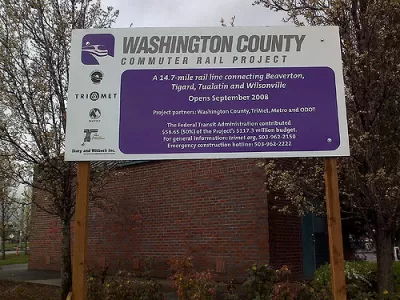
Andrew Theen reports on significant declines in ridership on TrimMet's Westside Extension Service (WES) commuter rail line.
"Nine years ago, the transit agency officially got into the heavy-rail business with the 14.7-mile suburban route between Wilsonville and Beaverton," according to Theen. "And ever since, ridership has consistently failed to live up to TriMet's original projections."
March boardings were down 13.2 percent compared to the same month the year before, according to data recently released by TriMet. "The tepid ridership comes despite record-low unemployment levels in the Portland area and amid ever-growing grumbling about stifling congestion on Interstates 5 and 205, Oregon 217 and U.S. 26," adds Theen. Ridership is dropping on TriMet's bus and light rail routes. The plan to recover some of the last ridership along the WES route—marketing to new developments built along the corridor.
FULL STORY: WES train ridership down 13 percent from 2017, but TriMet rolls on

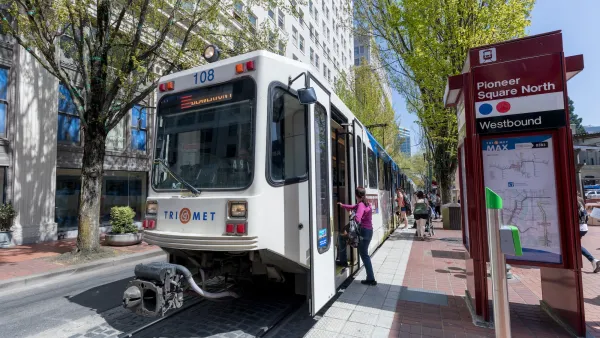
TriMet will eliminate 'Hand-to-Hand' paratransit service for half of its users
Roughly 300 Portland-area paratransit riders will lose access to a program that lets drivers escort them into their destination.
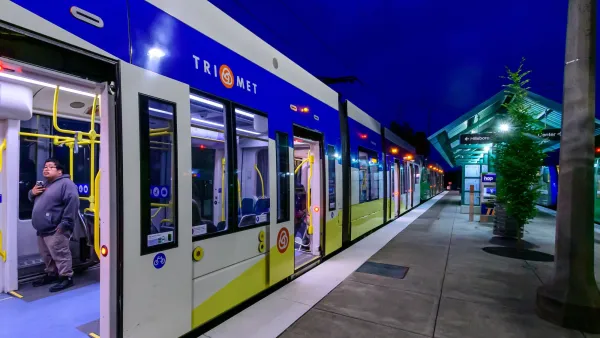
Portland transit announces deep service cuts, hundreds of layoffs
The TriMet agency is cutting service on multiple transit lines, reducing customer service phone hours and eliminating over 100 staff positions.

Portland gathers to pay respects to the last of its original light rail cars
The TriMet agency has fully replaced its aging fleet of Type 1 cars.

The state-sanctioned urbicide of Austin
People don’t kill cities. Freeways do.

US to reduce Colorado River water deliveries to Mexico
A new Colorado Treaty amendment reduces Mexico’s Colorado River water allocation by 250,000 acre feet.

New Jersey’s second-largest city bans standalone data centers
Jersey City will continue to allow co-location facilities, such as those meant for research institutions that store their own data.

Amtrak not solely to blame for New Jersey commuter rail's unreliability, report finds
A new study from the Garden State Initiative found that NJ Transit’s budget grew 20% across a 4 year period, but reliability declined significantly over the same period.

EPA erases limits on planet-warming pollution from power plants
Under Monday’s plan, power plants would still have some limits on how much mercury, arsenic and other contaminants they can emit.

Phoenix announces new on-demand transit service, more frequent RAPID buses
Both new services will launch in October, and are part of Phoenix's Project Effective Access Solutions for Easing Congestion.

FREE Course: Walkable City 1: Why Walkability?
After describing his path towards focusing on walkability as the essence of good planning, Jeff Speck marches through his five principal reasons for making more walkable places.
Reinventing Malls: Planning Alchemy—Turning Gray Fields Into Gold
The course focuses on the opportunities and imperatives that shape reinvention of mall sites.

Eagle County Government
Harvard University Graduate School of Design
Nashville Planning Department
The Architects Foundation
University of Cincinnati Online
The Pocatello Development Authority
The Urban Renewal Agency of the City of Pocatello
Journal of the American Planning Association