Despite its immeasurable geographic and cultural distinctiveness, there is perhaps no American city that has embraced Modernist city planning as fully as Honolulu has.


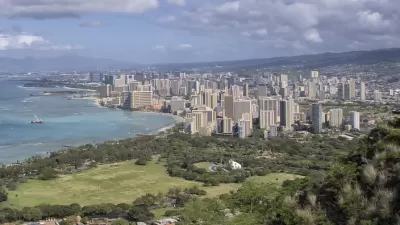
"The Corbusian connection struck me most acutely when I realized on my recent trip that many of Honolulu’s towers, both in Waikiki and throughout the rest of the city, sit atop open-air lobbies, of the very sort that Corbu said would bring healthy breezes to the masses. I suppose it makes sense in Hawaii, with the trade winds and all, but the effect is still deadening. Ground floors are given to parking areas. Towers are surrounded by pointless greenery and setbacks, making them mutually hostile towards each other. Curb cuts interrupt the sidewalk and, in many neighborhoods, there’s really nowhere to walk to."
"Honolulu should be the most distinctive city in the country. It is literally an island unto itself. In fact, it’s the most isolated big city in the world. I would have thought that a city on an island would embrace efficiency and create dense, lively places in order to conserve scarce land, the way Hong Kong or San Francisco does. Instead, Honolulu looks like Houston with volcanoes."
"Of course, all of these places reflect their historical eras and the prevailing fashions when they were built. That’s another reason I’m sad about Honolulu. It was invaded too soon, before the native culture had a chance to make a lasting architectural impact. It was built too late, without much of an old compact downtown to provide refuge from the auto-oriented, suburban form that just happened to dominate at the very moment that Hawaii became a state and its (non-native) population boomed."
Read the full story: Reconsidering Paradise: How Honolulu Became a Poster Child for American Autocentric Urbanism

What ‘The Brutalist’ Teaches Us About Modern Cities
How architecture and urban landscapes reflect the trauma and dysfunction of the post-war experience.
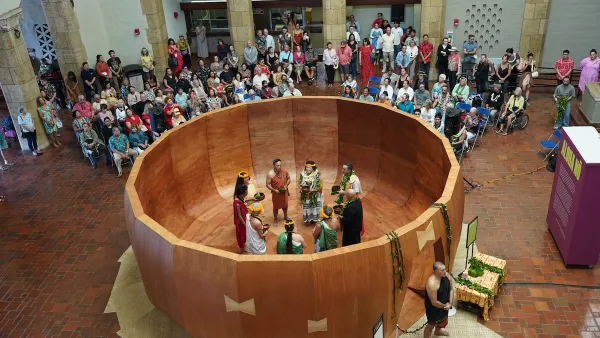
A Monument to Resilience: Native Hawaiian Art Installation Honors History and Healing
The towering ʻUmeke Lāʻau installation by Native Hawaiian artist Meleanna Aluli Meyer, unveiled at Honolulu's city hall, is a powerful symbol of cultural resilience and healing.
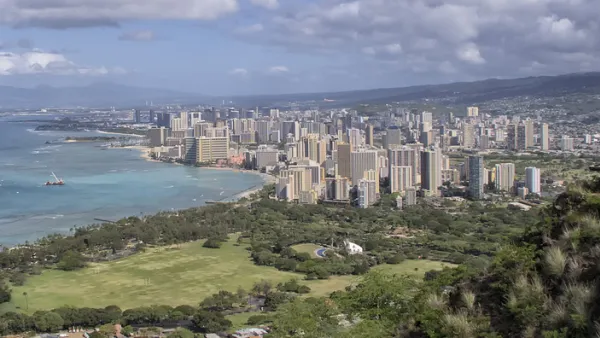
Hawaii Cities Commit to Fully Renewable Ground Transportation by 2045
Mayors and civic leaders from across the Hawaiian islands signed a commitment to target 100 percent renewable ground transportation by 2045, both public and private.

Planetizen Federal Action Tracker
A weekly monitor of how Trump’s orders and actions are impacting planners and planning in America.

The state-sanctioned urbicide of Austin
People don’t kill cities. Freeways do.

US to reduce Colorado River water deliveries to Mexico
A new Colorado Treaty amendment reduces Mexico’s Colorado River water allocation by 250,000 acre feet.

Nation's most wind-powered state turns to coal as data centers increase energy demand
For the first time in decades, Iowa has increased its generation of coal power.

NYC cools commuters with city's first rain garden above a bus stop
New York City officials say the plants in the rain garden can absorb 16 gallons of rainwater during heavy storms.

Brightline West’s future may rely on $6 billion federal loan
The company has until Nov. 2 to make a $400 million equity investment into its proposed high-speed rail line.

FREE Course: Walkable City 1: Why Walkability?
After describing his path towards focusing on walkability as the essence of good planning, Jeff Speck marches through his five principal reasons for making more walkable places.
Reinventing Malls: Planning Alchemy—Turning Gray Fields Into Gold
The course focuses on the opportunities and imperatives that shape reinvention of mall sites.

Eagle County Government
Harvard University Graduate School of Design
Nashville Planning Department
The Architects Foundation
University of Cincinnati Online
The Pocatello Development Authority
The Urban Renewal Agency of the City of Pocatello
Journal of the American Planning Association