Holmdel, New Jersey, was home to a huge, beautiful, and empty headquarters of the now defunct Bell Labs. Now the campus is home to tech startups, a library, and a host of other businesses.


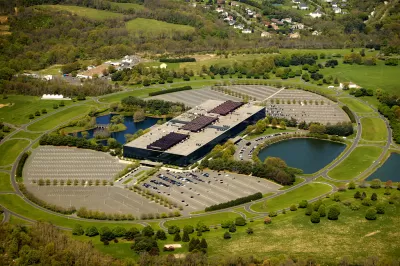
Bell Labs' giant, former headquarters sat empty for years. "The company’s 2 million-square foot complex was zoned for office use by a single tenant. Coming to terms with the impossibility of finding a single tenant for the building, the town’s zoning committee consented to alter the site’s zoning to accommodate multiple uses, "Anthony Paletta writes for CityLab.
A project to revitalize the building included modernizing the utility spaces and getting rid of a lot of cubicles among other things. But the unique building maintains its midcentury charms. "The office floors are now 70 to 80 percent leased by a variety of tenants—mostly tech and coworking companies—and one is headed by a former Bell Labs employee," Paletta writes.
Read the full story: A New Urbanist Developer Gives Saarinen a Reboot

Mountain View Goes Big on Google Expansion, Approves 10,000 Housing Units
Could the approval of a massive redevelopment plan for Google property in the city of Mountain View pave the way for a new development-friendly approach to planning in the Silicon Valley and the greater Bay Area?
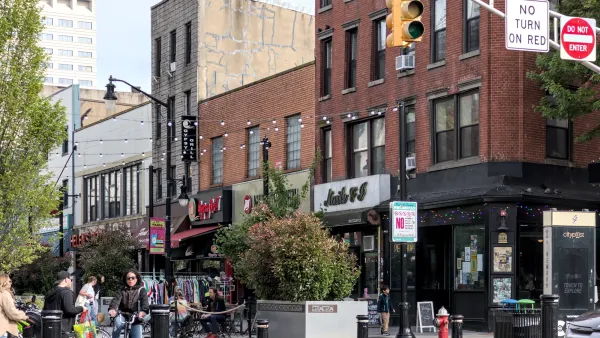
Jersey City could build 700 homes on city-owned parking lots
If approved, a redevelopment proposal would build hundreds of new homes on a pair of city parking lots.
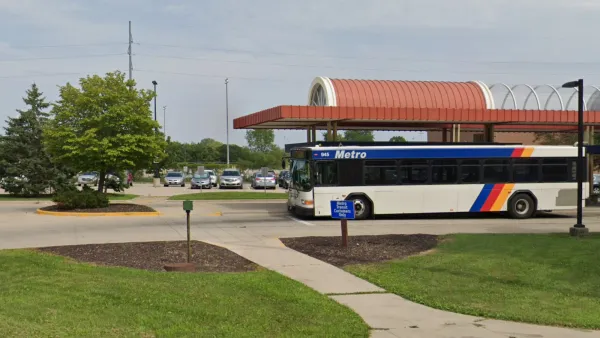
Madison approves hundreds of affordable apartments as deadline for federal funding looms
A recently approved project will bring 163 affordable units to the north side.

Planetizen Federal Action Tracker
A weekly monitor of how Trump’s orders and actions are impacting planners and planning in America.

California plans to bury El Niño’s downpour
If the state plays its cards right, it may be able to store a billion acre-feet of El Niño’s water in aquifers.

Desperate measures: Advocates weigh draining Lake Powell to fill Colorado River
Draining the reservoir could reduce evaporation losses by a couple hundred thousand acre-feet.

Mamdani’s pied-à-terre tax survives legal challenge
A panel of judges found that the plaintiffs failed to demonstrate injury as a result of New York City's implementation of the tax.

Eastern Nebraska is running out of electricity
Data centers and electrification are straining eastern Nebraska’s grid, throttling economic development.

Seattle passes record-breaking transit services expansion
Proposition 1 will double the city’s transit tax to add 95,000 more bus trips and preserve 180,000 bus trips annually.

FREE Course: Walkable City 1: Why Walkability?
After describing his path towards focusing on walkability as the essence of good planning, Jeff Speck marches through his five principal reasons for making more walkable places.
Reinventing Malls: Planning Alchemy—Turning Gray Fields Into Gold
The course focuses on the opportunities and imperatives that shape reinvention of mall sites.


City of Rosemead
Rutgers University, Edward J. Bloustein School of Planning and Public Policy
One Hundred Miles
University of Michigan School for Environment and Sustainability (SEAS)
Hunter College, City University of New York (CUNY)
The Architects Foundation
City of Cambridge
Montrose County
The Pocatello Development Authority