YIMBYs are describing the jobs-housing imbalance represented in the Central SoMa Plan as reminiscent of the housing policies of cities farther down the Peninsula.


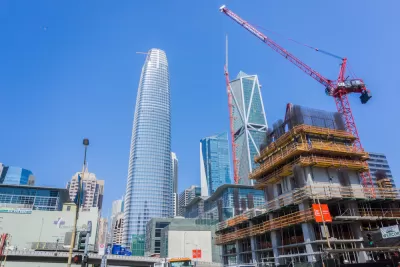
"For the first time since San Francisco’s 1970’s downtown highrise boom, activists are demanding that new office space—-in this case in Central SOMA— be balanced by new housing," reports Randy Shaw.
The advocates, in this case, are YIMBYs, with a position on the Central SoMa Plan clearly explained in an opinion piece by Joe Rivano Barros in the SF Examiner.
Shaw starts from an assumption that San Francisco’s affordability crisis resulted from decades of adding jobs but not housing. "Activists see this mistake repeating in a Central SOMA plan adding 40,000-50,000 jobs and only 7000 housing units." YIMBYs see that ratio as a formula for displacement and gentrification.
Yet, according to Shaw, "Mission activists and D9 Supervisor Hillary Ronen are aggressively fighting to stop housing from being built on a Laundromat at Mission and 25th Streets." That kind of housing development opposition, whether from self-interest or more communitarian concerns, isn't afforded to proposals that would add many jobs without commensurate housing units: "neither are battling a Central SOMA plan which will unquestionably drive up Mission rents and evictions."
The article also examines the question of why there's a lack opposition to the plan, as well as the position of a group of candidates for the supervisor's position in District 6.
As for the details of the Central SoMa Plan, J.K. Dineen reported on the key components of the plan at the end of February 2018: "[the plan] would dramatically raise height limits in portions of a 17-block zone that stretches from close to Market Street south to Townsend Street, and from Second Street west to Sixth Street.” According to Shaw, "[the] plan calls for two forty story condo towers at Fourth and Townsend, and 3.1 million square feet of new office space overall. It’s 20 million square feet of development also includes 2,310 affordable housing units, 33 percent of the total."
FULL STORY: CENTRAL SOMA EXPOSES SF’S POLITICAL IDENTITY CRISIS

Does Zoning Create a Vicious Circle—Or Can It Fix Itself?
Ideally, planners could balance homeowners' interests in zoning against the public good, liberalizing zoning when prices got too high. But this may be politically impossible.
San Francisco Mayor’s ‘Family Zoning’ Plan Faces Pushback, Displacement Concerns
Newly proposed legislation aims to protect long-term tenants from displacement caused by Mayor Lurie’s proposed zoning reform plan, which would allow for more housing construction in parts of the city.

How Cities Are Resisting State Efforts To Increase Density
Cities are attempting to wrest back local control over land use and zoning via some ingenious—and sometimes disingenuous—strategies.

Planetizen Federal Action Tracker
A weekly monitor of how Trump’s orders and actions are impacting planners and planning in America.

The state-sanctioned urbicide of Austin
People don’t kill cities. Freeways do.

US to reduce Colorado River water deliveries to Mexico
A new Colorado Treaty amendment reduces Mexico’s Colorado River water allocation by 250,000 acre feet.

5 New England states march closer to 800 megawatt wind energy project
Securing federal approval for the project may be complicated under the Trump administration, which has historically been hostile towards domestic wind power.

Baltimore to break ground on $50 million Transit Priority Project
The project will bring faster bus trips, safer streets and better bike connections to Baltimore.

Airbnb launches $250 million 'last-dollar financing' housing accelerator, makes first investment in Austin
The company will put $6.4 million towards affordable housing development in Texas’ capital.

FREE Course: Walkable City 1: Why Walkability?
After describing his path towards focusing on walkability as the essence of good planning, Jeff Speck marches through his five principal reasons for making more walkable places.
Reinventing Malls: Planning Alchemy—Turning Gray Fields Into Gold
The course focuses on the opportunities and imperatives that shape reinvention of mall sites.

Eagle County Government
Harvard University Graduate School of Design
Nashville Planning Department
The Architects Foundation
University of Cincinnati Online
The Pocatello Development Authority
The Urban Renewal Agency of the City of Pocatello
Journal of the American Planning Association