Elaine Herzberg's death by autonomous vehicle on March 18 in Tempe was a "first," but what of the 224 pedestrians that died last year in Arizona, the nation's most dangerous state for pedestrians according to a 50-state report released Feb. 28?


Five days before Elaine Herzberg was fatally struck on March 18 by an Uber operating in autonomous mode with a driver behind the wheel in Maricopa County, Az., becoming the first pedestrian fatality caused by a self-driven vehicle, four pedestrians were struck by an SUV that hopped a curb in Fountain Hills, also Maricopa County.
Those three pedestrian deaths and one critical injury was no aberration among 10 pedestrian fatalities in the Phoenix Metro area that week. Arizona had the highest pedestrian fatality rate in the nation last year, based on a report released Feb. 28 by the Governors Highway Safety Association.
"GHSA estimates the number of pedestrians killed in motor vehicle crashes nationwide in 2017 was 5,984, a decrease of one half of one percent — essentially unchanged from 2016," notes the summary of the report [pdf] based on the first six months of data last year.
"The increased rate of pedestrian deaths [1.61 per 100,000 people] in Arizona is nearly double the national average of 0.81 deaths per 100,000 people and translates to 113 people killed from January through June of 2017, the national report said," reported BrieAnna J Frank for The Arizona Republic on March 1. "That's up from 101 during the same time span in 2016."
With just over 7 million residents, the Grand Canyon State is the 14th most populous, yet it ranked #5, behind California, Florida, Texas, and New York in pedestrian deaths during the time period.
"The Governor's Office of Highway Safety in Arizona said [Feb. 28] the total number of pedestrian deaths for 2017 jumped to 224 from the previous year," adds Frank. According to agency director, Alberto Gutier, there were 30 bicyclist deaths in 2017.
"I've seen the consequences and the lack of respect for pedestrians and bicyclists," Gutier said, noting that 26 percent of all traffic fatalities in Arizona last year involved pedestrians or bicyclists.
Arizona was hardly alone in seeing its pedestrian fatality rate increase; 22 other states and the District of Columbia experienced increases, while 20 saw decreases, and seven were stable, according to the report.
Nationwide, pedestrians are faring far worse than motorists in terms of safety, notes the study, written by Richard Retting of Sam Schwartz Consulting.
The number of pedestrian fatalities increased 27 percent from 2007 to 2016, while at the same time, all other traffic deaths decreased by 14 percent.
Alissa Walker, Curbed's urbanism editor, pens a powerful piece on March 22 on the death of Herzberg, hoping it will inspire Arizona cities to prioritize pedestrian safety, not by ticketing jaywalkers but through street design.
The fact that the state is so deadly for walkers is not a coincidence. The same factor that is responsible for Arizona’s high number of pedestrian deaths is the very same reason Uber is testing there—the state prioritizes cars over the lives of pedestrians.
Hat tip to Alissa Walker.
Read the full story: Pedestrian Traffic Fatalities by State: 2017 Preliminary Data

Did Uber Just Get Away With Manslaughter?
Remember Elaine Herzberg, the 49-year-old woman who became the first pedestrian fatality due to an autonomous vehicle when she was hit last March by an Uber with a safety driver in Tempe, Ariz.? Prosecutors found no criminal liability.
Tempe Police Chief: Uber AV vs. Pedestrian Crash May Have Been Unavoidable
After viewing the videos taken by two cameras equipped in the Uber autonomous vehicle that fatally struck 49-year-old Elaine Herzberg on Sunday, the chief concluded the crash was difficult to avoid. Also, lessons on the crash from David Leonhardt.
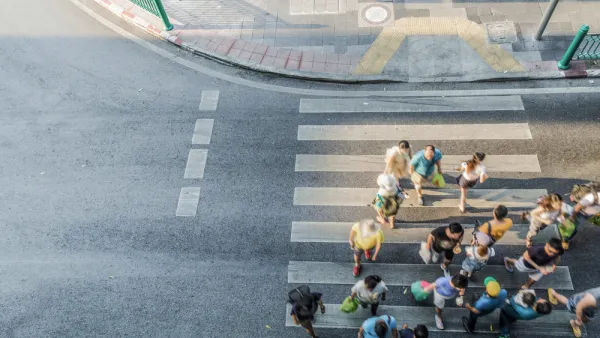
2020 Could Set Records for Pedestrian Fatality Rates
The novel coronavirus wasn't the only public health risk spreading around the United States in 2020.

Planetizen Federal Action Tracker
A weekly monitor of how Trump’s orders and actions are impacting planners and planning in America.

California plans to bury El Niño’s downpour
If the state plays its cards right, it may be able to store a billion acre-feet of El Niño’s water in aquifers.

Chicago breaks ground on $3 billion megadevelopment
The new neighborhood, titled Foundry Park, will one day host 3,700 residences.

Satanic place names
From streams and lakes to valleys and canyons, I mapped more than 1,000 places named after the Devil.

California High-Speed Rail Authority CEO resigns after $600,000 scandal
Under Ian Choudri, the authority used taxpayer dollars to fund first class flights and trips to nightclubs.

Want to study the Missouri River? Soon, you may need unanimous approval from 10 states
Legislation would require 10 governors’ permission to study or build projects moving water outside the basin.

FREE Course: Walkable City 1: Why Walkability?
After describing his path towards focusing on walkability as the essence of good planning, Jeff Speck marches through his five principal reasons for making more walkable places.
Reinventing Malls: Planning Alchemy—Turning Gray Fields Into Gold
The course focuses on the opportunities and imperatives that shape reinvention of mall sites.

City of Rosemead
Rutgers University, Edward J. Bloustein School of Planning and Public Policy
One Hundred Miles
Hunter College, City University of New York (CUNY)
The Architects Foundation
University of Cincinnati Online
City of Cambridge
Montrose County
The Pocatello Development Authority