Nuisance laws in Ohio cities endanger and discriminate against the victims of abuse, domestic violence, and the mentally ill.


Nuisance laws levy fines against properties that are the sites of multiple calls to 911. The rationale behind these laws is that, if criminals are regularly breaking laws on the same property, property owners should have a monetary disincentive for allowing the problems to continue. The ACLU writes "…alleged nuisance conduct (a category that can include assault, harassment, stalking, disorderly conduct, and many other kinds of behavior)." These fines can be levied whether the person living at the property is the criminal or the victim.
The result is that victims of abuse, assault or stalking can be fined for reporting abuse. These crimes, many of which already go unreported, become even harder to report when the victim fears a fine or that the authorities will contact their landlord.
Another problem for renters, is access to due process, "Fifty percent of the nuisance letters reviewed in the study were issued for renters. Those letters, most times, however, are sent to the property owner or landlord, giving renters no avenue to contest the findings, even when the issue at hand was in no way criminal," Vince Grzegorek writes for Cleveland Scene. This was exactly the case when a woman living in Lakewood Ohio was fined for being assaulted by a visitor in her home, who had broken her nose and concussed her.
That case is by no means an anomaly. In the cities of Bedford, Lakewood, Euclid and Parma “Domestic violence accounted for between 21 and 56% of the nuisance letters in the study — but it also includes people who have called 911 for mental health reasons, including reporting suicidal family members, or drug addiction," Grzegorek reports.
Read the full story: How Northeast Ohio Nuisance Laws Harm Domestic Violence Victims, Minorities, Renters and People Experiencing Mental Illness

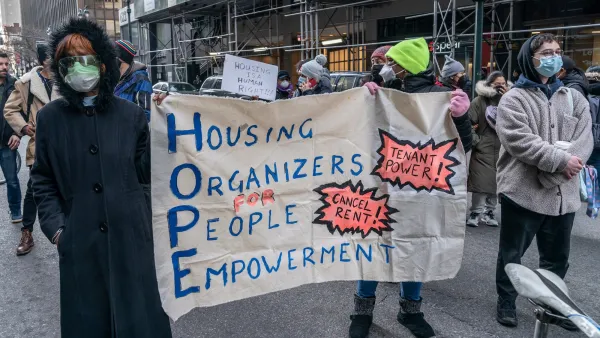
NYC 'Rental Ripoff' report calls for crackdown on negligent landlords
The report outlines strategies for empowering renters and transferring properties from 'low-road' landlords to those who focus on improved tenant outcomes.

The Pacific Northwest is an unlikely front in the fight for cooling
A 2021 heat dome killed over 250 people in the Pacific Northwest, bringing into sharp focus the potential of extreme heat to have deadly consequences even in historically cool climates.
Federal cuts to voucher program put 9,000 New Yorkers at risk of homelessness
The Emergency Housing Voucher program is ending years ahead of schedule, forcing housing agencies to find new ways to support roughly 70,000 households nationwide.

Planetizen Federal Action Tracker
A weekly monitor of how Trump’s orders and actions are impacting planners and planning in America.

The state-sanctioned urbicide of Austin
People don’t kill cities. Freeways do.

Colorado’s Largest Data Center Could Rise Next to Homes — Without a Public Hearing
The proposed campus would consume 11 times the power of Denver International Airport; as it has across the country, opposition mounts.

Amtrak, CN end decades-long dispute with eight-year agreement
The new operating agreement establishes an updated framework for the companies to work together, including processes to resolve disputes.

Raised interest rates may kill financially vulnerable construction projects
The chief economist at ConstructConnect warns that if construction project owners are negatively impacted by the raised rates, it could result in delayed payments to contractors.

Data centers are consuming nearly 25% of Oregon’s power
The state has 111 data centers, with 32 more either planned or under construction.

FREE Course: Walkable City 1: Why Walkability?
After describing his path towards focusing on walkability as the essence of good planning, Jeff Speck marches through his five principal reasons for making more walkable places.
Reinventing Malls: Planning Alchemy—Turning Gray Fields Into Gold
The course focuses on the opportunities and imperatives that shape reinvention of mall sites.

Greater Baltimore Committee
Eagle County Government
Harvard University Graduate School of Design
The Architects Foundation
University of Cincinnati Online
The Pocatello Development Authority
The Urban Renewal Agency of the City of Pocatello
Journal of the American Planning Association