New York, like every other city in the United States, isn't more prepared for a major storm event than it was on October 29, 2012.



Five years after Superstorn Sandy, the splashy and widely referenced "The Big U" plan is still "just lines on paper" according to an article by Robert Lewis.
You probably remember the Big U—"a 10-mile U-shaped barrier from 57th Street on the west side, down the battery and up the east side to 42nd Street," writes Lewis. "It was supposed to feature public art space and stunning new parkland."
A first phase of the Big U, the East Side Coastal Resiliency Project, has $335 in funding from the federal government, but the "groundbreaking has been delayed by at least 18 months, and already some of the amenities promised to the community have been removed to cut costs."
According to Lewis, the Big U is not the only project that emerged in the days and months following Superstorm Sandy that seems to have sputtered out of political favor. In fact, the assessment looks a lot like the city of New York and the surrounding region is no more prepared for an extreme weather even than it was when Superstorm Sandy slammed ashore exactly five years ago today. That dire assessment about the overall state of resilience in New York, as well as the rest of the country, is echoed by another article by the Associated Press, if you're looking for more.
FULL STORY: Why 'The Big U' Storm Barrier Could End Up as 'Half a J'

Saving Lower Manhattan
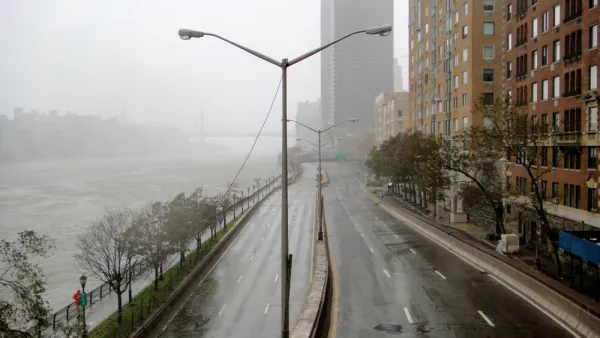
A debate over how to protect the East River waterfront from Sandy-level flooding and storm damage has delayed the project as community activists decry the city's last-minute change of plans.
City Council: New York Must Plan for Resilience at the Local Level
The city of New York has a new mandate for resilience planning.

In Battery Park City, Public Infrastructure Meets Climate Resilience
A massive project underway in Lower Manhattan seeks to protect the shoreline from future flooding and mitigate the effects of climate change and rising sea levels.

Planetizen Federal Action Tracker
A weekly monitor of how Trump’s orders and actions are impacting planners and planning in America.

The state-sanctioned urbicide of Austin
People don’t kill cities. Freeways do.

US to reduce Colorado River water deliveries to Mexico
A new Colorado Treaty amendment reduces Mexico’s Colorado River water allocation by 250,000 acre feet.

5 New England states march closer to 800 megawatt wind energy project
Securing federal approval for the project may be complicated under the Trump administration, which has historically been hostile towards domestic wind power.

Baltimore to break ground on $50 million Transit Priority Project
The project will bring faster bus trips, safer streets and better bike connections to Baltimore.

Airbnb launches $250 million 'last-dollar financing' housing accelerator, makes first investment in Austin
The company will put $6.4 million towards affordable housing development in Texas’ capital.

FREE Course: Walkable City 1: Why Walkability?
After describing his path towards focusing on walkability as the essence of good planning, Jeff Speck marches through his five principal reasons for making more walkable places.
Reinventing Malls: Planning Alchemy—Turning Gray Fields Into Gold
The course focuses on the opportunities and imperatives that shape reinvention of mall sites.

Eagle County Government
Harvard University Graduate School of Design
Nashville Planning Department
The Architects Foundation
University of Cincinnati Online
The Pocatello Development Authority
The Urban Renewal Agency of the City of Pocatello
Journal of the American Planning Association