Alstom and Siemens are close to a merger in a move calculated to help the companies compete against the Chinese state-backed company CRRC.



Reuters reports a scoop from the world of rail transit manufacturing: French rail transport giant Alstom is merge with German giant Siemens. Siemens will reportedly pick Alstom instead of Canadian company Bombardier for the merger—a move calculated to position the company to better compete with the Chinese state-backed company CRRC.
"Siemens and Alstom are strong in high-speed intercity trains with their ICE and TGV models," explains the article. "Siemens is also the leader in signalling technology, while Bombardier - whose transportation headquarters are in Berlin - is stronger in commuter and light-rail trains."
The article includes a lot more detail about the potential regulatory and anti-trust issues that might arise as a result of the Alstom and Siemens merger, as well as the new company's potential size and power in the market.
Read the full story: Siemens likely to pick Alstom for rail merger: Sources

Opinion: It's the Perfect Time for More Trains in Maine
A more concerted effort could bring together the state's recent plans and federal infrastructure investment to link the region and reduce greenhouse gas emissions.
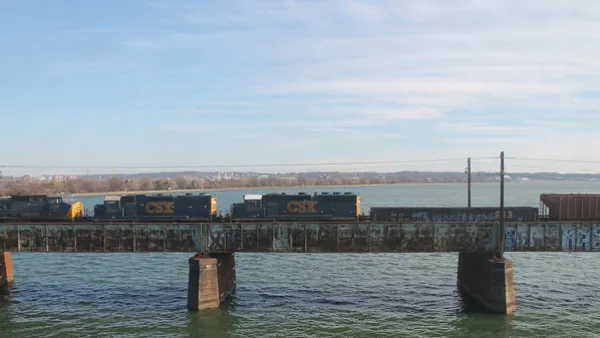
Key Virginia Rail Bridge Project Completes Environmental Review
A $1.9 billion project to add a second set of rail tracks to the Long Bridge that connects Virginia to D.C. is ready to move forward with a recently completed Environmental Impact Statement.

Virginia to Pay $3.7 Billion for 225 Miles of Rail Track
New passenger rail improvements for the Virginia Railway Express and Amtrak are on the way in 2020.

Planetizen Federal Action Tracker
A weekly monitor of how Trump’s orders and actions are impacting planners and planning in America.

Eastern Nebraska is running out of electricity
Data centers and electrification are straining eastern Nebraska’s grid, throttling economic development.

Washington state to charge fee to drivers with fuel-efficient cars
Revenue from the fee will go towards supporting the state’s highways.

Instead of building new housing, LA developers are turning mansions into mega-mansions
In the richest areas, the number of houses valued at $30 million with demolition permits has skyrocketed since 2018.

Illinois considers spending $1 billion in taxpayer money on data center
A quantum computing campus and data center are currently under construction in Chicago.

As development costs rise, Boston moves to lessen affordable housing requirements
The Boston Zoning Commission and the City Council still need to approve Boston Mayor Michelle Wu’s proposed changes

FREE Course: Walkable City 1: Why Walkability?
After describing his path towards focusing on walkability as the essence of good planning, Jeff Speck marches through his five principal reasons for making more walkable places.
Reinventing Malls: Planning Alchemy—Turning Gray Fields Into Gold
The course focuses on the opportunities and imperatives that shape reinvention of mall sites.

City of Charlotte
City of Rosemead
Rutgers University, Edward J. Bloustein School of Planning and Public Policy
University of Michigan School for Environment and Sustainability (SEAS)
Hunter College, City University of New York (CUNY)
The Architects Foundation
City of Cambridge
The Pocatello Development Authority
The Urban Renewal Agency of the City of Pocatello