The 139 Square Miles report attempts to comprehensively report the realities of Detroit, without commentary or critique.


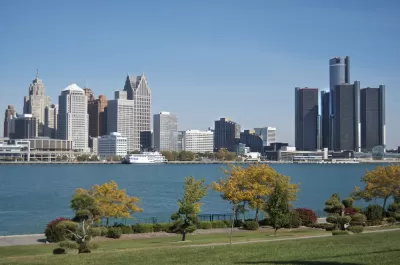
Oscar Perry Abello shares insights into the report 139 Square Miles by the nonprofit Detroit Future City.
"The report claims to be the first, comprehensive, citywide, data-driven study on the state of Detroit 'without analysis or critique.' It compiles quantitative and spatial data from a variety of sources, including the U.S. Census Bureau’s Survey of Business Owners, which is conducted every five years," according to Abello.
The article focuses on a few themes from the report, including the size of small businesses and the racial and economic segregation of neighborhoods around the city. One of the obvious takeaways is the lack of jobs located in the city.
"Even with the recent job growth, the report found that Detroit still only has 30 jobs per 100 residents (though that’s up from 25 per 100 in 2010). Among the jobs that are inside Detroit, well-paying jobs tend to be held by workers who live in the suburbs and commute into the city for work, while many Detroiters leave the city for low-paying jobs outside the city," explains Abello.
For more on the 139 Square Miles report, see also an article by John Gallagher for the Detroit Free Press.
Read the full story: These Detroit Commuting Numbers Show Stark Inequality


Comparing the Racial Segregation of U.S. Cities
The City Observatory used American Community Survey from the U.S. Census to compare the segregation of the largest U.S. cities. Portland is the most integrated American city; Detroit is the most segregated U.S. city.

Black-White Segregation Decreasing, Slowly
Segregation is decreasing, even in America’s most segregated big cities.

Report Details Racial Inequality in Four Cities
Five decades after the Fair Housing Act, racial inequality is still rampant in American cities. Trulia and the National Fair Housing Alliance collaborated on this report on four of them.

Planetizen Federal Action Tracker
A weekly monitor of how Trump’s orders and actions are impacting planners and planning in America.

California plans to bury El Niño’s downpour
If the state plays its cards right, it may be able to store a billion acre-feet of El Niño’s water in aquifers.

Chicago breaks ground on $3 billion megadevelopment
The new neighborhood, titled Foundry Park, will one day host 3,700 residences.

California High-Speed Rail Authority CEO resigns after $600,000 scandal
Under Ian Choudri, the authority used taxpayer dollars to fund first class flights and trips to nightclubs.

Want to study the Missouri River? Soon, you may need unanimous approval from 10 states
Legislation would require 10 governors’ permission to study or build projects moving water outside the basin.

Desperate measures: Advocates weigh draining Lake Powell to fill Colorado River
Draining the reservoir could reduce evaporation losses by a couple hundred thousand acre-feet.

FREE Course: Walkable City 1: Why Walkability?
After describing his path towards focusing on walkability as the essence of good planning, Jeff Speck marches through his five principal reasons for making more walkable places.
Reinventing Malls: Planning Alchemy—Turning Gray Fields Into Gold
The course focuses on the opportunities and imperatives that shape reinvention of mall sites.

City of Rosemead
Rutgers University, Edward J. Bloustein School of Planning and Public Policy
One Hundred Miles
Hunter College, City University of New York (CUNY)
The Architects Foundation
University of Cincinnati Online
City of Cambridge
Montrose County
The Pocatello Development Authority