A 33-year GIS professional lets loose his geospatial and population analysis skills on the occasion of a lifetime: today's "Great American Eclipse."



Michael Zeiler forecasted traffic impacts from eclipse-viewing visitors around the country in an impressive bit of GIS analysis.
Zeiler's analysis of the human response to this celestial event considers the "accessibility of the August 21 total solar eclipse is simultaneously a great benefit and a problem." The benefit is the chance to view a total eclipse, but the problem is the congestion resulting from something like "20 Woodstock festivals occurring simultaneously across the nation."
Zeiler's breathless appreciation of the eclipse is supplemented with a series of infographics, including a particularly fetching image of the "population access and estimated visitation" for the eclipse, which shows all the roadways people will travel and the likely viewing points for today's solar eclipse.
After presenting the infographic and detailing his methodology, Zeiler predicts the following for today's spectacle behind the spectacle: "Clearly, the state with the greatest impact on eclipse day will be South Carolina. It is the closest destination for the entire Eastern Seaboard. Other states with major impacts will be Tennessee, Missouri, and Oregon."
Other infographics in the post include "drive times to the path of totality," "population proximity to the path of totality" (i.e., 12.2 million Americans live in the path of totality), and "drivesheds of the great eclipse."
Read the full story: Predicting eclipse visitation with population statistics

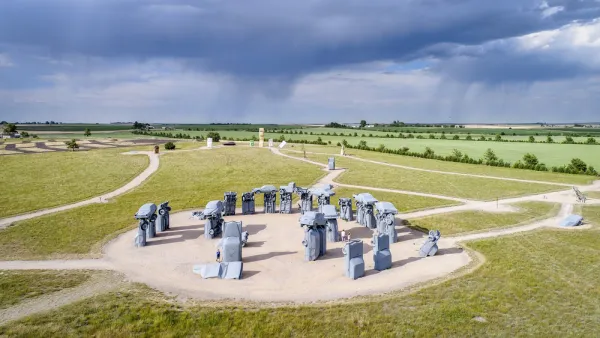
Google Maps Traffic Alerts Follow Eclipse Totality Path, Carhenge Gets the Last Laugh
Parting shots from the Great American Eclipse.
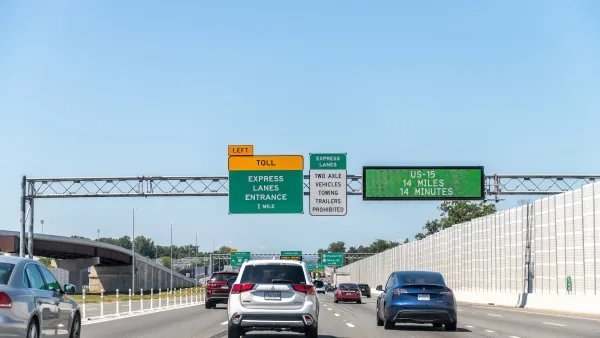
Congestion Costing Reality Check, Part 2: A congestion costing critique
There are good reasons to be skeptical of highway industry claims that traffic congestion is a growing problem. Their analysis is often incomplete and biased. Let’s pull back the curtain on some major congestion cost studies.
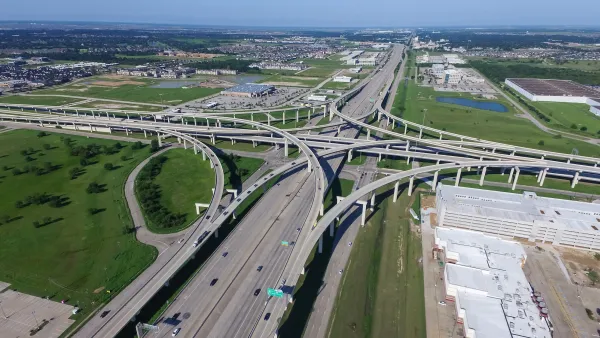
Induced demand is real: Commutes on Houston's 26-lane freeway take 51% longer after expansion
A massive freeway expansion only led to longer drive times, showing that building more lanes won't solve congestion.

Planetizen Federal Action Tracker
A weekly monitor of how Trump’s orders and actions are impacting planners and planning in America.

Amtrak, CN end decades-long dispute with eight-year agreement
The new operating agreement establishes an updated framework for the companies to work together, including processes to resolve disputes.

Judges permit Denver to divert 77,000 acre feet from the Colorado River for reservoir expansion
Overuse and climate change have caused the Colorado River’s water levels to plummet.

NYC DOT wants faster, more permanent street upgrades
The city is examining ways to build more concrete infrastructure without getting entangled in 'decades-long' projects.

'Something we’ve never seen before:' rising utility rates could strain city finances nationwide
Data centers, climate change and other factors have caused utility rates in the United States to increase by 38% since 2020.

Trump to overrule local leaders, lease millions of acres of America’s Pacific Island territories’ seafloors to mining companies
International law says that the Indigenous people of America’s territories have a right to prior and informed consent regarding projects that impact their countries.

FREE Course: Walkable City 1: Why Walkability?
After describing his path towards focusing on walkability as the essence of good planning, Jeff Speck marches through his five principal reasons for making more walkable places.
Reinventing Malls: Planning Alchemy—Turning Gray Fields Into Gold
The course focuses on the opportunities and imperatives that shape reinvention of mall sites.

Harvard University Graduate School of Design
KFH Group Inc.
Greater Baltimore Committee
The Architects Foundation
University of Cincinnati Online
The Pocatello Development Authority
The Urban Renewal Agency of the City of Pocatello