Montgomery County's plan for Bethesda calls for height bonuses in return for affordable housing. Residents neighboring the proposed incentive zones have successfully resisted that idea.



"Montgomery County wants to encourage developers to build more affordable housing in downtown Bethesda. But due to pressure from neighbors, the County Council voted to allow less affordable housing and shorter buildings instead," reports Peter Tomao.
The vote is the latest twist in the county's ongoing housing policy process, following the approval of a new plan for Downtown Bethesda earlier this year, as reported by Michael Neibauer at the time.
Now, however, the rubber is hitting the road, and the County Council spent the last week debating which areas in the master plan would be allowed new affordable housing incentives—namely, additional height in return for affordable housing allotments.
The proposed height bonuses inspired resistance from local residents. "Groups like the Coalition of Bethesda Area Residents (CBAR) wanted firm height caps on properties at the edge of downtown," according to Tomao. "After a lengthy discussion, the Montgomery County Council voted on a compromise plan that would add a handful of properties at the edge of downtown Bethesda, while reducing heights and affordable housing allotments elsewhere."
Tomao concludes the article by arguing that the decision will exacerbate an existing rental housing affordability problem in Bethesda and the region.
Read the full story: Montgomery County rejects incentives to build more affordable housing in Bethesda
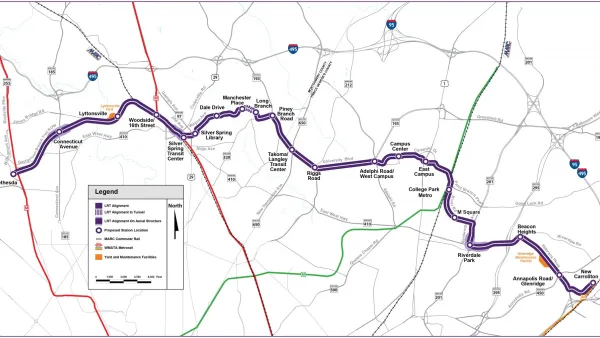
Maryland's Purple Line Clears Final Legal Obstacle
A third lawsuit tried to halt the Purple Line light rail project in Maryland, but it was just the latest lawsuit to get tossed by a judge.
Montgomery County, Maryland Updates Inclusionary Housing Requirements
New rules will require more affordable housing in affluent areas, but also allow more exceptions.
Opinion: After Rent Stabilization, More Action Needed to Make Housing Affordable
Montgomery County just passed a slew of regulatory and legislative changes aimed at improving affordable housing. One writer suggests several more.

Desperate measures: Advocates weigh draining Lake Powell to fill Colorado River
Draining the reservoir could reduce evaporation losses by a couple hundred thousand acre-feet.

Eastern Nebraska is running out of electricity
Data centers and electrification are straining eastern Nebraska’s grid, throttling economic development.

Move over, LA: St. Louis gears up for Olympics, invests millions in downtown redevelopment
The Missouri city will host the 2028 Olympic soccer group stage and knockout matches.

Mass. votes against statewide minimum lot size for single-family homes
Over 2 million residents voted on Question 7; it was decided by just over 30,000 votes.

Maryland’s $15 billion bridge project gains key approval
The Maryland Transit Authority said the project will create over 60,000 jobs and add $23 billion to the local economy.

‘No clear next steps’ for Chicago's permanent festival grounds
Eleventh Ward Ald. Nicole Lee has suggested Soldier Field as a possible location for the permanent event space.

FREE Course: Walkable City 1: Why Walkability?
After describing his path towards focusing on walkability as the essence of good planning, Jeff Speck marches through his five principal reasons for making more walkable places.
Reinventing Malls: Planning Alchemy—Turning Gray Fields Into Gold
The course focuses on the opportunities and imperatives that shape reinvention of mall sites.

City of Rosemead
Rutgers University, Edward J. Bloustein School of Planning and Public Policy
One Hundred Miles
University of Michigan School for Environment and Sustainability (SEAS)
Hunter College, City University of New York (CUNY)
The Architects Foundation
City of Cambridge
The Pocatello Development Authority
The Urban Renewal Agency of the City of Pocatello