Led by the companies Mobike and Ofo, so-called "dockless" bike sharing is all the rage in Chinese cities. Unlocked by app, the bikes can be left anywhere for the next user to pick up. There have been some hiccups.


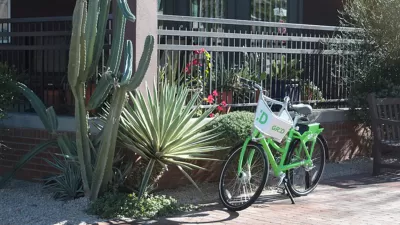
Is "dockless" bikeshare a practical possibility? Maybe, judging from the success of operators Mobike and Ofo in China. Sherisse Pham writes, "The bikes can be locked and unlocked anywhere via a smartphone app, which means users don't have to return them to designated stations."
Now, this "game-changing" approach is getting its test run outside China. "One of China's largest operators, Mobike, unleashed 1,000 of its orange-wheeled bicycles in the rainy English city of Manchester on Thursday, marking its first foray outside of Asia."
As one might expect, operating a dockless bikeshare system comes with its share of challenges. "The rapid spread of this approach across China has already thrown up problems, including mountains of discarded bikes and companies going bust [...] To try counter those kinds of problems, Mobike and Ofo track their bikes through GPS and penalize users who hide bikes or park them in inaccessible places."
This data-intensive approach lets the companies finely tailor their logistics. "Prodding users to help redistribute their bikes is possible thanks to the data Mobike and Ofo collect on the millions of people who use their service daily -- they know when bikes are sitting idle, and when high traffic areas need more service."
Read the full story: China's 'dockless' bike sharing could be coming to a street near you

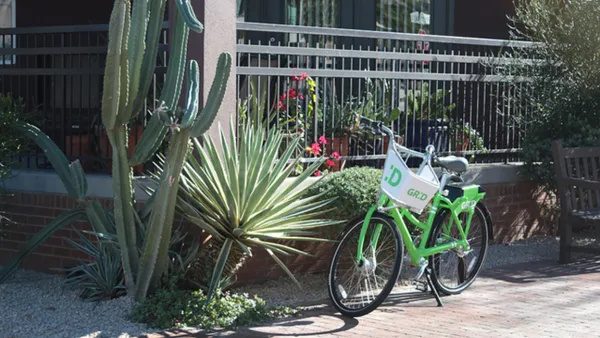
On the Pitfalls of Dockless Bikeshare
App-driven bikeshare, without the station, has been spreading rapidly, especially in China. But the system comes with its share of problems, including its own version of the tragedy of the commons.
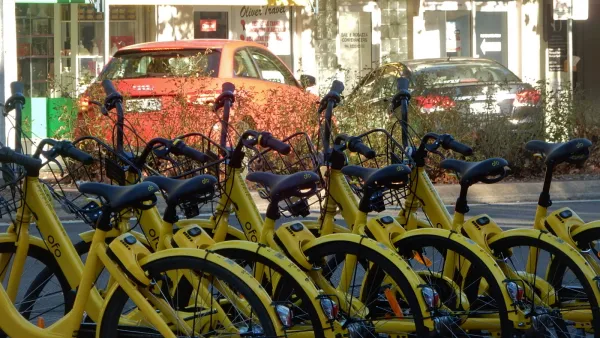
Bikeshare Startup Ofo’s Future Is Looking Dim. What Went Wrong?
The Chinese company seemed to be dominating its corner of the shared mobility market—until its dramatic downfall.
San Diego Merchants Call for Halt to Dockless Bikeshare Operations
Public bikeshare arrived in San Diego in 2014. Last month, three companies unleashed thousands of dockless bikes, cluttering sidewalks in three business districts to the chagrin of merchants who want a time-out so the city can develop regulations.

Planetizen Federal Action Tracker
A weekly monitor of how Trump’s orders and actions are impacting planners and planning in America.

Amtrak, CN end decades-long dispute with eight-year agreement
The new operating agreement establishes an updated framework for the companies to work together, including processes to resolve disputes.

Nation's most wind-powered state turns to coal as data centers increase energy demand
For the first time in decades, Iowa has increased its generation of coal power.

Alabama scores up to $2.5 billion federal loan for largest infrastructure project in state’s history
The Mobile River Bridge and Bayway Project aims to ease congestion at Alabama’s worst bottleneck.

Trump is considering data centers on 6 states' public land — some state officials say they had no idea
If the administration approves the proposed projects, data center and data center-related developments will cover 17,600 acres of public land.

Despite court ruling, Trump is keeping nearly all wind projects in the US on hold
At least 110 wind energy projects have not heard from the government since a federal judge ruled that the Trump administration's freeze on wind turbine clearances was likely illegal.

FREE Course: Walkable City 1: Why Walkability?
After describing his path towards focusing on walkability as the essence of good planning, Jeff Speck marches through his five principal reasons for making more walkable places.
Reinventing Malls: Planning Alchemy—Turning Gray Fields Into Gold
The course focuses on the opportunities and imperatives that shape reinvention of mall sites.

KFH Group Inc.
Greater Baltimore Committee
Eagle County Government
The Architects Foundation
University of Cincinnati Online
The Pocatello Development Authority
The Urban Renewal Agency of the City of Pocatello