It's not just the ears of dogs that suffer the consequences of the nation's loudest celebration—it's also our lungs. Louisville provides the proof.


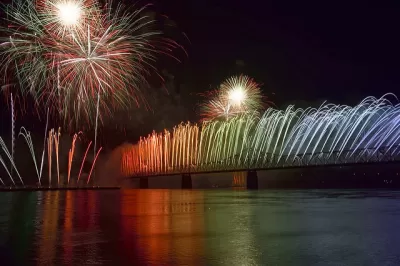
"[A]s is common for Independence Day, fireworks sent soot levels soaring in Louisville, with city monitors registered a sharp spike in the smallest particulate pollution starting around 9 p.m.," reports James Bruggers.
Louisville air quality quickly surpassed national standards (and then some), according to Bruggers. "The national standard is 35 micrograms per cubic meter, averaged over 24 hours," but on July 4, the "Watson Lane monitor climbed from 24 at 8 p.m. to 140 at 9 p.m., 166 at 10 p.m. before trailing off to 100 at 11 p.m. and 25 at midnight."
Louisville police say the combination of legal, sanctioned fireworks displays combined with illegal fireworks contribute to the poor air quality that follows Fourth of July celebrations.
Read the full story: Fireworks may have been a blast, but they sent Louisville pollution levels soaring

Enviros Want To Nix Fireworks on the Fourth: Locals Say Nay
In pollution-heavy San Joaquin Valley of California's Central Valley, some cities are considering replacing Fourth of July fireworks with laser light shows. Locals aren't so sure.
Cash-Strapped Cities Ditch Fourth of July Fireworks
Tight budgets are causing cities across the country to skip fireworks displays for their Fourth of July celebrations.
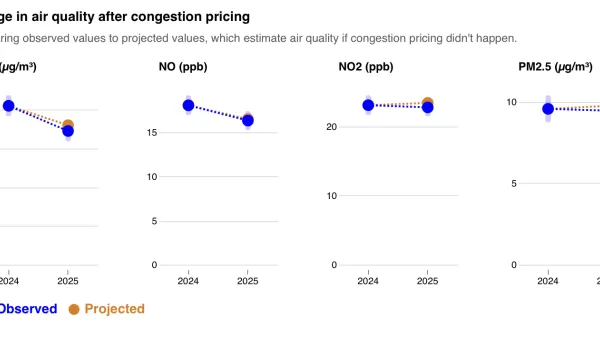
First study of NYC congestion zone’s air quality impact shows improvements
The study also examined air quality around freeways which experts worried would see increased traffic from people avoiding the tolls.

Planetizen Federal Action Tracker
A weekly monitor of how Trump’s orders and actions are impacting planners and planning in America.

‘Going backwards:’ Baltimore mayor, students rally against state's transit funding plan
Maryland's proposed six-year plan provides no funding for Baltimore’s BMORE bus program and reduces its road maintenance funding.

Detroit to transform waterfront with $2.2 billion investment
Developers will convert about 18 acres of unused parking lot space into civic spaces.

Data center developers are using lawsuits, cash offers to ‘overwhelm’ rural America
Newsrooms in five states worked together to uncover the tactics big tech developers use to buy land from reluctant communities.

U.S.-Iran war may have ‘devastating’ impact on cost to warm homes
Vermont and Maine residents may see a 76% increase in the cost of warming their homes this winter.

Senate bill would ‘overhaul’ environmental permitting laws
Under the proposed act, government agencies would also not be able to suspend or rescind permits after granting them.

FREE Course: Walkable City 1: Why Walkability?
After describing his path towards focusing on walkability as the essence of good planning, Jeff Speck marches through his five principal reasons for making more walkable places.
Reinventing Malls: Planning Alchemy—Turning Gray Fields Into Gold
The course focuses on the opportunities and imperatives that shape reinvention of mall sites.

One Hundred Miles
County of Mendocino
planning NEXT
The Architects Foundation
University of Cincinnati Online
Montrose County
Northern Illinois Transit Authority (NITA)
The Pocatello Development Authority