Denver has approved a new Tourism Improvement District to help cover the cost of the $233 million expansion project at the Colorado Convention Center in Denver.



"Hotel industry leaders received a green light Monday from the Denver City Council to initiate a new kind of tourism tax that would help pay for a rooftop expansion on the Colorado Convention Center," reports Jon Murray.
"The city’s convention center project calls for an 80,000-square-foot ballroom and a 50,000-square-foot outdoor terrace with mountain and downtown views, built atop the existing parking garage," adds Murray. "The project also includes technology upgrades and renovations of three downstairs lobbies."
Hotels will still need to approve the district, which will add a one percent surcharge when staying at Denver hotels with more than 50 rooms. There are actually several layers of approvals required from the hotel industry, as Murray details in the article. The cost of the project has increased a great deal since the original proposal—up to $233 million from $104 million.
Read the full story: Hotel tax proposal tied to convention center wins Denver council’s OK, paving way for possible owner vote
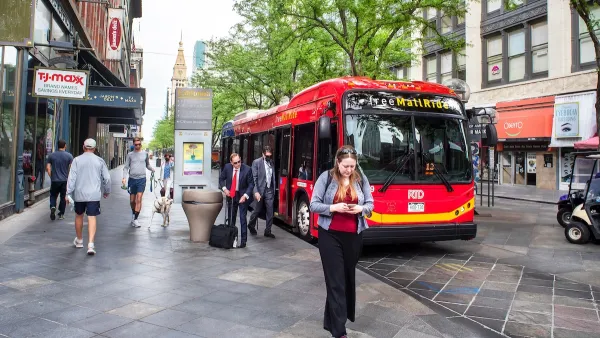
One of Denver’s busiest corridors to gain BRT
The project will span 18 miles and contain 74 bus rapid transit stations.

Learning loss and urban schools, part 2
Did test scores in progressive cities drop more post-COVID than test scores in moderate ones?

Denver is solving homelessness. Why aren't the rest of us?
Since 2023, Denver's street homeless population has decreased by 64%, proving that effective tools exist to support those in need of housing.

Planetizen Federal Action Tracker
A weekly monitor of how Trump’s orders and actions are impacting planners and planning in America.

California plans to bury El Niño’s downpour
If the state plays its cards right, it may be able to store a billion acre-feet of El Niño’s water in aquifers.

Desperate measures: Advocates weigh draining Lake Powell to fill Colorado River
Draining the reservoir could reduce evaporation losses by a couple hundred thousand acre-feet.

Housing is the top priority of Seattle’s sole new councilmember
Jenks campaigned on building 1,000 new units of affordable housing.

New tax cuts may slash $1.5 billion in funding for Miami transit, public parks
Amendment 3 will save Miami-Dade homeowners $2,700 in 2028.

Arizona, Wisconsin, Pennsylvania hope to finally advance climate goals post-midterms
The three states have spent years under Republican or divided control.

FREE Course: Walkable City 1: Why Walkability?
After describing his path towards focusing on walkability as the essence of good planning, Jeff Speck marches through his five principal reasons for making more walkable places.
Reinventing Malls: Planning Alchemy—Turning Gray Fields Into Gold
The course focuses on the opportunities and imperatives that shape reinvention of mall sites.

City of Rosemead
Rutgers University, Edward J. Bloustein School of Planning and Public Policy
One Hundred Miles
University of Michigan School for Environment and Sustainability (SEAS)
Hunter College, City University of New York (CUNY)
The Architects Foundation
City of Cambridge
Montrose County
The Pocatello Development Authority