The Internet of Things is quickly taking over roads, even before cars start driving themselves en masse around the world.



"General Motors Co. is testing a safety feature in Macomb County to warn drivers that traffic signals are about to turn red," reports Melissa Burden.
According to Burden, the new feature is just one of several new technologies demonstrating southeast Michigan as "a leader in developing 'connected' roads and traffic signals that will 'talk' directly to the next generation of cars."
"The Michigan Department of Transportation and Macomb County are two of the government units working with carmakers and auto suppliers in testing of the life-saving technology," according to Burden. The state's investments include "at least 100 miles of 'connected” highway corridors with roadway sensors for testing in Metro Detroit, with plans to grow to some 350 miles." Macomb County has implemented a series of public-private partnerships "piggybacking off the county’s recent infrastructure investments." The county also has a $13.5 million Communications and Technology Center that "brings together traffic-monitoring, weather-mapping, road-department cameras and a video wall with 40 monitors."
One of the highlights of the article is the explanation of roadside signs with "black-and-white 2D codes" that resemble QR codes—except these signs are designed for cars, not phones. 3M Co. provided the codes and enabled cars can access information like exact locations, warnings about upcoming work zones, and estimated wait times.
Read the full story: GM testing smart road tech with MDOT, Macomb Co.


New Federal Grant Rules Could Kill Detroit Road Diets
Millions in federal dollars for safe streets could be in jeopardy after federal agencies changed conditions for grant funding.

Detroit and Michigan on the Upswing
It's been 66 years since the Motor City last grew its population. Census data released last month revealed an increase of nearly 2,000 people last year, nearly half the state's population growth.
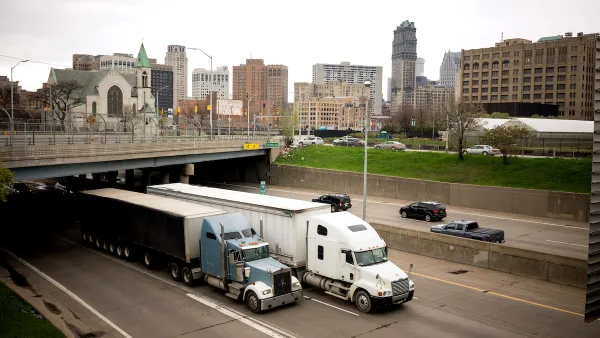
Detroit Metro Testing ‘Smart Road’ Tech
Sensors installed along a segment of Interstate 94 could help improve safety, limit speeding, and alert officials to potholes and debris.

Planetizen Federal Action Tracker
A weekly monitor of how Trump’s orders and actions are impacting planners and planning in America.

‘Going backwards:’ Baltimore mayor, students rally against state's transit funding plan
Maryland's proposed six-year plan provides no funding for Baltimore’s BMORE bus program and reduces its road maintenance funding.
Mamdani sent nearly 6,000 pied-à-terre tax warnings to homes that didn’t qualify
A judge has ordered the administration to cancel thousands of pied-à-terre tax notices after it sent 35% of them erroneously.

Mamdani sent nearly 6,000 pied-à-terre tax warnings to homes that didn’t qualify
A judge has ordered the administration to cancel thousands of pied-à-terre tax notices after it sent 35% of them erroneously.

Detroit to transform waterfront with $2.2 billion investment
Developers will convert about 18 acres of unused parking lot space into civic spaces.

‘Going backwards:’ Baltimore mayor, students rally against state's transit funding plan
Maryland's proposed six-year plan provides no funding for Baltimore’s BMORE bus program and reduces its road maintenance funding.

FREE Course: Walkable City 1: Why Walkability?
After describing his path towards focusing on walkability as the essence of good planning, Jeff Speck marches through his five principal reasons for making more walkable places.
Reinventing Malls: Planning Alchemy—Turning Gray Fields Into Gold
The course focuses on the opportunities and imperatives that shape reinvention of mall sites.

City of Thousand Oaks
City of Wisconsin Rapids
Harvard University Graduate School of Design
The Architects Foundation
University of Cincinnati Online
Northern Illinois Transit Authority (NITA)
The Pocatello Development Authority
The Urban Renewal Agency of the City of Pocatello