Couch Court in Portland's central city is one of those rare pieces of public right of way where pedestrians and people on bikes rule.


"To improve circulation of vehicle traffic through a very fast-growing part of the central city, the Portland Bureau of Transportation decided to expand the road network," writes Jonathan Maus. "With two new lanes, people can now travel on a new road between NE 3rd Avenue and Couch Street."
Get the sense that something is amiss? Why is one of the country's leading bike advocates celebrating the opening of a new street in the downtown urban core of one of the most multi-modal cities in the country? Well, "in this case it’s fine because the new street is carfree." In fact, writes Maus, "[i]t’s the most efficient and humane way to utilize this important space adjacent to three new buildings that tower over the east end of the Burnside Bridge and have a combined 300 residential units and over 100,000 square feet of office and retail space."
Couch Court, as the new car-free street is called, is only 130 feet long, but it accommodates a 14-foot wide bikeway and two sidewalks. "As for design elements, it’s pretty straightforward," writes Maus. "I really like the angle of the mountable curbs used throughout. One thing to watch for is whether or not this becomes a popular plaza — where people on foot wander into the bikeway."
Maus includes a bunch of images to supplement his words—it's definitely worth a look.
Read the full story: Portland’s newest and smallest street is also carfree

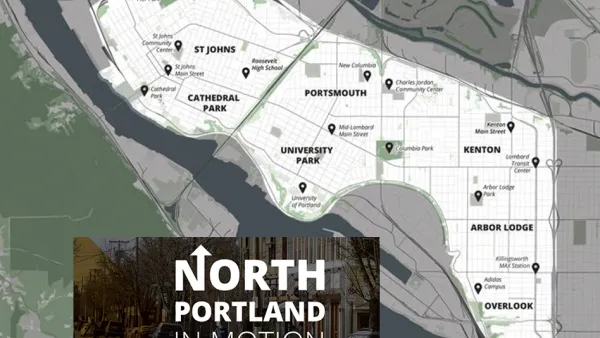
North Portland in Motion Launches with Goals to Improve Walking, Biking, and Transit
The Portland Bureau of Transportation continues its work of drafting transportation plans targeted to specific geographic corners of the city,
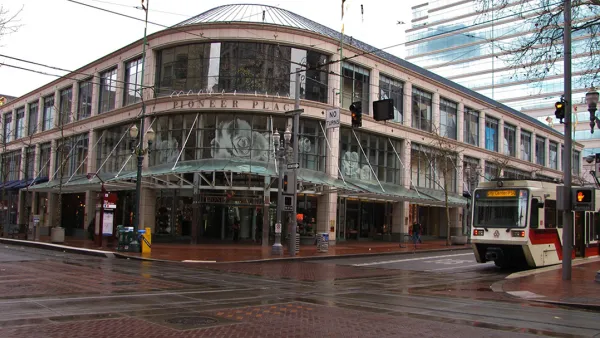
Business Community Weigh In on Portland's Downtown Multi-Modalism Plans
A potentially game-changing suite of transit and active transportation projects is under consideration in Portland. The business community has reservations, but is also strongly supportive of aspects of the plan.
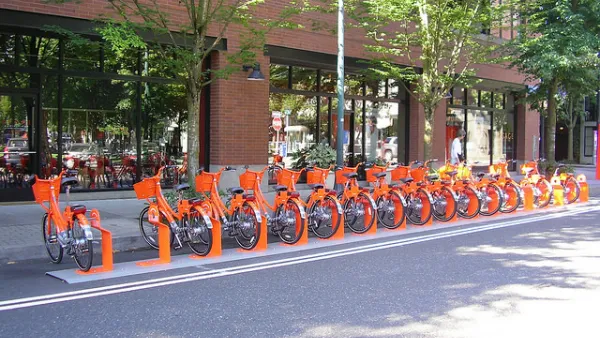
Portland Bikeshare Drawing Big Crowds in First Six Months
Users of Portland's Biketown bikeshare system are choosing to rent bikes instead of driving.

Planetizen Federal Action Tracker
A weekly monitor of how Trump’s orders and actions are impacting planners and planning in America.

The state-sanctioned urbicide of Austin
People don’t kill cities. Freeways do.

US to reduce Colorado River water deliveries to Mexico
A new Colorado Treaty amendment reduces Mexico’s Colorado River water allocation by 250,000 acre feet.

Nation's most wind-powered state turns to coal as data centers increase energy demand
For the first time in decades, Iowa has increased its generation of coal power.

NYC cools commuters with city's first rain garden above a bus stop
New York City officials say the plants in the rain garden can absorb 16 gallons of rainwater during heavy storms.

Brightline West’s future may rely on $6 billion federal loan
The company has until Nov. 2 to make a $400 million equity investment into its proposed high-speed rail line.

FREE Course: Walkable City 1: Why Walkability?
After describing his path towards focusing on walkability as the essence of good planning, Jeff Speck marches through his five principal reasons for making more walkable places.
Reinventing Malls: Planning Alchemy—Turning Gray Fields Into Gold
The course focuses on the opportunities and imperatives that shape reinvention of mall sites.

Greater Baltimore Committee
Eagle County Government
Harvard University Graduate School of Design
The Architects Foundation
University of Cincinnati Online
The Pocatello Development Authority
The Urban Renewal Agency of the City of Pocatello
Journal of the American Planning Association