Along with Hamtramck, Highland Park is one of two tiny cities entirely surrounded by the city of Detroit. Here's how its leaders want its center to develop over the next five to ten years.


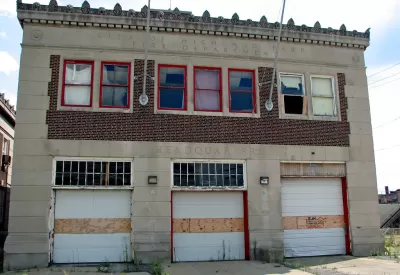
It's not actually part of Detroit, giving Highland Park some local leeway in how it wants to handle redevelopment. Tasked to create plans for the next 2, 5, and 10 years by Mayor Hubert Yopp, "[Tax Increment Financing Authority] Board chair Theresa Johnson plans on focusing first on demonstrating that there is demand for development, through community-driven, targeted, short term wins in multi-modal infrastructure, activated public spaces, and pop-up experiences."
MKSK Studios has put together plans incorporating those elements. Here, Robin Runyan gives us a look at this "bold vision" for the city. In context, Highland Park lies along what could be a key corridor for rejuvenation outside of downtown Detroit.
"In it, we see opportunities for increased public space, adaptive reuse of historic buildings, an emphasis on pedestrian safety, increased retail opportunity, and taking advantage of the Inner Circle Greenway, connecting neighborhoods of Detroit with Highland Park, Hamtramck, and Dearborn in a non-motorized capacity."
Read the full story: A bold vision for Highland Park

Bad Bets on Detroit Housing Speculation
When investors from Belgium and elsewhere snapped up Detroit houses for a song, some of them didn't consider the full picture. The lesson: do your research, and maybe don't invest thousands of miles form home.

GM's Electric Vehicle Future Arrives Early in Detroit-Hamtramck
GM's first non-internal combustion engine vehicle assembly plant will be in the form of 35-year-old plant straddling the Detroit-Hamtramck border thanks in part to a $2.27 billion state tax credit. Electric pickups, SUVs, and AVs will be produced.
Digging Into the Data on Detroit's 'Recovery'
In key areas like jobs and housing, the numbers show a definite Motor City rebound since the recession. But a closer look reveals uneven gains and weakness next to state averages.

Planetizen Federal Action Tracker
A weekly monitor of how Trump’s orders and actions are impacting planners and planning in America.

Eastern Nebraska is running out of electricity
Data centers and electrification are straining eastern Nebraska’s grid, throttling economic development.

Study reveals best places in the U.S. for cycling, walking
New research from Streetlight Data examines bicycle and pedestrian miles per capita in the 100 largest U.S. cities by population.

Federal government nominates new FTA administrator
Mark Aesch is currently the founder and CEO of a transportation management consulting firm.

Developers reveal $10 billion stadium plan as ‘Hail Mary’ to keep Bears in Chicago
The plan would also boast a public park, high- and mid-rise buildings and a youth sports complex.

As Texas embraces carbon storage, a Black community questions the risks
Texas now issues permits for companies to store carbon dioxide underground. East Texas residents fear safety risks, and skeptics doubt the climate benefits.

FREE Course: Walkable City 1: Why Walkability?
After describing his path towards focusing on walkability as the essence of good planning, Jeff Speck marches through his five principal reasons for making more walkable places.
Reinventing Malls: Planning Alchemy—Turning Gray Fields Into Gold
The course focuses on the opportunities and imperatives that shape reinvention of mall sites.

City of Rosemead
Rutgers University, Edward J. Bloustein School of Planning and Public Policy
One Hundred Miles
University of Michigan School for Environment and Sustainability (SEAS)
Hunter College, City University of New York (CUNY)
The Architects Foundation
City of Cambridge
The Pocatello Development Authority
The Urban Renewal Agency of the City of Pocatello