San Francisco's Great Highway is losing great chunks of asphalt to the ocean. A new plan intends to change that.


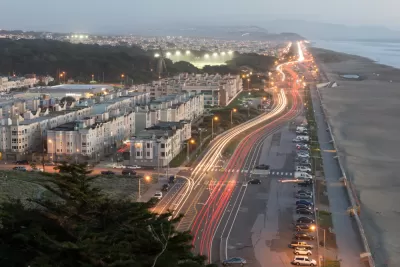
More than a hundred years ago, San Francisco built the Great Highway close to the Pacific Coast. Lamar Anderson argues that the city made a bad bet when it pitted the road against the tides. "The city has been paying for that naïveté ever since, in frequent closures on the Great Highway (at least 23 this fall and winter) and in chunks of asphalt, which are breaking off the roadway and parking lots along southern Ocean Beach as the waves undermine the highway," Anderson writes in San Francisco Magazine.
A new plan would narrow the highway to one lane in each direction and put a bike path in the new space. "The designs balance maintaining the road for as long as is feasible and mixing in recreational features, including a new coastal trail south of Sloat Boulevard," Anderson reports. But the plan represents more than an expansion of the city’s bike infrastructure. Anderson says: "The move is a belated acknowledgment that it’s the road that’s in the wrong place, not the ocean.”
Read the full story: How to Make the Great Highway Great Again

Battle Over San Francisco's Pedestrianized 'Great Highway'
Although the project has been hugely successful with local residents, the mayor and some county supervisors wanted to revert the road to vehicle use.
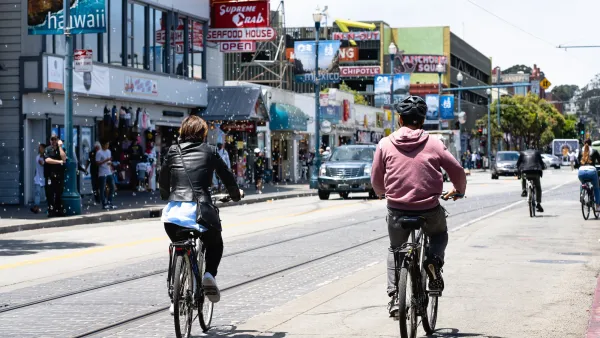
San Francisco's dissolved bike committee holds its last meeting
The bicycle advisory committee has been advocating for safer streets for over 35 years.
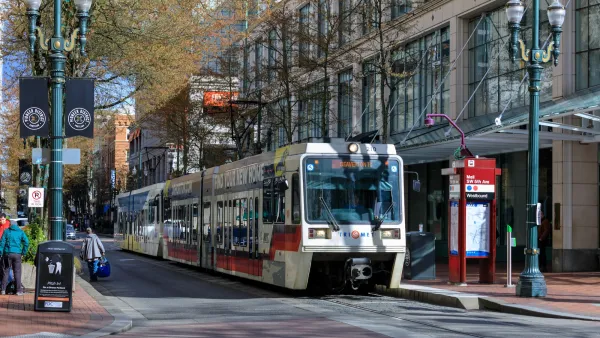
February Must-Reads: Top 10 Articles From Last Month
Transit agencies like BART and TriMet face lingering budget shortfalls, forcing major service cuts and layoffs, while federal plans to ban fare-free transit throw a wrench in NYC Mayor Mamdani’s proposal to make the city’s buses ‘fast and free.’

Planetizen Federal Action Tracker
A weekly monitor of how Trump’s orders and actions are impacting planners and planning in America.

California plans to bury El Niño’s downpour
If the state plays its cards right, it may be able to store a billion acre-feet of El Niño’s water in aquifers.

Desperate measures: Advocates weigh draining Lake Powell to fill Colorado River
Draining the reservoir could reduce evaporation losses by a couple hundred thousand acre-feet.

Housing is the top priority of Seattle’s sole new councilmember
Jenks campaigned on building 1,000 new units of affordable housing.

New tax cuts may slash $1.5 billion in funding for Miami transit, public parks
Amendment 3 will save Miami-Dade homeowners $2,700 in 2028.

Arizona, Wisconsin, Pennsylvania hope to finally advance climate goals post-midterms
The three states have spent years under Republican or divided control.

FREE Course: Walkable City 1: Why Walkability?
After describing his path towards focusing on walkability as the essence of good planning, Jeff Speck marches through his five principal reasons for making more walkable places.
Reinventing Malls: Planning Alchemy—Turning Gray Fields Into Gold
The course focuses on the opportunities and imperatives that shape reinvention of mall sites.

City of Rosemead
Rutgers University, Edward J. Bloustein School of Planning and Public Policy
One Hundred Miles
University of Michigan School for Environment and Sustainability (SEAS)
Hunter College, City University of New York (CUNY)
The Architects Foundation
City of Cambridge
Montrose County
The Pocatello Development Authority