The team at Strong Towns is taking an in-depth look at Amazon, with a week of events, including the point-counterpoint series shared here.


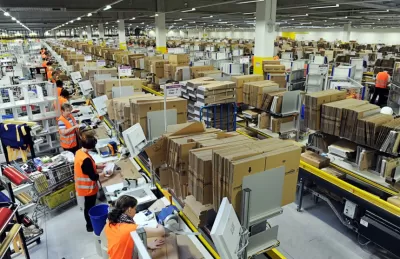
Kea Wilson writes an entreaty for planners and others concerned about the built environment to devote more considerations to the impacts of the growing popularity of online retailer Amazon.
Wilson begins the article by acknowledging the considerable time and energy devoted to critiquing the negative externalities of big box stores. Wilson's appeal to the audience: Amazon could be just as detrimental to the built environment as big box retail has been.
Wilson then lists a few reasons for skepticism toward a future of Amazon-enabled retail, such as Amazon's effect for property and sales tax revenues, Amazon's track record of eliminating jobs, and the casualties in Main Street businesses that will join the loss of larger, national brands.
Responding to the request to focus on Amazon, Charles Marohn has already penned a response. Marohn disagrees with Wilson, first by saying he doesn't dislike Walmart, and then by arguing that the "Amazon benefit" won't last. His larger point is that companies like Walmart and Amazon are taking advantage of a bad game with bad rules. "If you don't like the game, change the rules," writes Marohn, referencing earlier Strong Towns coverage of big box stores.
Read the full story: Why Urbanists Need to Talk About Amazon
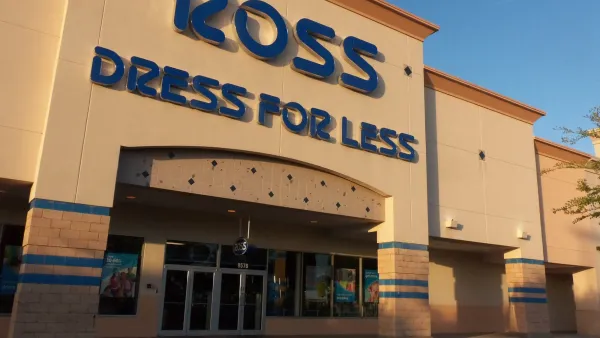
Ross May Be Immune from the Amazon Effect
Ross Stores continues its expansion in the face of a much-foretold retail apocalypse. The shopping experience it provides may be one reason it can stand up to Amazon.
Envisioning a Future Urban Dronescape
Jeff Bezos' proposal to deliver packages by aerial drone has the potential to upset traditional models of logistics and distribution, but it's most powerful effect may be on the urban airspace. Are blue skies ahead for Bezos' vision?

Desperate measures: Advocates weigh draining Lake Powell to fill Colorado River
Draining the reservoir could reduce evaporation losses by a couple hundred thousand acre-feet.

Eastern Nebraska is running out of electricity
Data centers and electrification are straining eastern Nebraska’s grid, throttling economic development.

Malls are becoming the midtowns of the future
Mall and office park redevelopments are a generational opportunity to create new nodes of urbanity.

NYC breaks ground on anti-flooding infrastructure project
New York City's new system will reduce stormwater flows to local sewers by 90%.

One Kentucky town’s secret to affordable housing
The Smoketown Community Land Trust has already built seven affordable homes for community members.

Houston gains petal-shaped cooling infrastructure to make streets more ‘delightful’
The city has installed the pavilions along 15 blocks in Houston.

FREE Course: Walkable City 1: Why Walkability?
After describing his path towards focusing on walkability as the essence of good planning, Jeff Speck marches through his five principal reasons for making more walkable places.
Reinventing Malls: Planning Alchemy—Turning Gray Fields Into Gold
The course focuses on the opportunities and imperatives that shape reinvention of mall sites.

City of Rosemead
Rutgers University, Edward J. Bloustein School of Planning and Public Policy
One Hundred Miles
University of Michigan School for Environment and Sustainability (SEAS)
Hunter College, City University of New York (CUNY)
The Architects Foundation
City of Cambridge
Montrose County
The Pocatello Development Authority