Chicago Cubs fans looking to bask in the glory of the team's first World Series victory since 1908 will find a new public plaza and lawn next to the stadium. The plaza will be open to the public on non-baseball days too.


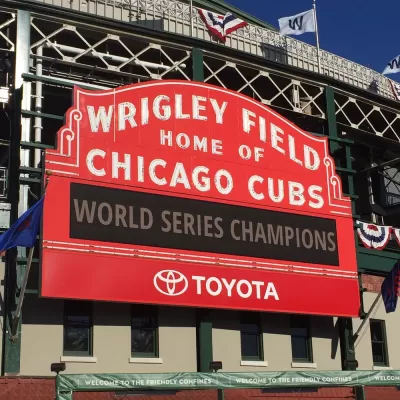
"For better or for worse, Wrigleyville is changing rapidly as Wrigley Field undergoes a continuing makeover, and a seven-story hotel and a huge mixed-used development are constructed next to the ballpark," according to an article by John Greenfield.
Overall, Greenfield sees a mixed-bag of planning decisions, as evaluated relative to the area's already existing walkability and transit-friendly bonafides. Greenfield takes a longer look at one positive change in particular: the addition of a plaza and lawn on the west side of the stadium—the site of a former surface parking lot.
"Although there were originally plans to replace the lot with a parking garage, four years ago the Ricketts family, which purchased the Cubs and ballpark in 2009, proposed the much wiser option of a community gathering place," writes Greenfield. "The space will host a farmers market and outdoor movies during the summer, and a skating rink during the winter."
Read the full story: The New Park at Wrigley Takes Space Away from Cars and Gives It to People
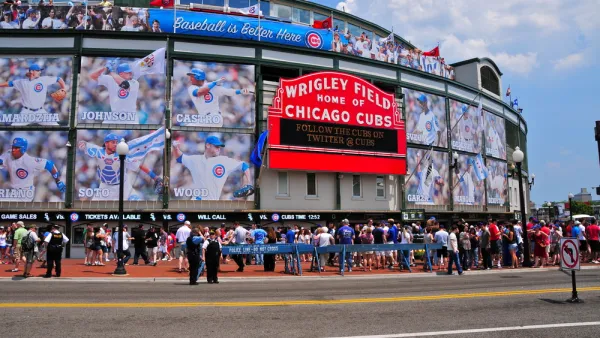
City Nixes Idea to Shut Down More Streets for Cubs Games
Any open streets benefits for a proposal to shut down Clark and Addison streets near Wrigley Field would have been secondary to security concerns—but it's all conjecture after the Mayor's Office nixed the idea.
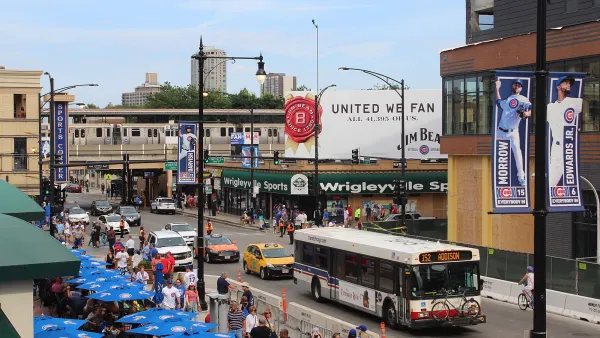
New Development Continues in Wrigleyville
New mixed-use projects bring residential units, retail, and entertainment venues to the neighborhood surrounding Chicago's Wrigley Field as stadium-adjacent development grows in popularity.
Dynamic Parking Prices Lack Political Will, Local Support Near Wrigley Field
Setting the example for the rest of city was too tough a pill to swallow for businesses located near Wrigley Field.

Planetizen Federal Action Tracker
A weekly monitor of how Trump’s orders and actions are impacting planners and planning in America.

California plans to bury El Niño’s downpour
If the state plays its cards right, it may be able to store a billion acre-feet of El Niño’s water in aquifers.

Desperate measures: Advocates weigh draining Lake Powell to fill Colorado River
Draining the reservoir could reduce evaporation losses by a couple hundred thousand acre-feet.

Seattle passes record-breaking transit services expansion
Proposition 1 will double the city’s transit tax to add 95,000 more bus trips and preserve 180,000 bus trips annually.

Post election, Texas is no longer Musk’s 'AI oasis'
Elon Musk dolled out $446 million on the 2026 midterms, the most ever spent by a non-canidate.

Chicago voters approve permanent festival grounds, penalty for vacant property owners
Currently, major summer and fall festivals take over public parks for weeks at a time, drawing criticism from nearby residents

FREE Course: Walkable City 1: Why Walkability?
After describing his path towards focusing on walkability as the essence of good planning, Jeff Speck marches through his five principal reasons for making more walkable places.
Reinventing Malls: Planning Alchemy—Turning Gray Fields Into Gold
The course focuses on the opportunities and imperatives that shape reinvention of mall sites.

City of Rosemead
Rutgers University, Edward J. Bloustein School of Planning and Public Policy
One Hundred Miles
Hunter College, City University of New York (CUNY)
The Architects Foundation
University of Cincinnati Online
City of Cambridge
Montrose County
The Pocatello Development Authority