The Wall Street Journal received lots of press packages from firms bidding to build the proposed wall between the border of the United States and Mexico. A gallery of renderings—sent in earnest, in protest, or in a crass marketing ploy—follows.


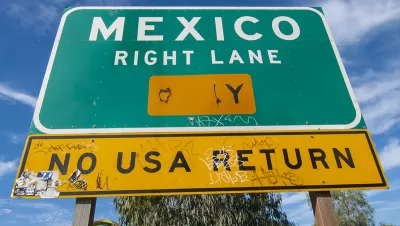
"Some companies interested in helping design and build a wall along the U.S. border with Mexico have submitted renderings of their vision for the barrier," reports Taylor Umlauf.
U.S. Customs and Border Protection asked for two designs, one made of concrete and another made of "alternative metal" in keeping with the campaign promises of President Donald Trump. Potential contractors had until Tuesday of this week to submit plans.
The current phase of the project solicitation did not require prospective contractors to send renderings, but some did anyways, according to Umlauf. The gallery of renderings included in the article showcases the project's marketing potential—for better or worse, many companies are trying to make a name for themselves by responding to the solicitation. View the gallery after the jump.
Update: The San Diego Union-Tribune also has published a slideshow showing many of the same renderings as The Wall Street Journal.]
Read the full story: Visions of Trump’s Border Wall
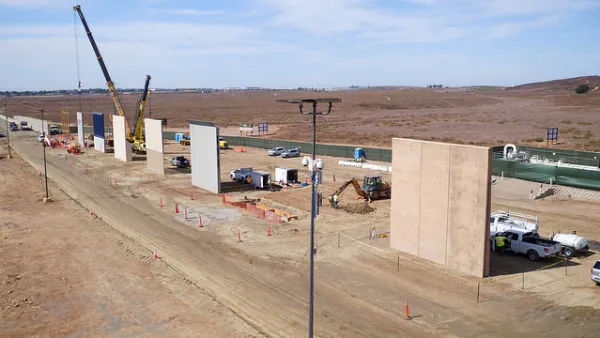
Homeland Security Waives More Than 30 Laws to Expedite Border Wall
In the drive to begin construction in New Mexico, the Trump Administration has bypassed dozens of federal environmental regulations.
Prototypes for Trump's Border Wall Now on View in California
The U.S.-Mexico border between San Diego and Tijuana received eight controversial additions over the weekend.
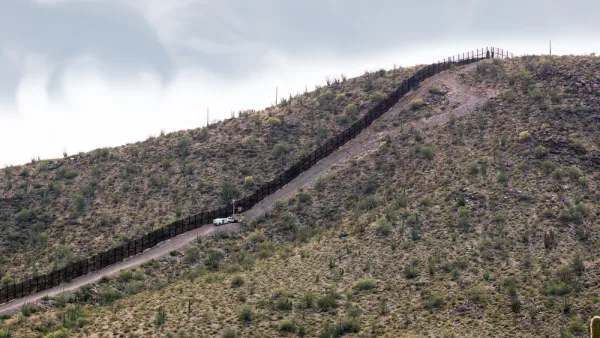
Four Companies Selected to Build Prototypes of Trump's Border Wall
In what was called a "significant milestone" by U.S. Customs and Border Protection officials, Trump's controversial border wall project has shown its first tangible results.

Planetizen Federal Action Tracker
A weekly monitor of how Trump’s orders and actions are impacting planners and planning in America.

Eastern Nebraska is running out of electricity
Data centers and electrification are straining eastern Nebraska’s grid, throttling economic development.

Study reveals best places in the U.S. for cycling, walking
New research from Streetlight Data examines bicycle and pedestrian miles per capita in the 100 largest U.S. cities by population.

DSA members accuse Mamdani of 'abandoning values' over housing redevelopment
New York City's mayor plans to replace about 2,000 units of public housing with private, mixed-income housing.

All sides of BRT debate unhappy with CDOT’s most recent move
The Colorado Department of Transportation is no longer considering center-running bus lanes for Colorado Boulevard.

Massachusetts bogs generate both power, and cranberries
Putting solar panels above farmland is one way Massachusetts is advancing toward its goal of net-zero carbon emissions by 2050.

FREE Course: Walkable City 1: Why Walkability?
After describing his path towards focusing on walkability as the essence of good planning, Jeff Speck marches through his five principal reasons for making more walkable places.
Reinventing Malls: Planning Alchemy—Turning Gray Fields Into Gold
The course focuses on the opportunities and imperatives that shape reinvention of mall sites.

City of Rosemead
Rutgers University, Edward J. Bloustein School of Planning and Public Policy
One Hundred Miles
University of Michigan School for Environment and Sustainability (SEAS)
Hunter College, City University of New York (CUNY)
The Architects Foundation
City of Cambridge
The Pocatello Development Authority
The Urban Renewal Agency of the City of Pocatello