In contrast to other California cities, seaside Santa Barbara is successfully reducing its homeless population. Local advocates cite a tight-knit network of service providers.



With a population of 90,000, Santa Barbara isn't one of California's largest urban areas. But its anti-homelessness efforts might prove instructive: "the 2017 [homeless] count revealed that at least 790 homeless people reside in Santa Barbara, down from 1,040 in 2011." Kate Wheeling covers the city's strategy, which involves coordinating a network of service providers through a central organization, the Central Coast Collaborative on Homelessness (C3H).
According to C3H executive director Chuck Flacks, the solution to homelessness isn't a mystery. "It's really about getting to know each of the people on the street, getting to know their needs, getting them into housing, and getting them the services they need to keep them housed."
"'Homeless people are more like a canary in a coal mine,' Flacks said. 'The homeless population tends to reflect some of the things that are broken in a system … mental health, alcohol and drug problems, and lack of housing.'"
FULL STORY: How One Small Town Is Turning a Corner on a Big Homeless Crisis

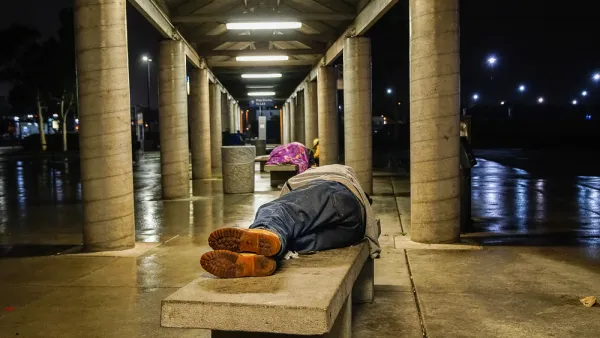
Homeless Counts Fall Short in Gathering Accurate Statistics
Assessing the scale of homelessness in the United States is surprisingly difficult, with statistics failing to capture the diversity of unhoused people and their situations.
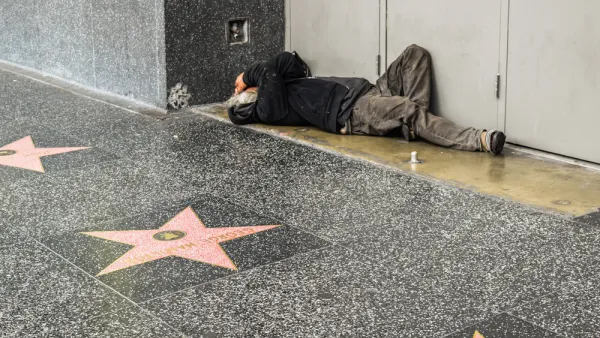
Alternative Analysis Pegs L.A. Homeless Count at Over 100,000
Casting doubt on an official estimate of around 52,000, researchers at a Los Angeles-based nonprofit put the number at close to double that level. That's accounting for anyone who became homeless at some point during the year.

Omaha Homeless Services Providers Struggle to Keep Up
With the worst of winter weather ahead, shelter providers say there are not enough beds to meet the rising rate of homelessness in the city.

The state-sanctioned urbicide of Austin
People don’t kill cities. Freeways do.

US to reduce Colorado River water deliveries to Mexico
A new Colorado Treaty amendment reduces Mexico’s Colorado River water allocation by 250,000 acre feet.

New Jersey’s second-largest city bans standalone data centers
Jersey City will continue to allow co-location facilities, such as those meant for research institutions that store their own data.

Amtrak not solely to blame for New Jersey commuter rail's unreliability, report finds
A new study from the Garden State Initiative found that NJ Transit’s budget grew 20% across a 4 year period, but reliability declined significantly over the same period.

EPA erases limits on planet-warming pollution from power plants
Under Monday’s plan, power plants would still have some limits on how much mercury, arsenic and other contaminants they can emit.

Phoenix announces new on-demand transit service, more frequent RAPID buses
Both new services will launch in October, and are part of Phoenix's Project Effective Access Solutions for Easing Congestion.

FREE Course: Walkable City 1: Why Walkability?
After describing his path towards focusing on walkability as the essence of good planning, Jeff Speck marches through his five principal reasons for making more walkable places.
Reinventing Malls: Planning Alchemy—Turning Gray Fields Into Gold
The course focuses on the opportunities and imperatives that shape reinvention of mall sites.

Eagle County Government
Harvard University Graduate School of Design
Nashville Planning Department
The Architects Foundation
University of Cincinnati Online
The Pocatello Development Authority
The Urban Renewal Agency of the City of Pocatello
Journal of the American Planning Association