With a surplus of unsold billboard spaces dotting Los Angeles, artists are using the empty spaces as canvasses for new forms of public art.



Billboard owners in Los Angeles and other cities across the country challenged by too much supply and too little demand have found a new life for their vacant advertising spaces. Jori Finkel of The Art Newspaper reports on the ongoing arts programming organized by The Billboard Creative and others to use some of these vacant billboards to display works by contemporary artists. Similar programs by LAX Art and the U.K.'s Art Below have placed art on regular and digital billboards across Los Angeles.
Mona Kuhn, the photographer who organised The Billboard Creative shows for the past two years, says the format is a natural for the city, going back to the 1960s when artists such as Ed Ruscha were painting billboards on canvas. “We live in a car culture; our largest audience is not sitting still but commuting,” she says. “Some of our locations have 200,000 cars passing weekly.”
As Kuhn explains, the city has so many commercial billboards that The Billboard Creative was able to rent surplus sites at a heavy discount from companies Out Front and Clear Channel in December, their slowest month for attracting advertisers. She adds that plans to take the project to San Francisco or Detroit have not panned out yet, partly because there are fewer billboards available.
Finkel notes that art integrated into billboards as a permanent component is also being pushed in West Hollywood, where digital billboards on the Sunset Strip are required to program for 13 minutes of video art displays every hour.
Read the full story: Artists go large on Los Angeles’s billboards
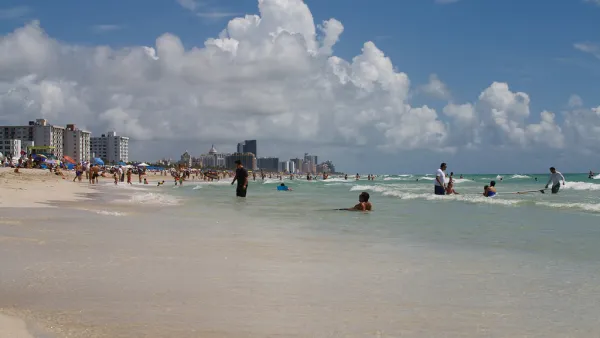
Miami Beach's Floating Billboards: A Nuisance on Water
The picturesque ocean front of Miami Beach is being sullied by digital billboards now floating off shore on boats, outside the reach of the city's authority.
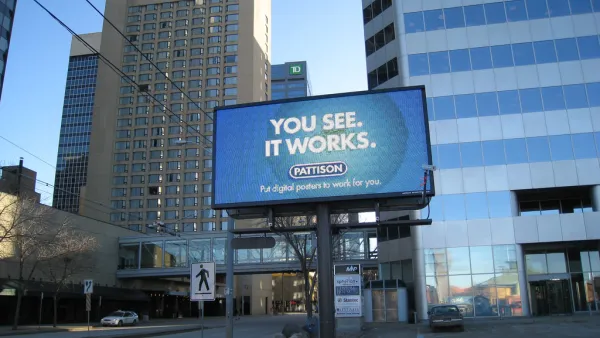
New Jersey Town's Digital Billboard Ban Found Unconstitutional
Overruling an earlier appeals court decision, the New Jersey Supreme Court has found one township's prohibition on digital billboards to be unconstitutional.
Cities Banning Digital Billboards
Digital billboards with flashing and changing images are being outlawed in cities across the country.

Planetizen Federal Action Tracker
A weekly monitor of how Trump’s orders and actions are impacting planners and planning in America.

Eastern Nebraska is running out of electricity
Data centers and electrification are straining eastern Nebraska’s grid, throttling economic development.

Study reveals best places in the U.S. for cycling, walking
New research from Streetlight Data examines bicycle and pedestrian miles per capita in the 100 largest U.S. cities by population.

Officials look to alter BART extension as price goes through the roof
Tariffs and the war with Iran are behind the rising cost.

To power data centers, Utah company may build hundreds of nuclear reactors on state land
In its permit application, Valar asked for the county to confirm that changes within its outlined plan would still be covered by the permit.

San Antonio is using environmental review to stall ICE detention center
San Antonio sued last month to pause work on the new detention center until the federal government studied its effect on the surrounding area.

FREE Course: Walkable City 1: Why Walkability?
After describing his path towards focusing on walkability as the essence of good planning, Jeff Speck marches through his five principal reasons for making more walkable places.
Reinventing Malls: Planning Alchemy—Turning Gray Fields Into Gold
The course focuses on the opportunities and imperatives that shape reinvention of mall sites.

City of Charlotte
City of Rosemead
Rutgers University, Edward J. Bloustein School of Planning and Public Policy
University of Michigan School for Environment and Sustainability (SEAS)
Hunter College, City University of New York (CUNY)
The Architects Foundation
City of Cambridge
The Pocatello Development Authority
The Urban Renewal Agency of the City of Pocatello