The Los Angeles Times Editorial Board issues a strong critique of ongoing Republican efforts to gut the Endangered Species Act.


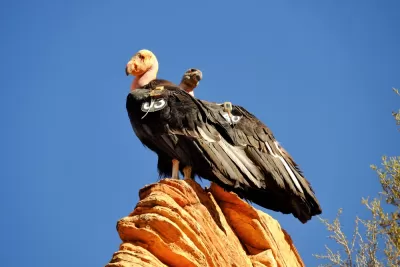
"The Endangered Species Act [pdf], which played a significant role in saving the bald eagle and the California condor from extinction, is now itself endangered," according to the Los Angeles Times Editorial Board.
The editorial pins the blame for the looming setbacks for the Endangered Species Act to the consequences of an election that turned total control of the federal government to the Republican Party. The consequences for the environment, should the party achieve its goals of rolling back environmental regulations like the Endangered Species Act, could be dire:
Were Congress and President Trump to accede to the demands of anti-regulatory zealots and gut the nature-protecting act, it would be calamitous for hundreds of plant and animal species, local ecosystems, and the complex interconnections that sustain the natural world.
The editorial proceeds to respond to the arguments for reform of the Endangered Species Act proffered by Republicans like Sen. John Barrasso (R-Wyo.).
Read the full story: With this Congress, the Endangered Species Act itself might be endangered

Will the Supreme Court’s Chevron Decision Impact Environmental Regulations?
By overturning the Chevron doctrine, the Supreme Court stripped federal agencies like the EPA of final say when interpreting ambiguous legislative policies, leaving future decisions up to judges.

Undoing Biden's EV Rule
The partisan divide over how government should reduce greenhouse gas emissions was on full display after the Biden administration finalized its emissions standards rule for light and medium duty vehicles on March 20.
A Desert Owl Takes on a Freeway
Conservation groups in Arizona are suing to stop a freeway project that would destroy essential habitat for the cactus ferruginous pygmy owl.

Planetizen Federal Action Tracker
A weekly monitor of how Trump’s orders and actions are impacting planners and planning in America.

The state-sanctioned urbicide of Austin
People don’t kill cities. Freeways do.

Colorado’s Largest Data Center Could Rise Next to Homes — Without a Public Hearing
The proposed campus would consume 11 times the power of Denver International Airport; as it has across the country, opposition mounts.

Nation's most wind-powered state turns to coal as data centers increase energy demand
For the first time in decades, Iowa has increased its generation of coal power.

NYC cools commuters with city's first rain garden above a bus stop
New York City officials say the plants in the rain garden can absorb 16 gallons of rainwater during heavy storms.

Brightline West’s future may rely on $6 billion federal loan
The company has until Nov. 2 to make a $400 million equity investment into its proposed high-speed rail line.

FREE Course: Walkable City 1: Why Walkability?
After describing his path towards focusing on walkability as the essence of good planning, Jeff Speck marches through his five principal reasons for making more walkable places.
Reinventing Malls: Planning Alchemy—Turning Gray Fields Into Gold
The course focuses on the opportunities and imperatives that shape reinvention of mall sites.

Greater Baltimore Committee
Eagle County Government
Harvard University Graduate School of Design
The Architects Foundation
University of Cincinnati Online
The Pocatello Development Authority
The Urban Renewal Agency of the City of Pocatello
Journal of the American Planning Association