The care that goes into each Little Free Library makes each example special and unique. A little architectural expertise can't hurt either.


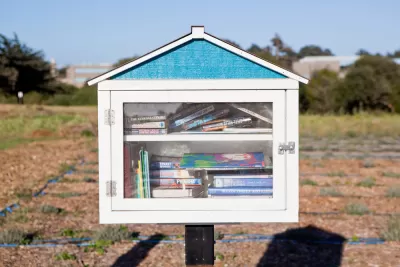
Anne Quito writes of a recent design competition to promote and improve the Little Free Library—a common sight around the world, with "50,000 vessels of literary generosity" in 70 countries. Little Free libraries are made by hand and tended by community members, but they do have the institutional assistance of the Wisconsin-based non-profit Little Free Library to promote and encourage the idea.
The idea for a design competition is a new wrinkle, however. Quito explains.
After thousands of crafty examples, Little Free Library noted that some models could be improved with advice from professional architects and builders. The ideal box library should be weather-proof, fit at least 25 books, and delight neighbors, including young children. The group teamed up with the American Institute of Architects-San Francisco and Chronicle Books to launch a contest to crowdsource solutions that negotiate usability and aesthetic concerns.
The design competition received over 300 entries. Quito shares renderings and descriptions of the winning prototypes.
Read the full story: Architects gave the humble “little free library” a makeover
Has Placemaking Become Cliché?
There’s very little that differentiates proposals by four distinguished planning and design firms to better connect my university to its immediate neighborhood and the wider city. Why is that, and does it have to be that way?
How Placemaking Lost its Way — And How it Can Get Back on Track
The term has often become diluted, getting attached to projects that don’t live up to its lofty aspirations.
String Lights are Secular! The Holiday Case for Year-round Placemaking
The holidays make streets and spaces warm, cozy, and welcoming. Why don’t we do that year round?

Planetizen Federal Action Tracker
A weekly monitor of how Trump’s orders and actions are impacting planners and planning in America.

Washington state to charge fee to drivers with fuel-efficient cars
Revenue from the fee will go towards supporting the state’s highways.

Illinois considers spending $1 billion in taxpayer money on data center
A quantum computing campus and data center are currently under construction in Chicago.

Did data centers change how voters cast their ballots?
Texas, Ohio, and Georgia all flipped party control. But in rural counties, the effect of local data centers was mixed.

Amtrak invests in eight new Airo trainsets
The new trainsets will begin serving passengers in 2031.

HUD to end aid for mixed-immigration-status households
The new rule is projected to impact 80,000 people, nearly half of whom are children.

FREE Course: Walkable City 1: Why Walkability?
After describing his path towards focusing on walkability as the essence of good planning, Jeff Speck marches through his five principal reasons for making more walkable places.
Reinventing Malls: Planning Alchemy—Turning Gray Fields Into Gold
The course focuses on the opportunities and imperatives that shape reinvention of mall sites.

City of Charlotte
City of Rosemead
Rutgers University, Edward J. Bloustein School of Planning and Public Policy
University of Michigan School for Environment and Sustainability (SEAS)
Hunter College, City University of New York (CUNY)
The Architects Foundation
University District Partnership