Designed for a different era, Willis Tower's pedestrian-phobic base is in line for a complete overhaul. The goal is to open the immense tower to the street.



Filling up a block, the forbidding base of Willis Tower (or as diehard Chicagoans would have it, Sears Tower) was designed as a fortification against the street. Fran Spielman writes, "Architects noted that the building once known as Sears Tower was built with the idea of separating the 'urban streetscape' from the building to 'minimize' pedestrian traffic."
Now, with the enthusiastic support of Mayor Rahm Emanuel, the structure will undergo a $500 million renovation to solve that problem and reap retail rewards. As Emanuel put it, "It'll be more receptive to foot traffic for people coming, staying longer and also not going outside the South Loop for lunch. It's gonna be a tremendous draw."
The tower will still be its old monolithic self, but renderings show it perched atop an open, airy retail space. "The plan calls for six levels of restaurant, entertainment and retail space, with three of the floors above ground and three below ground [...] It will include a 30,000-square-foot outdoor deck and garden and a new, three-story transparent glass structure set atop the existing stone plaza."
Read the full story: Willis Tower in line for a $500 million facelift

Chicago's New Train to O'Hare Won't Be a Train—It's Elon Musk's 'Loop'
Loop, as in a derivation of Hyperloop, conceived by Elon Musk and to be built by his newest venture, The Boring Company, is the technology of choice for high-speed transit to O'Hare Airport.
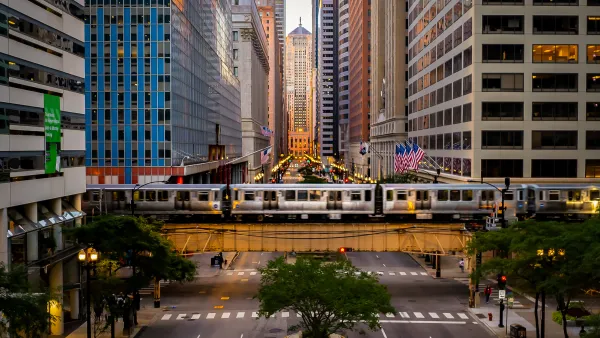
Chicago to Turn High-Rise Offices into Housing
Four commercial buildings in the Chicago Loop have been approved for redevelopment into housing in a bid to revitalize the city’s downtown post-pandemic.
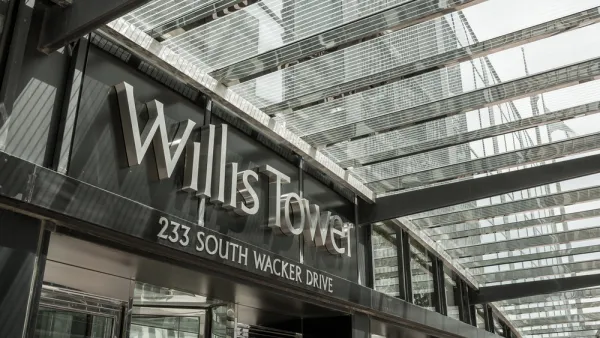
Willis Tower, Largest LEED Platinum Building, to Switch to 100 Percent Renewable Energy
The Willis Tower in Chicago, once the tallest building in the world, is still making history in superlative terms.

Planetizen Federal Action Tracker
A weekly monitor of how Trump’s orders and actions are impacting planners and planning in America.

California plans to bury El Niño’s downpour
If the state plays its cards right, it may be able to store a billion acre-feet of El Niño’s water in aquifers.

Desperate measures: Advocates weigh draining Lake Powell to fill Colorado River
Draining the reservoir could reduce evaporation losses by a couple hundred thousand acre-feet.

In Texas, data centers are swallowing promised parkland
Residents who moved to Taylor, Texas for a rural community now have to contend with three data centers in their backyard.

How a Chicago-sized wind farm beat the odds and powered on
The project spanned five presidential administrations and a standoff with a U.S. military base.

MTA gives itself 30 days to transform pit into basketball court
The site has been under construction since 2022; the city originally estimated it would finish the court in 2024.

FREE Course: Walkable City 1: Why Walkability?
After describing his path towards focusing on walkability as the essence of good planning, Jeff Speck marches through his five principal reasons for making more walkable places.
Reinventing Malls: Planning Alchemy—Turning Gray Fields Into Gold
The course focuses on the opportunities and imperatives that shape reinvention of mall sites.

City of Rosemead
Rutgers University, Edward J. Bloustein School of Planning and Public Policy
One Hundred Miles
Hunter College, City University of New York (CUNY)
The Architects Foundation
University of Cincinnati Online
City of Cambridge
Montrose County
The Pocatello Development Authority