The practice facility for a new Major League Soccer franchise was made possible by the demolition aging and affordable apartment buildings.


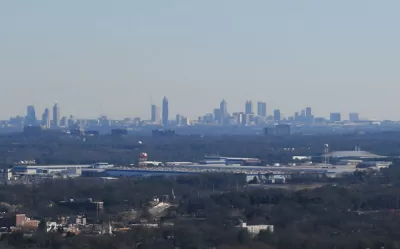
Joe Cortright writes: "For a couple of years now, we’ve been following the story of Marietta, Georgia, where local officials used $65 million in taxpayer funds to buy up and begin demolishing some 1,300 apartments along Franklin Road." A previous article by Cortright on the Marrietta case study explored the idea of suburban displacement. This time around, Cortright compares it to the poor example set by urban renewal practices of the mid-20th century.
The apartments are making way for a "verdant practice facility" to support a new Major League Soccer team, called the Alanta United. But as "hundreds of old but serviceable apartments were demolished to make way for these spacious fields," argues Cortright, the whole situation "is a striking case where the displacement of low income families was an explicit objective of public policy, rather than the side-effect of a changing real estate market."
If that all sounds familiar, that's because Marietta is taking a page from the same urban renewal playbook that many planners and urbanists consider a relic of the regrettable past. Cortright documents the changes in Marietta as the demolitions move forward along Franklin Road, which has now been renamed as Franklin Gateway, by sampling Google Street View images.
For the record, this isn't the first time that the words "urban renewal" have made an auspicious appearance in the urbanism news cycle. As Emily Badger noted in a New York Times article in December, President Donald Trump has used the words to describe his proposal for a "New Deal for Black America"—seemingly unaware of their fraught history and the discriminatory practices they connote.
FULL STORY: Suburban Renewal:

A Case Study of Displacement in Suburban Marietta, Georgia
An article in City Observatory's City Commentary sheds light on an underreported fact of life in some parts of the country: suburban displacement.
‘Reconnecting Communities’ Could Fund Highway Expansions
Applications to the program reveal a pattern of state agencies requesting funds for projects that perpetuate car-centric development with only nominal equity components.

Boston's New Mayor Wants to End Old Urban Renewal Districts
Michelle Wu, Boston's new mayor, is ready to finally end the government powers that displaced communities in the mid-20th century.

Planetizen Federal Action Tracker
A weekly monitor of how Trump’s orders and actions are impacting planners and planning in America.

The state-sanctioned urbicide of Austin
People don’t kill cities. Freeways do.

US to reduce Colorado River water deliveries to Mexico
A new Colorado Treaty amendment reduces Mexico’s Colorado River water allocation by 250,000 acre feet.

Mamdani overhauls NYC's Vision Zero plan with 100 new policy goals
The overhaul aims to reduce traffic deaths and make streets safer for pedestrians, cyclists and drivers through lower speed limits, new safety infrastructure and more.

Amtrak not solely to blame for New Jersey commuter rail's unreliability, report finds
A new study from the Garden State Initiative found that NJ Transit’s budget grew 20% across a 4 year period, but reliability declined significantly over the same period.

EPA erases limits on planet-warming pollution from power plants
Under Monday’s plan, power plants would still have some limits on how much mercury, arsenic and other contaminants they can emit.

FREE Course: Walkable City 1: Why Walkability?
After describing his path towards focusing on walkability as the essence of good planning, Jeff Speck marches through his five principal reasons for making more walkable places.
Reinventing Malls: Planning Alchemy—Turning Gray Fields Into Gold
The course focuses on the opportunities and imperatives that shape reinvention of mall sites.

Eagle County Government
Harvard University Graduate School of Design
Nashville Planning Department
The Architects Foundation
University of Cincinnati Online
The Pocatello Development Authority
The Urban Renewal Agency of the City of Pocatello
Journal of the American Planning Association