Maglev high-speed rail, financed (partially) by Japan, is still under consideration for the stretch between Washington, D.C. and Baltimore. It would take a princely sum to build.


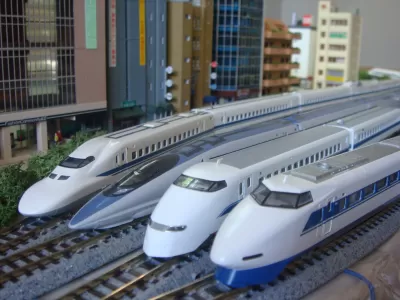
With the potential to rival airliners for speed, maglev trains are something of a pipe dream in this country. Joe Fox writes, "Superconducting maglev trains ('SCMAGLEV,' to be even more precise) are a rail technology that eschews rails, instead sitting within a concrete guideway. Trains are surrounded by superconducting magnets on each side, causing them to 'float' in the guideway."
Despite a lack of American high-speed rail savvy, backers near the nation's capital are eyeing the concept. "The Baltimore-Washington Rapid Rail (BWRR) organization held a series of open houses across the region in December to showcase the work that they have done so far, and solicit general public comment on their Environmental Impact Statement (EIS)."
The prospect of a 15-minute ride from D.C. to Baltimore is compelling, and the plan envisions an extension to New York City. But who puts up the money? "The Japan Bank of International Cooperation (JBIC) has offered to pay half the cost of the D.C.-to-Baltimore line. The remainder of the initial funding would come from a yet-to-be-identified mix of (American) federal, state, and private sources."
Read the full story: The idea for a maglev train from DC to Baltimore keeps…floating down the track

LaHood Rides MagLev
The line may only be 12 miles, but the train speeds at 312 mph. The Secretary of Transportation was in Japan as part of the effort to bring high speed rail to the U.S. though it's not clear whether he is in fact considering the maglev technology.

Two Boring Co. Projects Appear to Bite the Dust
References to the Dugout Loop, in Los Angeles, and the Baltimore-to-Washington Loop have been removed from the Boring Company's website.
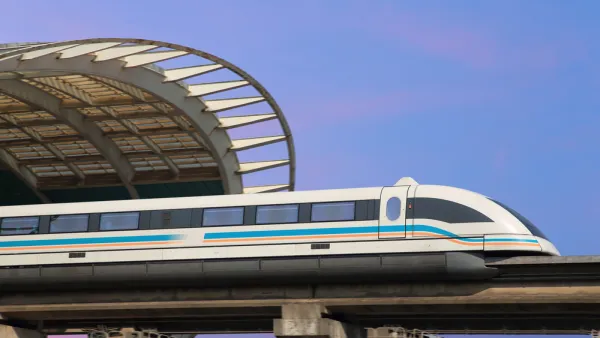
Federal Review of High-Speed Maglev Train Between D.C. and Baltimore Nearing the Finish Line
The Federal Railroad Administration recently released a preliminary study of a proposed high-speed maglev train route between Baltimore and Washington, D.C.

Planetizen Federal Action Tracker
A weekly monitor of how Trump’s orders and actions are impacting planners and planning in America.

Amtrak, CN end decades-long dispute with eight-year agreement
The new operating agreement establishes an updated framework for the companies to work together, including processes to resolve disputes.

Judges permit Denver to divert 77,000 acre feet from the Colorado River for reservoir expansion
Overuse and climate change have caused the Colorado River’s water levels to plummet.

NYC DOT wants faster, more permanent street upgrades
The city is examining ways to build more concrete infrastructure without getting entangled in 'decades-long' projects.

'Something we’ve never seen before:' rising utility rates could strain city finances nationwide
Data centers, climate change and other factors have caused utility rates in the United States to increase by 38% since 2020.

Trump to overrule local leaders, lease millions of acres of America’s Pacific Island territories’ seafloors to mining companies
International law says that the Indigenous people of America’s territories have a right to prior and informed consent regarding projects that impact their countries.

FREE Course: Walkable City 1: Why Walkability?
After describing his path towards focusing on walkability as the essence of good planning, Jeff Speck marches through his five principal reasons for making more walkable places.
Reinventing Malls: Planning Alchemy—Turning Gray Fields Into Gold
The course focuses on the opportunities and imperatives that shape reinvention of mall sites.

Harvard University Graduate School of Design
KFH Group Inc.
Greater Baltimore Committee
The Architects Foundation
University of Cincinnati Online
The Pocatello Development Authority
The Urban Renewal Agency of the City of Pocatello