Days earlier the presumed nominee was Rep. Cathy McMorris Rodgers of Washington, a member of the GOP congressional leadership, but Zinke's interview with Don Trump Jr., the president's son, appears to have caused the change.



The selection of Zinke, a first term Republican congressman elected to Montana's one at-large congressional district in 2014, is expected to be nominated to head the Department of the Interior, "according to an individual with firsthand knowledge of the decision," reports Juliet Eilperin, Washington Post White House bureau chief, as well as by multiple news outlets on Tuesday night.
Although Rep. Cathy McMorris Rodgers (R-Wash.) was a leading contender to lead Interior in recent days, Zinke hit it off with Trump’s oldest son, Don Jr., an avid hunter, and met personally with the president-elect on Monday in New York. [Also see last paragraph.]
The pick should go over somewhat better than McMorris Rodgers with environmental groups if for no other reason than Zinke's defense of "public access to federal lands...This summer, he quit his post as a member of the GOP platform-writing committee after the group included language that would have transferred federal land ownership to the states."
However, Eilperin notes that "he frequently votes against environmentalists on issues ranging from coal extraction to oil and gas drilling."
During his time in Congress, Zinke has established a 3 percent voting score with the League of Conservation Voters. But he has broken ranks with the panel’s GOP majority on occasion, opposing a measure by Rep. Don Young (R-Alaska) that would have allowed each state to buy up to 2 million acres in U.S. Forest Service land to boost timber production. He has also pushed for full funding of the Land and Water Conservation Fund, a high priority for outdoors group.
"Created by Congress in 1965, the Land and Water Conservation Fund (LWCF) was a bipartisan commitment to safeguard natural areas, water resources and our cultural heritage, and to provide recreation opportunities to all Americans," states the fund's webpage.
The Sierra Club acknowledged Zinke's support of the fund in a statement by Executive Director Michael Brune opposing the nomination:
“Zinke is only able to recognize the importance of programs like the Land and Water Conservation Fund a mere 3 percent of the time, while the other 97 percent of the time he’s voted with those that would dismantle, degrade and dispose of our public lands. Being Secretary of the Interior requires someone who will protect our public lands 100 percent of the time.
As for climate change, he has said "it is real, but that the degree to which human activity is to blame is unsettled," reports Scientific American. “It's not a hoax, but it's not a proven science, either,” he said during one debate in 2014.
The unusual role played by the president-elect's son, Don Jr., an avid outdoorsman, in making this selection is the topic of a POLITICO report by Jake Sherman And Matthew Nussbaum.
In fact, [Don Jr.] once floated himself as the next interior secretary, telling an outdoors publication that, "the big joke at Christmas this year was that the only job in government that I would want is with the Department of Interior. I understand these issues. It's something I'm passionate about. I will be the very loud voice about these issues in my father's ear..."
FULL STORY: Trump taps Montana congressman Ryan Zinke as interior secretary

Another Fossil-Fuel-Friendly Climate Skeptic Selected for Trump Cabinet
President-elect Donald Trump is reported to have selected Rep. Cathy McMorris Rodgers, a Republican from Washington, for Secretary of the Department of Interior. Also, "Climate McCarthyism" emerges as a concern for federal employees.

The Environmental Regulation Overturned by the New Interior Secretary on Day One
A dramatic entrance on horseback preceded one of Ryan Zinke's first actions as Secretary of the Department of Interior—rescinding guidance issued by the Fish & Wildlife Service to phase out the use of toxic, lead ammunition on federal lands.
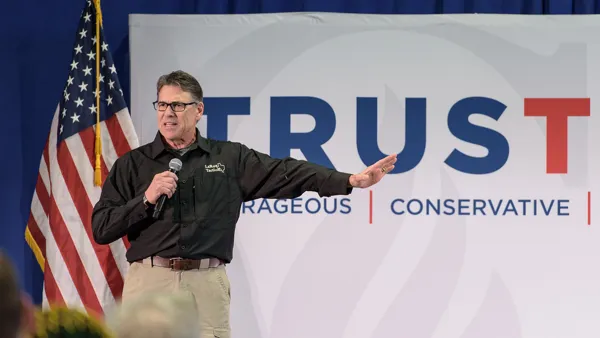
Trump Picks Energy Secretary Who Wanted to Eliminate Department
In an infamous 2011 Republican presidential primary debate, then-Texas Gov. Rick Perry stated he would abolish three federal agencies: Commerce, Education, and "Oops!" — he couldn't recall. That department, energy, he has now been selected to lead.

The state-sanctioned urbicide of Austin
People don’t kill cities. Freeways do.

US to reduce Colorado River water deliveries to Mexico
A new Colorado Treaty amendment reduces Mexico’s Colorado River water allocation by 250,000 acre feet.

New Jersey’s second-largest city bans standalone data centers
Jersey City will continue to allow co-location facilities, such as those meant for research institutions that store their own data.

Amtrak not solely to blame for New Jersey commuter rail's unreliability, report finds
A new study from the Garden State Initiative found that NJ Transit’s budget grew 20% across a 4 year period, but reliability declined significantly over the same period.

EPA erases limits on planet-warming pollution from power plants
Under Monday’s plan, power plants would still have some limits on how much mercury, arsenic and other contaminants they can emit.

Phoenix announces new on-demand transit service, more frequent RAPID buses
Both new services will launch in October, and are part of Phoenix's Project Effective Access Solutions for Easing Congestion.

FREE Course: Walkable City 1: Why Walkability?
After describing his path towards focusing on walkability as the essence of good planning, Jeff Speck marches through his five principal reasons for making more walkable places.
Reinventing Malls: Planning Alchemy—Turning Gray Fields Into Gold
The course focuses on the opportunities and imperatives that shape reinvention of mall sites.

Eagle County Government
Harvard University Graduate School of Design
Nashville Planning Department
The Architects Foundation
University of Cincinnati Online
The Pocatello Development Authority
The Urban Renewal Agency of the City of Pocatello
Journal of the American Planning Association