A fractured rail is suspected as the cause of the worst train crash in India since 2010. The Indore-Patna Express train derailed near Kanpur in northern India. At least 200 are injured.


"At least 120 people are said to have have been killed and at least 200 more injured after a train derailed near the city of Kanpur in northern India in the country’s worst train crash since 2010," reports Vidhi Doshi in Mumbai for The Guardian.
Hundreds of people were trapped after 14 carriages of the express train, travelling from Indore to Patna [operated by the government-owned Indian Railways], crumpled into one another as they came off the tracks on Sunday.
Every day, more than 20 million Indians use the country’s heaving, out of date and poorly maintained railway system, the fourth largest in the world. Accidents on Indian trains are common and claim more than 25,000 lives a year, according to the National Crime Records Bureau [PDF].
[Correspondent's note: In "passengers carried in rail transport per year", it is ranked third, behind China and Japan, per Wikipedia.]
A document sent to the Guardian by Anil Saxena, a railways spokesman, said derailments were often caused by “poor maintenance of infrastructure especially at stations and failure to take appropriate precautionary measures against flash floods, landslides, boulder[s] falling, etc."
The Commission of Railway Safety "will look into the possibility of a fracture in the tracks as a possible cause of the accident, which led to the coaches to not only go off the rails but pile up, leading to high casualties," report Ramendra Singh and Avishek G Dastidar for The Indian EXPRESS. "Derailment is the cause of 50 per cent of all accidents in the Indian Railways."
Dastidar also reports in a subsequent article in The Indian EXPRESS that 695 passengers were on the train. The article focuses on travel insurance, indicating that the derailment "will be the first real test of the recently-launched optional travel insurance scheme for train passengers."
In a third article on the derailment, he reports that outdated coaches used on the Indore-Patna Express contributed to the high casualties on the train.
Hat tip to Emma Bowman of NPR.
FULL STORY: Desperate search for survivors after India train crash kills 120

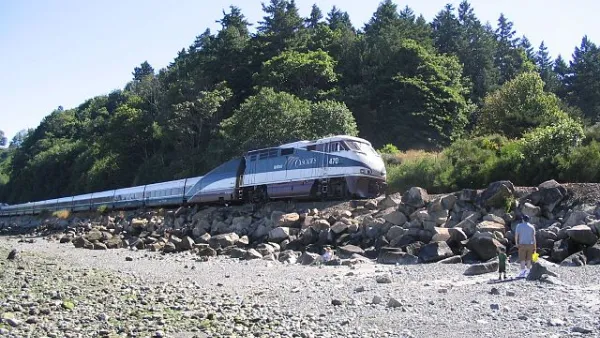
Focus on Positive Train Control after Amtrak Train 501 Derails in Washington
Excessive speed is thought to be the cause of the deadly derailment on Dec. 18. Positive train control, which likely would have slowed down the train, was installed on the tracks and locomotive but was not yet operational.
Amtrak Suffers Third Fatal Crash in Less than Two Months
The crash in Cayce, South Carolina on Sunday killed the engineer and conductor riding in the Amtrak locomotive, injuring over 100 passengers and crew members. A locked switch had directed Amtrak #91 into a siding where it hit a parked CSX train.
Will GOP Reconsider Redirecting Amtrak Funding After Train Crash?
Republican lawmakers got a first-hand lesson in train safety Wednesday when their chartered Amtrak train hit a trash truck at a grade crossing in Virginia, killing one in the truck. Trump's infrastructure plan redirects Amtrak and transit funding.

The state-sanctioned urbicide of Austin
People don’t kill cities. Freeways do.

US to reduce Colorado River water deliveries to Mexico
A new Colorado Treaty amendment reduces Mexico’s Colorado River water allocation by 250,000 acre feet.

New Jersey’s second-largest city bans standalone data centers
Jersey City will continue to allow co-location facilities, such as those meant for research institutions that store their own data.

Amtrak not solely to blame for New Jersey commuter rail's unreliability, report finds
A new study from the Garden State Initiative found that NJ Transit’s budget grew 20% across a 4 year period, but reliability declined significantly over the same period.

EPA erases limits on planet-warming pollution from power plants
Under Monday’s plan, power plants would still have some limits on how much mercury, arsenic and other contaminants they can emit.

Phoenix announces new on-demand transit service, more frequent RAPID buses
Both new services will launch in October, and are part of Phoenix's Project Effective Access Solutions for Easing Congestion.

FREE Course: Walkable City 1: Why Walkability?
After describing his path towards focusing on walkability as the essence of good planning, Jeff Speck marches through his five principal reasons for making more walkable places.
Reinventing Malls: Planning Alchemy—Turning Gray Fields Into Gold
The course focuses on the opportunities and imperatives that shape reinvention of mall sites.

Eagle County Government
Harvard University Graduate School of Design
Nashville Planning Department
The Architects Foundation
University of Cincinnati Online
The Pocatello Development Authority
The Urban Renewal Agency of the City of Pocatello
Journal of the American Planning Association