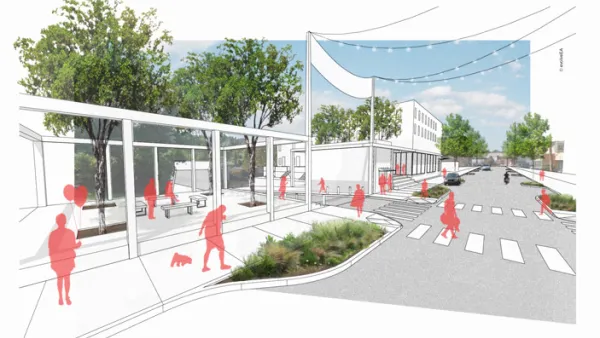
The product of a four-year community effort, Millvale's Ecodistrict Plan integrates placemaking and sustainability priorities for a town striving to make its Ecodistrict status part of its identity and culture, not just its infrastructure.


Allentown, PA — The annual conference of the Pennsylvania chapter of the American Planing Association (APA) took place in Allentown this week and included an awards ceremony to honor the best planning projects in the state. One of five projects to receive a Planning Excellence Award this year was the Ecodistrict Pivot Plan for the Borough of Millvale, located just across the Allegheny River from Pittsburgh.

evolveEA led the planning team in partnership with the Millvale Community Development Corporation, Millvale Community Library, Millvale Borough, New Sun Rising, Sisters of Saint Francis at Mt. Alvernia and other Millvale based community organizations. The Pivot Plan has been a continuing, multi-year effort to improve quality of life for Millvale’s existing community while attracting new residents and businesses by building a unique Ecodistrict identity for the town. The Plan emphasizes placemaking in addition to environmental sustainability and raising the community’s capacity to steward sustainable redevelopment initiatives.
Results include the construction of green rainwater infrastructure and $1.7 million in funding for the recently renovated Town Center and Food Hub for Millvale’s business district. The town’s community garden is also expanding with the hope of providing up to 95% of the fresh produce needed for Millvale’s restaurants, and the community is working to expand local production of solar energy beyond the 100% solar powered library.
Millvale Sustainability Coordinator, Zaheen Hussain, remarked:
The growth of our partnership with evolveEA and the Pivot plan have been key in helping to advance the community’s sustainable development goals. Like many small towns, our projects rely on bootstrapped efforts driven by community leadership. Having a plan that ties together our work not only empowers our residents, but ensures efficiency and coordination of efforts between the Millvale Community Library, Millvale Community Development Corporation, New Sun Rising, and the Borough of Millvale.
Community members have been active in the planning process and determined to see their vision to completion. Millvale has been challenged by a history of flooding and other issues that threaten the well being of residents, such as poor air quality. These issues are countered by the community’s sense of self-determination, driving them to strategize around key issue areas—Water, Food, Energy, Mobility, Air and Equity.
Residents were inspired to imagine solutions for mobility chokepoints that reflect their unconventional culture, such as a Kayak Commuter Hub and Kayak Crossing Intersection near Millvale's riverfront. The Town Center Food Hub was identified as a focus project by the community during the first round of Ecodistrict planning (2013) in order to address the town’s “food desert” status. The Food Hub is opening in a reused building this year to house offices, a food-based business incubator and a café at street level.
Read the full story: Millvale Ecodistrict Pivot Plan Selected for Pennsylvania Planning Excellence Award
Sharpsburg Ecodistrict the World's Third EcoDistricts Certified Community
The Sharpsburg Ecodistrict in Pennsylvania has been recognized with EcoDistrict Certification, joining Millvale and Etna to become the third certified community in Southwestern Pennsylvania's Triboro Ecodistrict—and the world.

750 Pittsburgh city workers to get free transit passes
City employees working downtown will have access to free transit from Pittsburgh Regional Transit.

Pittsburgh downtown tax diversion plan draws criticism for lack of transparency
A proposed new development tax faces opposition from transit advocates.

Planetizen Federal Action Tracker
A weekly monitor of how Trump’s orders and actions are impacting planners and planning in America.

California plans to bury El Niño’s downpour
If the state plays its cards right, it may be able to store a billion acre-feet of El Niño’s water in aquifers.

Desperate measures: Advocates weigh draining Lake Powell to fill Colorado River
Draining the reservoir could reduce evaporation losses by a couple hundred thousand acre-feet.

Mamdani’s pied-à-terre tax survives legal challenge
A panel of judges found that the plaintiffs failed to demonstrate injury as a result of New York City's implementation of the tax.

Eastern Nebraska is running out of electricity
Data centers and electrification are straining eastern Nebraska’s grid, throttling economic development.

Seattle passes record-breaking transit services expansion
Proposition 1 will double the city’s transit tax to add 95,000 more bus trips and preserve 180,000 bus trips annually.

FREE Course: Walkable City 1: Why Walkability?
After describing his path towards focusing on walkability as the essence of good planning, Jeff Speck marches through his five principal reasons for making more walkable places.
Reinventing Malls: Planning Alchemy—Turning Gray Fields Into Gold
The course focuses on the opportunities and imperatives that shape reinvention of mall sites.

City of Rosemead
Rutgers University, Edward J. Bloustein School of Planning and Public Policy
One Hundred Miles
University of Michigan School for Environment and Sustainability (SEAS)
Hunter College, City University of New York (CUNY)
The Architects Foundation
City of Cambridge
Montrose County
The Pocatello Development Authority