An interview with a photographer about his unflattering pictures of train riders in Tokyo's crowded subway.


In his series called "Tokyo Compression," Michael Wolf, took photos of Japanese commuters on crowded trains. According to an interview with Mr. Wolf by CNN's Zahra Jamshed, "Wolf, who lives in Hong Kong, often uses photography to critique the harsh living conditions of large cosmopolitan cities."
"These people are squeezed against the back walls as more and more people are shoveled in. You're living life as a sardine -- it's horrific. This is not a dignified way of living. It's like looking into a ride in hell." Some train riders might point out that all commuters look uncomfortable from time to time as they ride to work. And that, while they might not love the rush hour squeeze, they might not appreciate being photographed at their worst to make the point that they are living in "hell."
But Wolf was intent on capturing the most dramatic and unflattering aspects of the commute. As he explains, "The entire process took four years because the first images I took had no condensation on the windows. The next time I was there, there was more condensation because of the change in season, so the pictures became more dismal and I was able to better express what it was that I wanted."
In the interest of giving Mr. Wolf the benefit of the doubt, he doesn't universally pity all mass transit commuters, later in the interview he allows that, "there are cities around the world that are planned more sensibly." That's almost certainly true, though it's funny to read it in the same outlet which ranked Tokyo's metro system among the 10 best in the world.
Read the full story: A ride in hell? An up-close look at real life in megacities

Images of the World's Most Uncomfortable Commute
You've probably heard of the improbable lengths to which Tokyo's subway goes to pack in riders. But you likely haven't seen images of "unwilling subjects trapped in the train window" like those taken by photographer Michael Wolf.
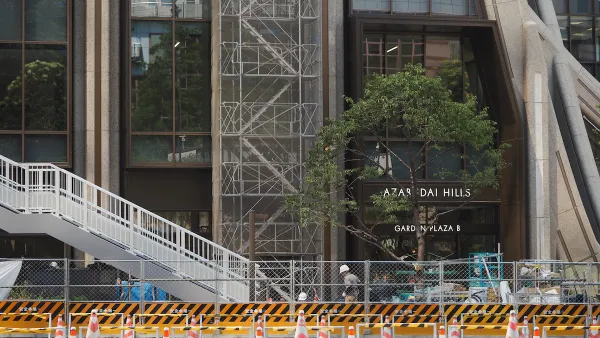
A New Tallest Skyscraper for Japan
The Toranomon-Azabudai reaches 330 meters into the sky, far lower than international standards but taller by 30 meters than the previous tallest building in Japan.
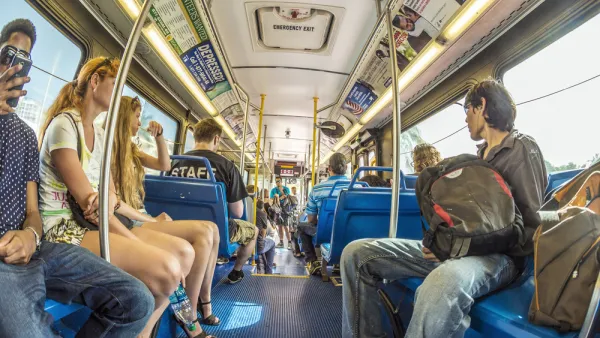
To Fight Climate Change, Support Public Transit
Electric cars may garner a lot of attention these days, but significantly reducing carbon emissions and urban congestion means investing in high-quality mass transit.

Planetizen Federal Action Tracker
A weekly monitor of how Trump’s orders and actions are impacting planners and planning in America.

Amtrak, CN end decades-long dispute with eight-year agreement
The new operating agreement establishes an updated framework for the companies to work together, including processes to resolve disputes.

Judges permit Denver to divert 77,000 acre feet from the Colorado River for reservoir expansion
Overuse and climate change have caused the Colorado River’s water levels to plummet.

NYC DOT wants faster, more permanent street upgrades
The city is examining ways to build more concrete infrastructure without getting entangled in 'decades-long' projects.

'Something we’ve never seen before:' rising utility rates could strain city finances nationwide
Data centers, climate change and other factors have caused utility rates in the United States to increase by 38% since 2020.

Trump to overrule local leaders, lease millions of acres of America’s Pacific Island territories’ seafloors to mining companies
International law says that the Indigenous people of America’s territories have a right to prior and informed consent regarding projects that impact their countries.

FREE Course: Walkable City 1: Why Walkability?
After describing his path towards focusing on walkability as the essence of good planning, Jeff Speck marches through his five principal reasons for making more walkable places.
Reinventing Malls: Planning Alchemy—Turning Gray Fields Into Gold
The course focuses on the opportunities and imperatives that shape reinvention of mall sites.

Harvard University Graduate School of Design
KFH Group Inc.
Greater Baltimore Committee
The Architects Foundation
University of Cincinnati Online
The Pocatello Development Authority
The Urban Renewal Agency of the City of Pocatello