The BlightSTAT system has helped New Orleans track and improve blighted conditions around the city.


Katherine Hillenbrand reports on the details of the city of New Orleans' BlightSTAT performance management approach to blight reduction. Between 2010 and 2015, the city eliminated over 15,000 blighted units "through a mix of demolition, sale, and owner repairs," according to Hillenbrand. The city's Office of Performance and Accountability (OPA) oversees BlightSTAT, in partnership with the Department of Code Enforcement.
Hillenbrand's article explains the data-driven tools employed by the OPA team, including a "nudging" program that relies on behavioral science and a decision support card (also known as the Blight Scorecard). OPA's Blight Scorecard is designed to reduce workload and the backlog of properties awaiting a decision by code enforcement. "Working with Enigma, a data science startup, OPA tested machine learning algorithms to see if a model could be trained on that data. Based on the tests, OPA chose a logistic regression model and built an in-house tool, the Blight Scorecard, to work within the existing Code Enforcement workflow," according to Hillenbrand.
Read the full story: New Orleans Brings Data-Driven Tools to Blight Remediation
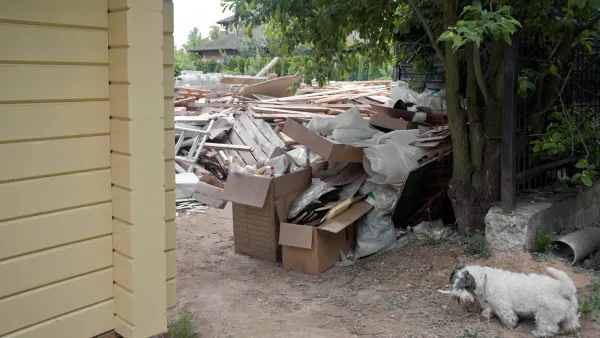
Controversial Blight Ordinance in Gilbert, Arizona, Zeroes in on Backyards
Local officials in Gilbert, Arizona, say a new town ordinance that will fine homeowners for unsightly debris in their backyards is about fighting blight; critics say it’s a violation of their Fourth Amendment right against unreasonable search and seizure.
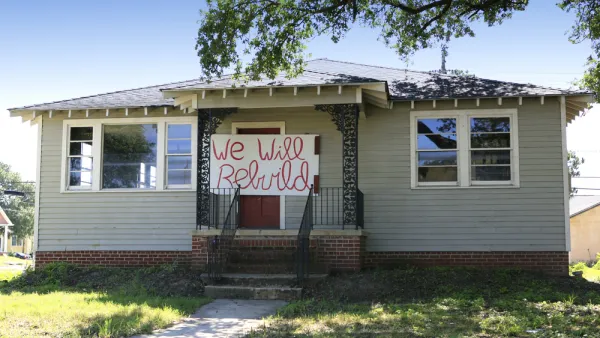
Measuring the Effect of Blight Remediation Programs
Tulane researchers received major funding support from the National Institutes of Health to study the effects of blight remediation on youth and family violence.
Court Restores 'Doors and Windows' Code Enforcement Ordinance in Philadelphia
One of Philadelphia's most potent code enforcement tools is back in effect after the state Supreme Court overturned a previous ruling by a lower court.

Planetizen Federal Action Tracker
A weekly monitor of how Trump’s orders and actions are impacting planners and planning in America.

California plans to bury El Niño’s downpour
If the state plays its cards right, it may be able to store a billion acre-feet of El Niño’s water in aquifers.

Desperate measures: Advocates weigh draining Lake Powell to fill Colorado River
Draining the reservoir could reduce evaporation losses by a couple hundred thousand acre-feet.

Housing is the top priority of Seattle’s sole new councilmember
Jenks campaigned on building 1,000 new units of affordable housing.

New tax cuts may slash $1.5 billion in funding for Miami transit, public parks
Amendment 3 will save Miami-Dade homeowners $2,700 in 2028.

Arizona, Wisconsin, Pennsylvania hope to finally advance climate goals post-midterms
The three states have spent years under Republican or divided control.

FREE Course: Walkable City 1: Why Walkability?
After describing his path towards focusing on walkability as the essence of good planning, Jeff Speck marches through his five principal reasons for making more walkable places.
Reinventing Malls: Planning Alchemy—Turning Gray Fields Into Gold
The course focuses on the opportunities and imperatives that shape reinvention of mall sites.

City of Rosemead
Rutgers University, Edward J. Bloustein School of Planning and Public Policy
One Hundred Miles
University of Michigan School for Environment and Sustainability (SEAS)
Hunter College, City University of New York (CUNY)
The Architects Foundation
City of Cambridge
Montrose County
The Pocatello Development Authority