The Austin Chamber of Commerce is connecting the dots between land use and transportation—and voicing its support for reform of the city's land use regulations.


Michael Theis summarizes a policy recommendation by the Austin Chamber of Commerce: "If Austin wants to make a dent in its rush-hour congestion, it needs to first do a wholesale re-write of the city's land development code to allow for more density in key locations…"
That recommendation came in the chamber's 2016 Mobility Report. More specifically, the report suggests a focus on Austin's CodeNext process, "a dramatic but delayed overhaul of the city's land development code." Moreover, the report "recommends that the city adopt a 'form-based' land development code to replace the current 'use-based' land development code." The report argues that form-based codes make it easier to develop "missing middle" housing options.
Read the full story: Chamber: Want to tackle traffic? Tackle land use first

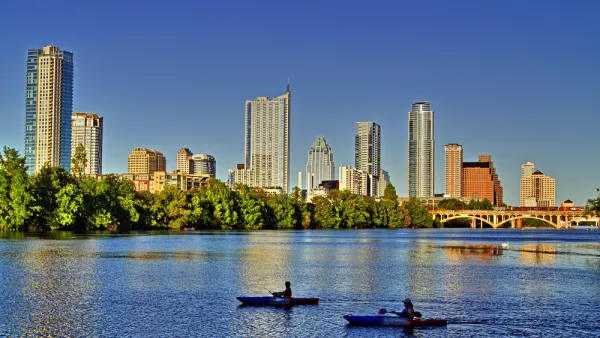
Austin Reminded to Be Respectful While Debating CodeNEXT
A call for civility amid the great zoning debate in Austin, Texas.
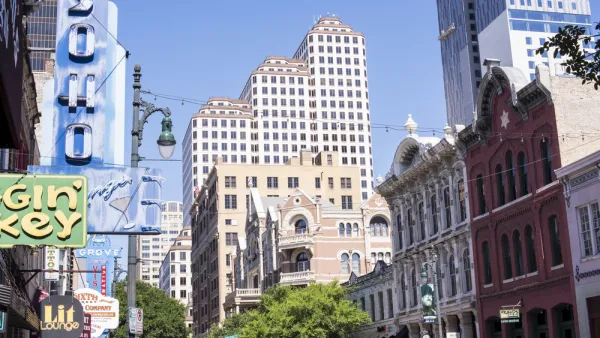
Catch Up With Austin's CodeNEXT
CodeNEXT is one of the most ambitious, and controversial, zoning reform projects ongoing in the country, with lessons to offer planners all over the country in code writing, public outreach, and planning outcomes.
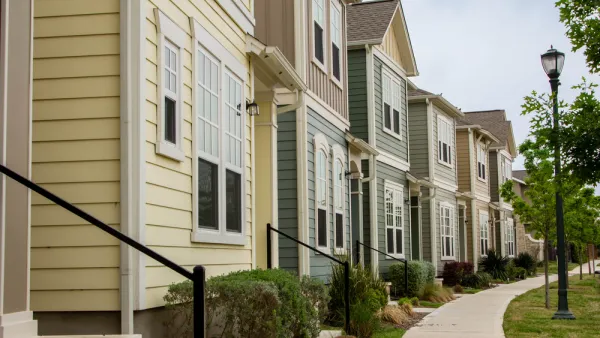
Missing Middle Housing: An Austin Case Study
The "missing middle" of housing is a concept familiar to many planners, but it's still probably unknown to most of the public. A story for Austin's NPR station could be an indication that the missing middle is entering the public consciousness.

Planetizen Federal Action Tracker
A weekly monitor of how Trump’s orders and actions are impacting planners and planning in America.

California plans to bury El Niño’s downpour
If the state plays its cards right, it may be able to store a billion acre-feet of El Niño’s water in aquifers.

Desperate measures: Advocates weigh draining Lake Powell to fill Colorado River
Draining the reservoir could reduce evaporation losses by a couple hundred thousand acre-feet.

California city breaks ground on transit connector
The project includes three mobility hubs and a pedestrian bridge.

After public outcry, Massachusetts city releases housing development tracker
Cambridge’s tracker currently shows 250 housing projects in various stages of development.

40 years after approval, Chicago breaks ground on new park
The park honors Jean Baptiste Point du Sable, the city’s first permanent non-native settler.

FREE Course: Walkable City 1: Why Walkability?
After describing his path towards focusing on walkability as the essence of good planning, Jeff Speck marches through his five principal reasons for making more walkable places.
Reinventing Malls: Planning Alchemy—Turning Gray Fields Into Gold
The course focuses on the opportunities and imperatives that shape reinvention of mall sites.

City of Rosemead
Rutgers University, Edward J. Bloustein School of Planning and Public Policy
One Hundred Miles
Hunter College, City University of New York (CUNY)
The Architects Foundation
University of Cincinnati Online
City of Cambridge
Montrose County
The Pocatello Development Authority