The Wall Street Journal provides detailed coverage of the Texas wind energy industry, as well as the prospects for even greater adoption of renewable energy in the state.


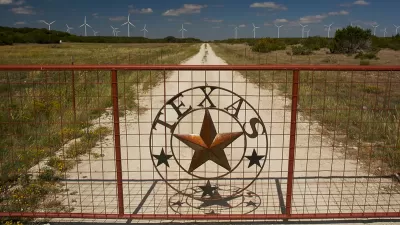
"Texas has added more wind-based generating capacity than any other state, with wind turbines accounting for 16% of electrical generating capacity as of April," report Bill Spindle and Rebecca Smith. Now Texas is anticipating a huge surge in solar power.
As for how Texas, "one of the few reliably Republican states," jumped on the renewable energy bandwagon," Spindle and Smith trace the growth of the industry to former President George W. Bush's time in the governor's office.
The roots of Texas’ renewables boom go back to 1999, when then-Gov. George W. Bush and a Republican-dominated legislature overhauled the Texas power market. The free market-oriented deregulation broke the grip of most monopoly utilities that controlled generation, transmission and retail sales of electricity and introduced competitive auctions for wholesale power.
That market environment as enabled the state to create more than 19,000 megawatts of renewable capacity by April of 2016, according to the U.S. Department of Energy cited in the article. That's enough renewable energy to power 4 million homes.
Spindle and Smith reference the potential for similar growth in the Texas solar market in the future. Recent Planetizen coverage, however, has noted that solar businesses are struggling to gain momentum in the state.
The strength of the Texas wind energy industry, however, has been obvious since 2014, when the state began smashing its wind power records. There's also the city of Georgetown, near Austin, which announced its plans to go 100 percent renewable back in 2015.
Read the full story: Which State Is a Big Renewable Energy Pioneer? Texas

Study: States approved 90% of renewable energy projects between 2018 and 2024
Ohio had the highest rejection rate for wind and solar proposals.
Feds Terminate $7.56 Billion for Clean Energy Projects
The Department of Energy canceled awards to over 200 renewable energy projects.
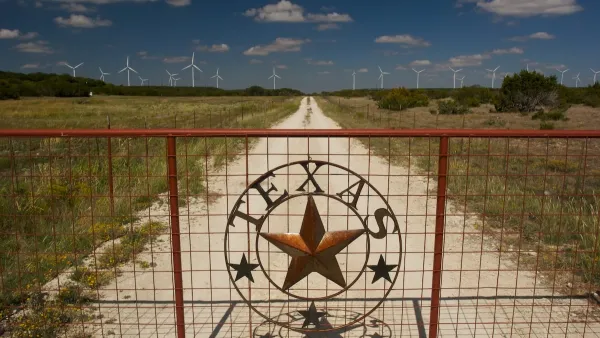
Texas Rural Communities Could Lose Billions From Renewable Energy Tax Credit Cuts
Texas produces more solar and wind energy than anywhere in America — and the tax revenue from it pays for rural schools, hospitals, law enforcement and more. The One Big Beautiful Bill threatens that.

Planetizen Federal Action Tracker
A weekly monitor of how Trump’s orders and actions are impacting planners and planning in America.

Amtrak, CN end decades-long dispute with eight-year agreement
The new operating agreement establishes an updated framework for the companies to work together, including processes to resolve disputes.

Judges permit Denver to divert 77,000 acre feet from the Colorado River for reservoir expansion
Overuse and climate change have caused the Colorado River’s water levels to plummet.

Philadelphia to invest $2 billion into upgrading city airports as PHL places last in customer satisfaction
Modernizations to Philadelphia's airports will include baggage system upgrades and a new automated parking garage guidance system.

The LA housing policies making developers turn away from the city
Despite LA’s housing shortage, developers say the city’s "mansion-tax" and pandemic-era policies make it an unappealing place to build housing.

New density bill would require 7 California cities to establish regional transit hubs
The bill would also require major cities in California to permit high-rise residential buildings.

FREE Course: Walkable City 1: Why Walkability?
After describing his path towards focusing on walkability as the essence of good planning, Jeff Speck marches through his five principal reasons for making more walkable places.
Reinventing Malls: Planning Alchemy—Turning Gray Fields Into Gold
The course focuses on the opportunities and imperatives that shape reinvention of mall sites.

City of Wisconsin Rapids
Harvard University Graduate School of Design
KFH Group Inc.
The Architects Foundation
University of Cincinnati Online
The Pocatello Development Authority
The Urban Renewal Agency of the City of Pocatello