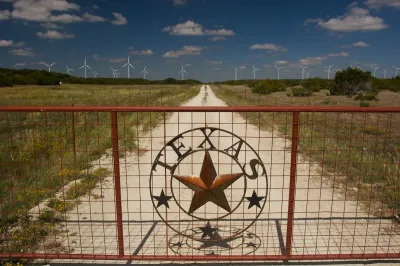
Texas produces more solar and wind energy than anywhere in America — and the tax revenue from it pays for rural schools, hospitals, law enforcement and more. The One Big Beautiful Bill threatens that.


This story was originally published on The Daily Yonder.
Renewable energy experts and developers in Texas are warning that rural communities could bear the brunt of the economic impact from changes to federal tax credits for wind and solar put in place by the recently passed One Big Beautiful Bill (OBBB) Act, President Donald Trump’s signature piece of second-term legislation.
Texas, which ranks first in installed renewable energy capacity, is continuing to build out its fleet of wind, solar, and energy storage projects. Previously, a Daily Yonder analysis of Atlas Public Policy data found that Texas leads the country in wind and solar projects planned to come online in rural areas over the next six years.
Already, renewable energy projects bring significant economic benefits to rural communities in the Lone Star State. The revenue that comes in is twofold: the county or municipal government earns money through local tax payments, and landowners are paid for leasing their land to developers.
In a 2025 state-level economic impact report, author and University of Texas at Austin research scientist Joshua Rhodes calculated that over their lifetime, the current fleet of utility-scale wind, solar, and energy storage projects in Texas is estimated to generate about $12.3 billion in new tax revenue to local communities.
As new projects come online, Rhodes updates an interactive database that was published at the same time as the impact report earlier this year. A Daily Yonder analysis of the most recent figures found that current wind, solar, and storage developments in rural communities will pay $9.1 billion in local taxes over their lifetimes.
Often, rural communities use this tax revenue to fund their public school systems, hospitals, and law enforcement. In rural counties that have a smaller tax base and may have agricultural land that receives tax exemptions, renewable energy and storage projects represent a major source of funding for local services.
“Many of these communities don’t have the tax base to support the students they already have,” said Jeffrey Clark, president of the Advanced Power Alliance, which represents 68 member organizations across wind, solar, storage, and other renewables in Texas. “So when we show up with a $300 million solar farm or a wind farm, all of a sudden the school for the first time ever has new facilities, new books, new technology.”
Now, that dynamic is in jeopardy. A Daily Yonder analysis of Texas renewable energy development data compiled by Rhodes found that expected projects — those that have agreements with utilities but have not yet undergone interconnection, the critical last step before a development comes online — are expected to generate over $4.7 billion in local taxes over their lifetimes.
“Simply adding up these data across Texas shows how much money these types of projects bring to rural areas, and sometimes it’s the only economic development that an area might get,” wrote Rhodes, who is from rural Nacogdoches County, in a statement to the Daily Yonder.
With changes to the tax structure at the federal level, however, the calculus for project developers has changed.
Federal tax credits established by the 2022 Inflation Reduction Act (IRA) under President Joe Biden incentivized renewable energy projects like wind and solar. At the commercial scale, which is what Rhodes tracks in Texas, investors and producers were made eligible for a 30% credit on their federal tax payments. Local taxes are still paid to the municipality, generating revenue for a project’s host county. Originally scheduled to run through 2032, cuts in the OBBB set the federal tax credits to expire at the end of 2027. To claim the credits, wind and solar projects must break ground on construction by next summer or come online by December 31, 2027.
Developers in Texas’ renewable energy industry say the credits’ phaseout timeline is not a reasonable one for years-long projects planning on taking advantage of the incentives. Since the OBBB passed, Trump signed an executive order directing the Department of the Interior to scrutinize wind and solar projects that try to claim the credits over the next eighteen months.
Stanley Pipkin is the CEO of Lighthouse Solar, based in Austin, Texas. Pipkin has been in the industry for nearly two decades and has done projects at the distributed scale all over the state, including in rural parts of Central Texas. Without the federal credits, Pipkin said, bigger developers may take their business elsewhere, either to other countries or states with policies more favorable to renewable energy. At the state level, Texas has passed legislation that makes it more difficult to develop wind and solar projects.
“People just leave, I mean we're not like martyrs,” said Pipkin.
Clark expressed concern about how an exodus of wind and solar projects from the state will impact rural communities. That investment, which in some counties is in the tens or hundreds of millions between landowner payments and local tax revenue, is at risk because of the OBBB, he said.
“Any project that dies because of this is a school district that's not going to have revenue that it would have otherwise had,” Clark said.

Study: States approved 90% of renewable energy projects between 2018 and 2024
Ohio had the highest rejection rate for wind and solar proposals.
Feds Terminate $7.56 Billion for Clean Energy Projects
The Department of Energy canceled awards to over 200 renewable energy projects.
Renewable Energy Overtakes Coal for First Time
Solar and wind power generated close to a third of U.S. electricity supplies in 2024.

Planetizen Federal Action Tracker
A weekly monitor of how Trump’s orders and actions are impacting planners and planning in America.

The state-sanctioned urbicide of Austin
People don’t kill cities. Freeways do.

US to reduce Colorado River water deliveries to Mexico
A new Colorado Treaty amendment reduces Mexico’s Colorado River water allocation by 250,000 acre feet.

5 New England states march closer to 800 megawatt wind energy project
Securing federal approval for the project may be complicated under the Trump administration, which has historically been hostile towards domestic wind power.

Baltimore to break ground on $50 million Transit Priority Project
The project will bring faster bus trips, safer streets and better bike connections to Baltimore.

Airbnb launches $250 million 'last-dollar financing' housing accelerator, makes first investment in Austin
The company will put $6.4 million towards affordable housing development in Texas’ capital.

FREE Course: Walkable City 1: Why Walkability?
After describing his path towards focusing on walkability as the essence of good planning, Jeff Speck marches through his five principal reasons for making more walkable places.
Reinventing Malls: Planning Alchemy—Turning Gray Fields Into Gold
The course focuses on the opportunities and imperatives that shape reinvention of mall sites.

Eagle County Government
Harvard University Graduate School of Design
Nashville Planning Department
The Architects Foundation
University of Cincinnati Online
The Pocatello Development Authority
The Urban Renewal Agency of the City of Pocatello
Journal of the American Planning Association

