One of the Pacific Northwest's remaining coal export facility proposals was dealt what could be a final blow in state court last week. Some are describing such projects as zombies "shambling forward unaware that their heart has stopped beating…"



"A judge has reaffirmed Oregon's rejection of a project that would've turned the state into a way station for coal exports to Asia," reports Rob Davis.
"An Oregon administrative law judge ruled that Oregon Department of State Lands acted lawfully when it rejected a developer's proposed coal export terminal at the Port of Morrow in 2014."
The decision sided with Oregon over the case made by the states of Wyoming and Montana—that Oregon's decision to block the coal facility "impeded interstate commerce."
Davis describes the ruling as a "coda" for coal exporting plans in Oregon. Back when coal was peaking, in 2010, Oregon and Washington was faced with nice export terminal project proposals. Since coal prices have collapsed, "just one export proposal remains alive, in Longview, where a major backer, Arch Coal, recently sold its 38 percent stake," reports Davis.
Read the full story: Oregon lawfully rejected Morrow coal export terminal, judge rules


Judge Overturns Township’s Ban on Cemeteries
Brooks Township in Michigan ran afoul of the state constitution when it instituted a blanket cemetery ban with the intent to block a green cemetery.

Charlottesville Comprehensive Plan Update Attracts Opponents
An updated version of the Charlottesville comprehensive plan update is now available for public comment, and a recent article in the local paper lets plan opponents air their grievances.
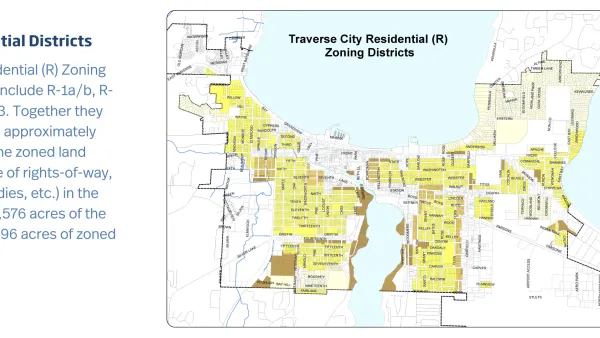
ADUs, Minimum Lot Sizes, and Quadplexes Under Discussion in Traverse City
Zoning changes for everything from housing density to minimum lot sizes are under consideration for a city on the shores of Lake Michigan.

Planetizen Federal Action Tracker
A weekly monitor of how Trump’s orders and actions are impacting planners and planning in America.

‘Going backwards:’ Baltimore mayor, students rally against state's transit funding plan
Maryland's proposed six-year plan provides no funding for Baltimore’s BMORE bus program and reduces its road maintenance funding.

Detroit to transform waterfront with $2.2 billion investment
Developers will convert about 18 acres of unused parking lot space into civic spaces.

MIT to create AI-powered hub for public transportation companies
Google awarded the project, titled the Public Transit Intelligence Hub, $2.1 million in funding.

A 3D concrete printer may solve Virginia’s housing crisis
The printer is able to build concrete walls much faster than humans, and can do so directly at job sites.

Newsom vetoes high-speed rail supervision bill after agency receives condemnatory audit
The audit found the CHSRA approved almost $600,000 in unallowable travel expenses.

FREE Course: Walkable City 1: Why Walkability?
After describing his path towards focusing on walkability as the essence of good planning, Jeff Speck marches through his five principal reasons for making more walkable places.
Reinventing Malls: Planning Alchemy—Turning Gray Fields Into Gold
The course focuses on the opportunities and imperatives that shape reinvention of mall sites.

City of Thousand Oaks
City of Wisconsin Rapids
Harvard University Graduate School of Design
The Architects Foundation
University of Cincinnati Online
Northern Illinois Transit Authority (NITA)
The Pocatello Development Authority
The Urban Renewal Agency of the City of Pocatello