Construction of MiamiCentral, an 11-acre plot in downtown Miami that will house the city's station for Brightline higher-speed train service and related transit oriented development, is well underway. Train service begins next summer.


MiamiCentral, the depot for All Aboard Florida's new intercity express Brightline train service to West Palm Beach, and eventually Orlando, "just received its first train beam," reports Sean Stewart-Muniz for The Real Deal, South Florida.
General contractor Suffolk Construction is speeding toward MiamiCentral’s expected completion date of mid-year 2017, when the first segment of the train service — between Miami and West Palm Beach — is scheduled to open for business.

The MiamiCentral construction site as of October 2015, courtesy The Real Deal, South Florida.
The Real Deal's Francisco Alvarado reported on October 22, 2015 about a land swap that "Miami commissioners signed off on that allows All Aboard Florida to expand its MiamiCentral project and gives the city some of the space it needs to build a fire station."
On YouTube, watch "MiamiCentral Time Lapse" to see it "rise from the ground up," then take a MiamiCentral Tour. See the two towers that will house 800 new residential, for-rent apartments in two towers that are planned above the depot.
"The project is split into two sections: the nine-acre transit hub in downtown Miami that’s being built alongside the existing Government Center Metromover Station, plus a separate 12-story tower with office space, parking and a major grocery tenant," adds Stewart-Muniz.
Four transit systems come together at MiamiCentral
Passengers alighting from Brightline will be able to board the 4.4-mile electrically-powered Metromover, a fully automated people mover system, that connects with Metrorail, the nation's tenth largest heavy rail system by ridership, at Government Center. The station is served by multiple Metrobus routes.
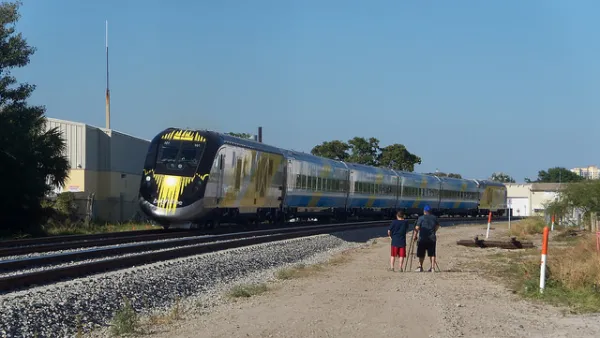
According to Progressive Railroading, "the first Siemens-built trainset (is) set to arrive in West Palm Beach, Fla., in fall of this year." The trainsets were ordered in September 2014.
Grade crossings
The diesel-powered trains will travel at speeds up to 125 mph. An "All Aboard Florida Gate Crossing Demonstration" shows a 7-car train, with locomotives at each end, traveling at 68 mph. Total gate down time: 49 seconds.
Historical precedent
A 2014 post indicates that Brightline will be the first privately built passenger rail line time since "(t)he last private passenger rail in the United States closed in 1983."
"Can new train service between Miami and Orlando be a model for the rest of the country?," asked Henry Gabar for CityLab?
"You'd have to go back over 100 years to find a significant investment in private intercity rail in the U.S.," says David Levinson, a transportation analyst at the University of Minnesota.
Plans are being considered to extend Brightline from Orlando to Jacksonville, 141 miles north, reports Mike Seemuth for The Real Deal.
All Aboard Florida is a wholly owned subsidiary of Florida East Coast Industries LLC.
Read the full story: MiamiCentral gets its first train beam in downtown Miami

Massive MiamiCentral Train Station Arriving Soon for All Aboard Florida
Part infrastructure, part urban development—MiamiCentral is moving ahead quickly as an urban hub on the south end of the All Aboard Florida high-speed rail project.
All Aboard Florida's Brightline Set to Launch this Month
The privately funded, diesel-powered trains will run at speeds up to 79 mph between West Palm Beach and Fort Lauderdale, with an extension to Miami opening early next year. Real estate development is key to profitability.
Florida's Brightline to Break Ground on Delayed Orlando Leg
The second phase of the highly anticipated Brightline express train service is finally moving forward after unanticipated delays.

Amtrak, CN end decades-long dispute with eight-year agreement
The new operating agreement establishes an updated framework for the companies to work together, including processes to resolve disputes.

Judges permit Denver to divert 77,000 acre feet from the Colorado River for reservoir expansion
Overuse and climate change have caused the Colorado River’s water levels to plummet.

Nation's most wind-powered state turns to coal as data centers increase energy demand
For the first time in decades, Iowa has increased its generation of coal power.

Boston has spent millions making the Green Line more accessible — and there’s no end in sight
While the city has invested millions into expanding and adding platforms to the Green Line to make it more accessible, new train cars set to arrive next year will be too tall for disabled passengers to board without raising the current platforms.

Idaho may see an 18% drop in federal surface transit funding — the largest estimated cut in the US
Transit systems in rural communities are much more reliant on federal funding to provide their services.

How ‘post-disaster gentrification’ alters neighborhoods after natural calamities
After hurricanes, fires or other calamities, the original residents of a community are often replaced by younger, wealthier residents.

FREE Course: Walkable City 1: Why Walkability?
After describing his path towards focusing on walkability as the essence of good planning, Jeff Speck marches through his five principal reasons for making more walkable places.
Reinventing Malls: Planning Alchemy—Turning Gray Fields Into Gold
The course focuses on the opportunities and imperatives that shape reinvention of mall sites.

City of Wisconsin Rapids
Harvard University Graduate School of Design
KFH Group Inc.
The Architects Foundation
University of Cincinnati Online
The Pocatello Development Authority
The Urban Renewal Agency of the City of Pocatello