St. Louis Public Radio explains the various efforts of the St. Louis Land Reutilization Authority.


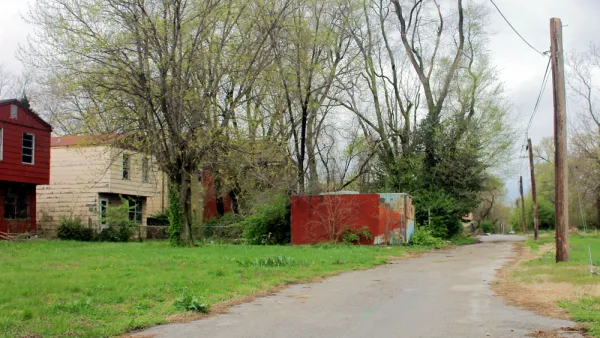
"St. Louis has the distinction of having the oldest land bank in the country, created by a Missouri state statute in 1971," according to an article by Maria Altman. "It was a response to St. Louis’ quickly shrinking population after reaching a height of 856,000 people in 1950." These days, the Land Reutilization Authority (LRA) owns more than 11,000 parcelts in the city of St. Louis.
In addition to explaining the larger and ongoing project of the LRA, Altman describes some of the "renewed focus on what to do with all the vacant land LRA controls." That renewed focus includes a Vacant Land and Blight Task Force several months again that includes both public and private stakeholders.
Altman also reports that Mayor Francis Slay in May announced a "Mow to Own" program that allows residents can now buy [a] vacant lot for $125 and some sweat equity." The program not only encourages residents to maintain vacant lots, it also brings in revenue through title transfer fees and property taxes. The article includes three more examples of projects by the LRA to help manage and improve the city's vacant properties.
Read the full story: St. Louis takes new look at old problem: What to do with vacant land and abandoned buildings

Population Decline in the Latest Census Estimates
Not only are suburbs growing, many of the larger, older cities that had reversed decades of population decline, are now losing population, again. The biggest losers: counties with the greatest population densities.
St. Louis Groups Come Together to Form Neighborhood Vacancy Coalition
Legal and community groups in St. Louis align to curb ill-effects of the city's many vacant properties.
Cook County Land Bank Expands Vacancy Program, Offers 4,400 Lots for Sale
The vacant lot program at the Cook County Land Bank Authority recently kicked into high gear—offering a huge number of vacant lots for sale, located around 27 neighborhoods and suburbs in the Chicago region.

Planetizen Federal Action Tracker
A weekly monitor of how Trump’s orders and actions are impacting planners and planning in America.

California plans to bury El Niño’s downpour
If the state plays its cards right, it may be able to store a billion acre-feet of El Niño’s water in aquifers.

Desperate measures: Advocates weigh draining Lake Powell to fill Colorado River
Draining the reservoir could reduce evaporation losses by a couple hundred thousand acre-feet.

In Texas, data centers are swallowing promised parkland
Residents who moved to Taylor, Texas for a rural community now have to contend with three data centers in their backyard.

How a Chicago-sized wind farm beat the odds and powered on
The project spanned five presidential administrations and a standoff with a U.S. military base.

MTA gives itself 30 days to transform pit into basketball court
The site has been under construction since 2022; the city originally estimated it would finish the court in 2024.

FREE Course: Walkable City 1: Why Walkability?
After describing his path towards focusing on walkability as the essence of good planning, Jeff Speck marches through his five principal reasons for making more walkable places.
Reinventing Malls: Planning Alchemy—Turning Gray Fields Into Gold
The course focuses on the opportunities and imperatives that shape reinvention of mall sites.

City of Rosemead
Rutgers University, Edward J. Bloustein School of Planning and Public Policy
One Hundred Miles
Hunter College, City University of New York (CUNY)
The Architects Foundation
University of Cincinnati Online
City of Cambridge
Montrose County
The Pocatello Development Authority