As more cities attempt to crackdown on homelessness, legal fights have broken out as advocates for the homeless fight back against the criminalization of panhandling and camping in public.



Justin Jouvenal of The Washington Post reports on the legal skirmishes that have been breaking out across the country, as cities have attempted to criminalize panhandling and public camping in order to push the homeless out of revitalized downtowns and tourist areas. The homeless crisis has forced cities, including Honolulu and Sarasota, Florida, to walk a fine line that seeks to move the homeless off the street while also respecting their rights. David Cross, a homeless resident in Sarasota, has filed suit against the city for barring him from sleeping outside without providing an alternative.
Cross was given an infraction for lodging outdoors on a night that he said the officer told him there was no room at Sarasota’s only homeless shelter. Cross said he wondered: Where was he supposed to go? He sought out the ACLU, which filed the lawsuit on behalf of Cross and five other plaintiffs. The suit claims that Cross’s experience is common. ... Even if the shelter had more room, Cross said the city’s expanded anti-panhandling law made it difficult to raise the nightly fee for a bed. The law enacted in 2013 bars soliciting at bus stops, cafes, parks, garages and a host of other locations. The lawsuit argued that the ordinance was a violation of free-speech rights.
Jouvenal reports that in a survey of 187 cities, between 2011 and 2014 new laws banning panhandling increased 25 percent, camping prohibitions increased 60 percent, and bans on sleeping in cars increased 119 percent.
Read the full story: Homeless say booming cities have outlawed their right to sleep, beg and even sit

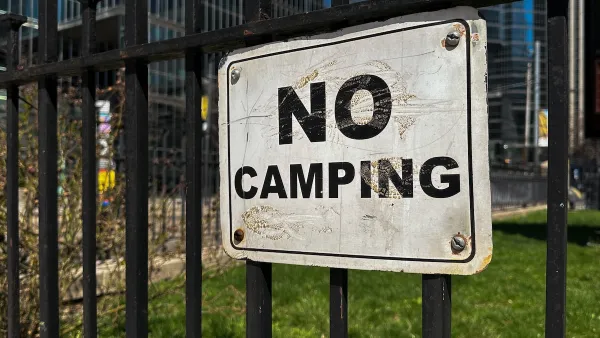
Nevada Cities Pass Punitive Anti-Homeless Laws
State legislators rejected a proposed bill that would have enshrined a “Homeless Person’s Bill of Rights” in state law.
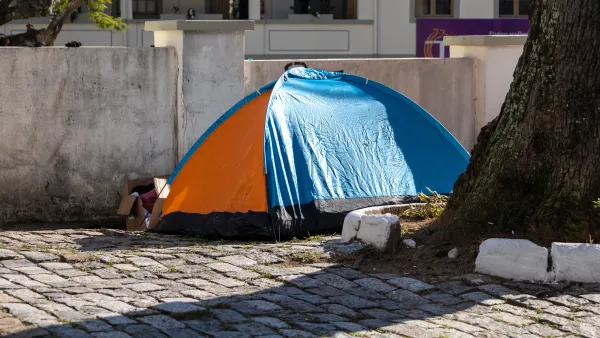
U.S. Supreme Court Upholds Camping Bans, but Challenges of Addressing Homelessness Remain
In Grants Pass v. Johnson, the Supreme Court upheld an Oregon city’s ban on camping in public places, paving the way for similar bans in cities across the country but doing nothing to solve the cause of homelessness.
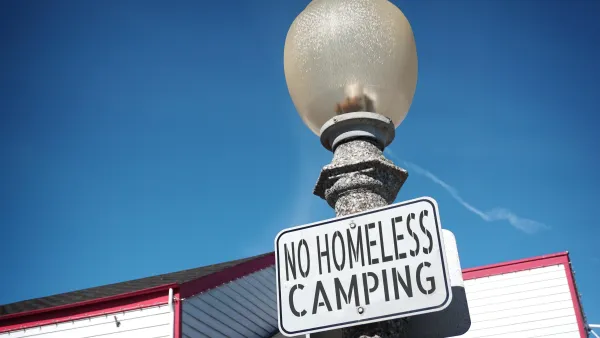
Sweeps Aren’t Outreach: Policing Homelessness Still Doesn’t Work
A new study shines a light on the connection between homeless outreach teams and policing, and examines why so many cities still use resident complaints to guide their response to the homelessness crisis.

Planetizen Federal Action Tracker
A weekly monitor of how Trump’s orders and actions are impacting planners and planning in America.

Amtrak, CN end decades-long dispute with eight-year agreement
The new operating agreement establishes an updated framework for the companies to work together, including processes to resolve disputes.

Judges permit Denver to divert 77,000 acre feet from the Colorado River for reservoir expansion
Overuse and climate change have caused the Colorado River’s water levels to plummet.

NYC DOT wants faster, more permanent street upgrades
The city is examining ways to build more concrete infrastructure without getting entangled in 'decades-long' projects.

'Something we’ve never seen before:' rising utility rates could strain city finances nationwide
Data centers, climate change and other factors have caused utility rates in the United States to increase by 38% since 2020.

Trump to overrule local leaders, lease millions of acres of America’s Pacific Island territories’ seafloors to mining companies
International law says that the Indigenous people of America’s territories have a right to prior and informed consent regarding projects that impact their countries.

FREE Course: Walkable City 1: Why Walkability?
After describing his path towards focusing on walkability as the essence of good planning, Jeff Speck marches through his five principal reasons for making more walkable places.
Reinventing Malls: Planning Alchemy—Turning Gray Fields Into Gold
The course focuses on the opportunities and imperatives that shape reinvention of mall sites.

Harvard University Graduate School of Design
KFH Group Inc.
Greater Baltimore Committee
The Architects Foundation
University of Cincinnati Online
The Pocatello Development Authority
The Urban Renewal Agency of the City of Pocatello