A new map-based web tool created by a former city employee calculates the redevelopment potential of every parcel in Philadelphia.


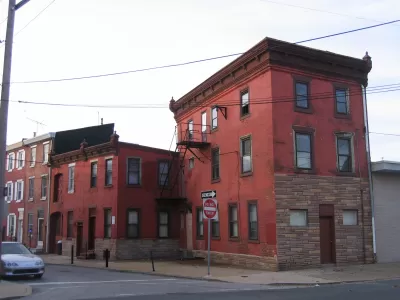
FixList compiles data from multiple city sources into a user-friendly, searchable map of Philadelphia—taking on the burden creator Stacey Mosley calls the "conflict resolution of information across departments."
Every parcel is assigned a Redevelopment Score between 0 and 100 points, using a proprietary model based on more than 50 different metrics pertaining to the property and the neighborhood. Philly Voice explains:
[The data] relates to land use of every kind: residential, commercial, or industrial. Using the website you can see how every parcel in the city is zoned, what it last sold for, who owns it, whether they are tax-delinquent (and how long they have been), as well as sales and construction trends in the surrounding neighborhood.
"I am trying to do predictive modeling to hone in on addresses that are underdeveloped in statistically significant areas that are ripe for redevelopment," Mosley tells the paper.
The wealth of data could also be useful for community groups, academics, and journalists interested in neighborhood health:
In West Philadelphia’s 19143 zip code, for instance, FixList makes visible where the 309 upcoming sheriff sales are — mostly west of 50th street, in the overwhelmingly African-American part of the area — and that 56 of those properties have been tax delinquent for more than 20 years.
On the other hand, Somerton in the Far Northeast, long a stable, white middle class section of the city, has just 15 upcoming sheriff sales, none of which have been tax delinquent for very long.
A local realtor reports that searching FixList compressed what could have been a weeklong project into about an hour of work.
It's worth noting that the resource is not a public good: a basic subscription costs $99/month.
FixList is developing databases for five other cities, which could be online by the end of next year.
Read the full story: FixList drills down on Philadelphia homes ripe for redevelopment

How Effective are Philadelphia’s Keystone Opportunity Zones?
The impacts of a tax break designed to create jobs, stimulate development, and reduce blight are proving hard to track.

Philly Waterfront Park Breaks Ground
Penn’s Landing is an ambitious redesign of 11.5 waterfront acres.

Equitable Development Plan Aims To Protect Philly's Chinatown
As the historic neighborhood experiences increased redevelopment around the new Rail Park, community activists are working to ensure older residents and businesses aren't displaced in the process.
Planetizen Federal Action Tracker
A weekly monitor of how Trump’s orders and actions are impacting planners and planning in America.

Eastern Nebraska is running out of electricity
Data centers and electrification are straining eastern Nebraska’s grid, throttling economic development.

Study reveals best places in the U.S. for cycling, walking
New research from Streetlight Data examines bicycle and pedestrian miles per capita in the 100 largest U.S. cities by population.

Federal government nominates new FTA administrator
Mark Aesch is currently the founder and CEO of a transportation management consulting firm.

Developers reveal $10 billion stadium plan as ‘Hail Mary’ to keep Bears in Chicago
The plan would also boast a public park, high- and mid-rise buildings and a youth sports complex.

As Texas embraces carbon storage, a Black community questions the risks
Texas now issues permits for companies to store carbon dioxide underground. East Texas residents fear safety risks, and skeptics doubt the climate benefits.

FREE Course: Walkable City 1: Why Walkability?
After describing his path towards focusing on walkability as the essence of good planning, Jeff Speck marches through his five principal reasons for making more walkable places.
Reinventing Malls: Planning Alchemy—Turning Gray Fields Into Gold
The course focuses on the opportunities and imperatives that shape reinvention of mall sites.

City of Rosemead
Rutgers University, Edward J. Bloustein School of Planning and Public Policy
One Hundred Miles
University of Michigan School for Environment and Sustainability (SEAS)
Hunter College, City University of New York (CUNY)
The Architects Foundation
City of Cambridge
The Pocatello Development Authority
The Urban Renewal Agency of the City of Pocatello