While the Justice Department and North Carolina duke it out over proper access to bathrooms, many places, including the White House, have designed gender-neutral bathrooms that address many of the problems associated with sex-segregated bathrooms.


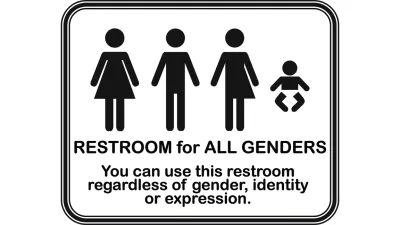
By now, most people have heard of North Carolina's infamous "bathroom law," House Bill (HB) 2, which requires people to use the bathroom of the gender listed on their birth certificate, potentially violating the civil rights of transgender people, and already costing the Tar Heel State state millions of dollars in economic damages due to boycotts resulting from the law, though the ultimate impact is uncertain.
Hours after McCrory called on the "U.S. Congress to bring clarity to our national anti-discrimination provisions..., Attorney General Loretta Lynch said no clarification was needed, and she asserted that federal civil rights laws barring discrimination on the basis of sex prohibit laws like the one in North Carolina," write Blinder, Pérez-Peña and Lichtblau.
“They created state-sponsored discrimination against transgender individuals who simply seek to engage in the most private of functions in a place of safety and security,” she said at a news conference in Washington. “None of us can stand by when a state enters the business of legislating identity and insists that a person pretend to be something or someone that they are not.”
Straying from her usual understated, lawyerly tone, Ms. Lynch, a North Carolina native, grew impassioned as she likened the fight to earlier battles over Jim Crow laws and laws against same-sex marriage.
Do we really need to segregate bathrooms by sex?
"An architect in Chicago is designing and advocating for private gender-neutral bathrooms — essentially a row of individual toilet stalls with doors that open onto a common area where everyone can wash their hands...," writes Emily Peck, business editor for Huffington Post.
Unisex bathrooms like this are cheaper to construct, offer users more privacy and safety and take up less space, said architect Matt Nardella, who owns Moss Design. Plus, there’s more “line equity” — never again will you have to wait in line with a hoard of women while the guys get to go and move on with their lives.
Nardella's design was prompted by the Houston Equal Rights Ordinance (HERO), an anti-discrimination ordinance passed by the Houston City Council but repealed by the voters last November.
There's another advantage for bathroom gender neutrality that any parent of an opposite sex child can relate to — real safety concerns involved when young children enter segregated-sex adult spaces alone," adds Peck.
Colleges and universities are also making gender-neutral bathrooms more available. The White House even installed a gender-neutral bathroom stall last year.
There's some irony in the North Carolina controversy. HB2 "was prompted by the City of Charlotte’s adoption of an ordinance barring discrimination against gay or transgender people, and specifically allowing people to use bathrooms and locker rooms that conform to their gender identity," write Blinder, Pérez-Peña and Lichtblau. McCrory, an outspoken proponent of HB2 which nullifies the Charlotte ordinance, was mayor of Charlotte, the largest city in the state, for 14 years.
Read the full story: Countersuits Over North Carolina’s Bias Law

USDOT will stop enforcing a key civil rights law
The agency will no longer enforce Title VI, eliminating disparate impact protections for federally protected groups.

HUD Investigating Boston for “Redlining Against White People”
The agency says the city is breaking the law by prioritizing people of color in its affordable housing strategy.

Artists Blanket Houston in Rainbow Murals After City Removes Rainbow Crosswalks
Houstonians are responding to the removal of rainbow crosswalks with new murals celebrating diversity.

Planetizen Federal Action Tracker
A weekly monitor of how Trump’s orders and actions are impacting planners and planning in America.

The state-sanctioned urbicide of Austin
People don’t kill cities. Freeways do.

US to reduce Colorado River water deliveries to Mexico
A new Colorado Treaty amendment reduces Mexico’s Colorado River water allocation by 250,000 acre feet.

Nation's most wind-powered state turns to coal as data centers increase energy demand
For the first time in decades, Iowa has increased its generation of coal power.

NYC cools commuters with city's first rain garden above a bus stop
New York City officials say the plants in the rain garden can absorb 16 gallons of rainwater during heavy storms.

Brightline West’s future may rely on $6 billion federal loan
The company has until Nov. 2 to make a $400 million equity investment into its proposed high-speed rail line.

FREE Course: Walkable City 1: Why Walkability?
After describing his path towards focusing on walkability as the essence of good planning, Jeff Speck marches through his five principal reasons for making more walkable places.
Reinventing Malls: Planning Alchemy—Turning Gray Fields Into Gold
The course focuses on the opportunities and imperatives that shape reinvention of mall sites.

Greater Baltimore Committee
Eagle County Government
Harvard University Graduate School of Design
The Architects Foundation
University of Cincinnati Online
The Pocatello Development Authority
The Urban Renewal Agency of the City of Pocatello
Journal of the American Planning Association